What Is a Closed Loop Extractor and How Does It Work for Cannabis Extraction?
Learn how a closed loop extractor works, its main components, benefits, and role in professional cannabis extraction workflows.
Introduction
A closed loop extractor is one of the core equipment systems used in professional hydrocarbon cannabis extraction. Rather than allowing extraction solvent to escape into the surrounding environment during normal operation, a properly designed closed-loop system contains, transfers, and recovers the solvent within an interconnected processing system.
That distinction matters. Hydrocarbon solvents can be highly flammable, so commercial extraction requires purpose-built equipment, appropriate facility engineering, trained operators, and compliance with applicable fire, building, electrical, occupational-safety, and cannabis regulations.
GreenLabGear provides extraction and laboratory equipment for cannabis processors building or expanding professional facilities. For operators evaluating hydrocarbon processing, understanding how a closed loop extractor fits into the overall workflow is an important first step.
Below, we'll explain what these systems do, their major components, how the extraction cycle works at a high level, and what facilities should consider when choosing equipment.
TLDR – Quick Guide
- A closed loop extractor is a contained system used for solvent-based extraction, commonly with hydrocarbons.
- The system is designed to transfer and recover solvent without routinely venting it into the workspace.
- Major sections typically include solvent storage, a material column, a collection vessel, transfer connections, and recovery components.
- The solvent contacts cannabis biomass and dissolves targeted extractable compounds.
- The resulting solution is separated from the plant material and collected for downstream processing.
- Solvent recovery allows much of the solvent to be captured for appropriate reuse rather than discarded after every batch.
- Closed-loop extraction can support repeatability, solvent management, and commercial-scale workflows.
- Because hydrocarbon solvents present serious fire and explosion hazards, equipment selection and operation require qualified professional oversight and compliant facilities.
Detailed Breakdown
What Is a Closed Loop Extractor?
A closed loop extractor is a processing system designed to move extraction solvent through cannabis biomass and subsequently recover that solvent within a contained equipment circuit.
Unlike an open process where volatile solvent could be intentionally exposed to the surrounding workspace, a closed-loop design keeps solvent within connected vessels, tubing or piping, valves, and recovery equipment during intended operation.
Professional Closed Loop Extractors may be configured differently depending on capacity, solvent, process requirements, and manufacturer design. However, their fundamental purpose is similar: facilitate extraction while supporting controlled solvent handling and recovery.
In cannabis processing, closed-loop systems are strongly associated with hydrocarbon extraction using solvents such as butane or propane. Those solvents can efficiently dissolve desirable compounds, but their flammability makes proper system and facility design critical.
How Does a Closed Loop Extractor Work?
At a high level, closed-loop extraction follows a circular process: solvent moves from storage through the extraction stage, carries extracted compounds into a collection stage, and is subsequently separated and recovered.
A simplified conceptual workflow looks like this:
Solvent storage → biomass extraction → extract collection → solvent recovery → solvent storage
The process begins with prepared plant material placed in the system's designated material vessel or column. Solvent is transferred through the biomass under the conditions established by the validated process and equipment design.
As the solvent contacts the plant material, soluble compounds transfer into the liquid phase. The resulting solvent-and-extract solution moves into a collection vessel, leaving much of the solid biomass behind.
The solvent is then recovered from the collected solution using the system's intended recovery process. Recovered solvent can be returned to an appropriate storage vessel for subsequent processing according to the equipment design and operating procedures.
What remains is concentrated extract requiring the appropriate downstream processing for the intended final product.
Major Components of a Closed Loop Extractor
Exact configurations vary, so manufacturers' specifications should always control. Still, understanding the main functional sections makes comparing systems easier.
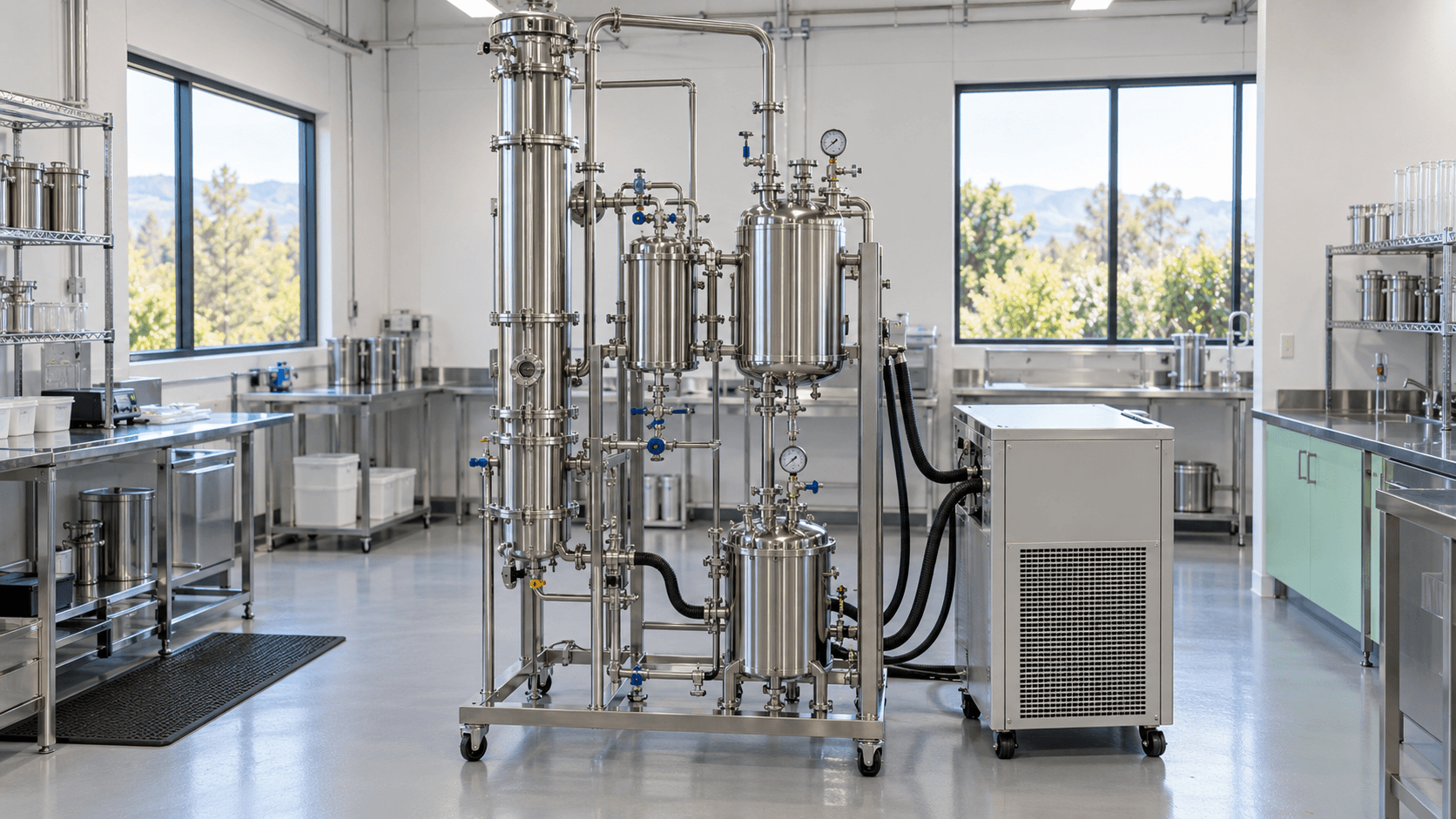
Solvent storage holds the extraction solvent in an appropriate vessel. The material column or extraction vessel contains the biomass during solvent contact.
A collection vessel receives the cannabinoid-containing solution after it passes through the biomass. The system also includes valves, connections, seals, hoses or piping, and other components that control movement through the closed circuit.
The recovery section supports separation and capture of solvent following extraction. Depending on system design, additional temperature-control, vacuum, filtration, and monitoring equipment may also be integrated.
This is why evaluating a closed loop extractor by vessel capacity alone can be misleading. Extraction equipment functions as a system, and every component must be appropriately matched.
Why Use Closed-Loop Extraction?
One major advantage is solvent containment and recovery. A properly designed system is intended to keep volatile solvent within controlled equipment rather than routinely releasing it into the processing environment.
Recovery can also improve resource efficiency because solvent may be captured and appropriately reused instead of being consumed as a single-use material.
Other potential advantages include:
- Repeatable batch workflows
- Efficient solvent management
- Scalable equipment configurations
- Controlled material handling
- Integration with downstream processing
- Production of hydrocarbon-derived concentrates
Facilities comparing broader Extraction Equipment should consider these benefits alongside throughput, facility requirements, operating costs, maintenance, and the final products they intend to manufacture.
Closed Loop Extraction vs Ethanol Extraction
Hydrocarbon closed-loop extraction isn't the only option available to cannabis processors.
Ethanol extraction typically uses alcohol as the extraction solvent and is often selected for larger-volume workflows and products destined for additional refinement. Hydrocarbon extraction, meanwhile, is frequently associated with concentrate production where preserving a broader range of desirable volatile compounds may be important.
The choice affects far more than the extractor itself.
It can influence:
- Facility design
- Solvent storage and handling
- Production throughput
- Temperature-control requirements
- Downstream equipment
- Solvent recovery strategy
- Desired finished products
- Regulatory and safety requirements
For a deeper comparison, see GreenLabGear's guide to Hydrocarbon vs Ethanol Extraction.
The best method is the one aligned with your production objectives and compliant facility—not whichever extraction technology happens to be getting the most attention.
Where a Closed Loop Extractor Fits in the Cannabis Workflow
Extraction is only one stage between raw biomass and a finished cannabis product.
A commercial workflow may involve material preparation, extraction, separation, solvent recovery, post-processing, refinement, testing, formulation, and packaging. The exact sequence depends on the extraction method and desired final product.
GreenLabGear's Cannabis Extraction Workflow provides a broader look at how equipment can fit together from biomass through downstream refinement.
Thinking in terms of the entire workflow is important when sizing a closed loop extractor. A high-capacity extractor isn't particularly helpful if downstream recovery or post-processing equipment can't keep up.
The slowest critical stage ultimately limits practical throughput.
What Should You Consider When Choosing a Closed Loop Extractor?
Start with production requirements rather than equipment size.
Estimate realistic daily biomass throughput and typical batch sizes. Then consider the products you plan to manufacture and how the extraction system will connect to downstream processing.
Important selection factors include:
- Intended solvent and application
- Batch capacity
- Desired daily throughput
- Recovery capability
- Materials of construction
- Available temperature-control systems
- Facility footprint
- Cleaning and maintenance requirements
- Manufacturer documentation
- Applicable equipment certifications
- Availability of replacement parts and service
Scalability matters too. A facility expecting substantial production growth should consider whether capacity can expand without requiring the entire workflow to be redesigned.
However, dramatically oversizing the extractor isn't automatically smart. Unused capacity still consumes floor space and capital.
Safety and Facility Requirements Come First
A closed loop doesn't mean a risk-free loop.
Hydrocarbon solvents such as butane and propane are extremely flammable. A leak, incorrect installation, equipment failure, or improper operating procedure can create serious fire and explosion hazards.
Commercial hydrocarbon extraction therefore requires much more than purchasing an extractor. Depending on jurisdiction and process, requirements can involve engineered ventilation, classified electrical systems, gas detection, fire protection, approved equipment, solvent-storage controls, permitting, inspections, and documented operating procedures.
Operators also require appropriate training.
Facilities should work with qualified engineers, fire and building authorities, equipment manufacturers, and other relevant safety professionals when designing or modifying hydrocarbon extraction operations.
Never treat a closed loop extractor as ordinary benchtop laboratory equipment.
Maintaining Closed Loop Extraction Equipment
Preventive maintenance helps protect both reliability and process integrity.
Components such as seals, gaskets, valves, hoses, connections, and gauges should be inspected according to manufacturer requirements. Any component showing unacceptable wear or damage should be removed from service and replaced with an appropriate part.
Maintenance programs should also document inspections and service history.
A sensible program addresses:
- Seal and gasket condition
- Valve performance
- Connection integrity
- Vessel condition
- Instrumentation
- Temperature-control equipment
- Recovery equipment
- Manufacturer-required testing and service
Trying to squeeze "one more batch" out of a questionable component is a poor trade when the system handles flammable solvent.
Common Closed Loop Extractor Selection Mistakes
One mistake is buying based entirely on advertised capacity. Nominal vessel volume doesn't automatically equal real-world production throughput.
Another is ignoring downstream equipment. If recovery and refinement can't match extraction output, additional extractor capacity simply moves the bottleneck elsewhere.
Facilities should also avoid:
- Treating all closed-loop systems as equivalent
- Ignoring facility engineering requirements
- Underestimating solvent recovery needs
- Neglecting temperature control
- Failing to plan maintenance access
- Overlooking replacement-part availability
- Buying before understanding local compliance requirements
Equipment selection should happen alongside facility and process planning—not after the room has already been built.
Key Takeaways
- A closed loop extractor is a contained solvent-based extraction system commonly associated with hydrocarbon cannabis processing.
- Solvent moves through biomass, carries extracted compounds into a collection stage, and is subsequently recovered.
- Solvent recovery is a defining feature of the closed-loop workflow.
- System components commonly include solvent storage, an extraction vessel or material column, collection equipment, connections, valves, and recovery components.
- Closed-loop hydrocarbon extraction can support repeatable commercial concentrate production.
- Extractor capacity should be matched with recovery and downstream processing capacity.
- Hydrocarbon extraction involves serious flammability hazards and requires properly engineered facilities.
- Applicable equipment, fire, building, electrical, and occupational-safety requirements should be addressed before operation.
- Preventive maintenance is critical for seals, valves, connections, vessels, and other system components.
- The best extractor is the one that fits your complete production workflow—not simply the system with the largest advertised capacity.
FAQs
What is a closed loop extractor?
A closed loop extractor is a contained processing system that uses solvent to extract desirable compounds from plant material while keeping solvent within interconnected equipment during intended operation. The solvent-containing extract moves into a collection stage before the solvent is recovered. Closed-loop systems are commonly associated with professional hydrocarbon cannabis extraction.
What solvents are used in a closed loop extractor?
Hydrocarbon cannabis extraction systems are commonly associated with solvents such as butane and propane, depending on the equipment and validated process. These materials are highly flammable and require appropriately designed equipment, facilities, and safety controls. Operators should only use solvents approved for the specific system and process.
Why is solvent recovery important in closed loop extraction?
Solvent recovery separates extraction solvent from the collected extract and captures it within the intended processing system. This supports efficient solvent management and can allow appropriate solvent reuse according to the equipment design and operating procedures. Recovery capacity also affects the overall throughput of an extraction workflow.
Is a closed loop extractor safer than open solvent extraction?
A properly designed closed-loop system is intended to contain and recover volatile solvent rather than routinely releasing it into the workspace. However, hydrocarbon extraction still presents serious fire, explosion, and chemical hazards that require professional facility engineering and appropriate operating controls. "Closed loop" should never be interpreted as meaning inherently risk-free.
What size closed loop extractor does my cannabis facility need?
The appropriate size depends on batch volume, daily biomass throughput, recovery capacity, downstream equipment, facility constraints, and production goals. Choosing an extractor substantially larger than downstream equipment can simply create another bottleneck. Evaluate the complete workflow and manufacturer specifications before selecting capacity.