High Viscosity Reactor Guide: How to Choose the Right Reactor for Your Process
Learn how to choose a high viscosity reactor based on torque, mixing, vessel material, temperature control, batch size, and process needs.
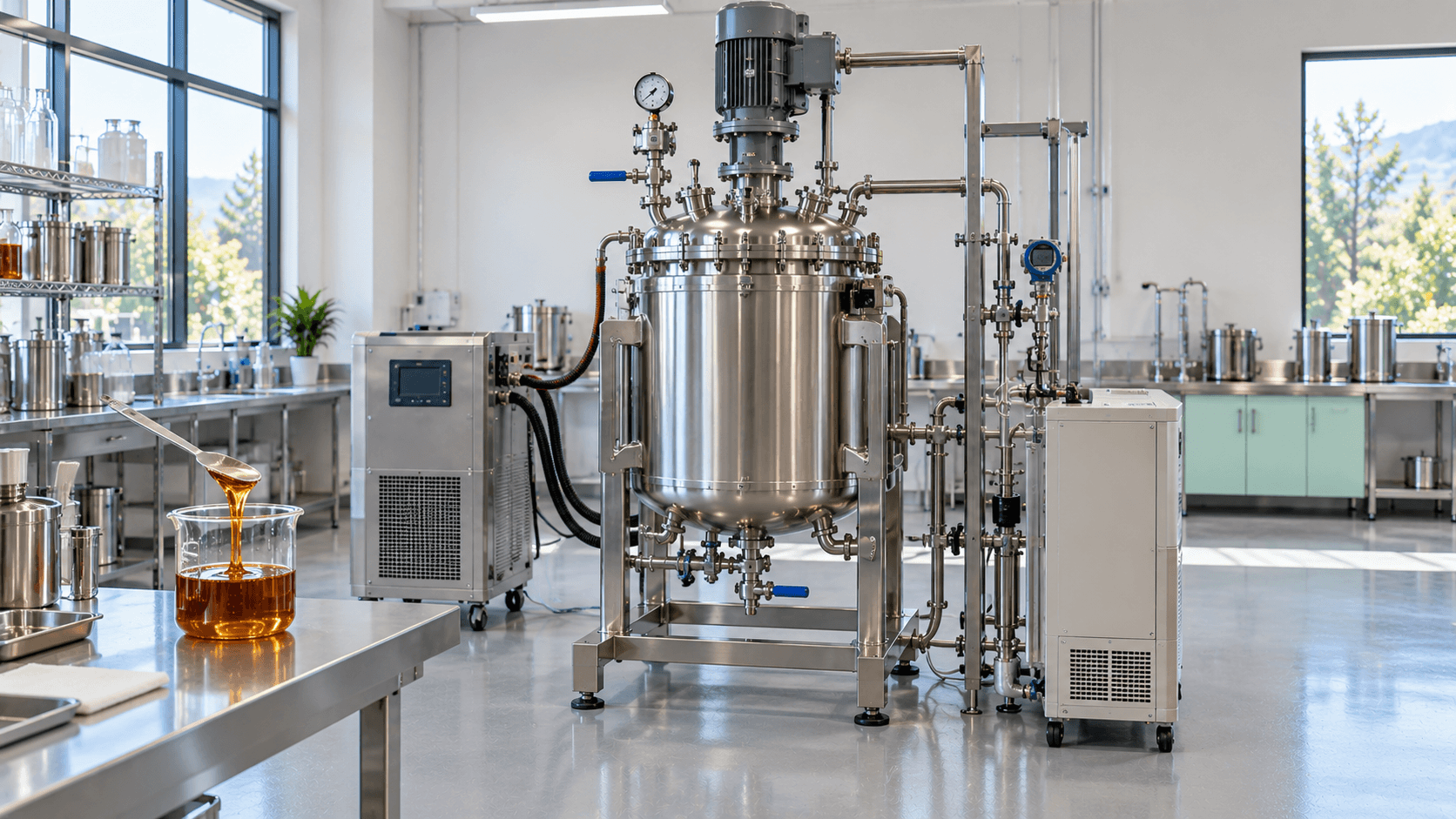
Introduction
Mixing water is easy. Mixing a thick resin, concentrated formulation, polymer-like material, or other high-viscosity product is a completely different engineering problem.
As viscosity rises, resistance to flow increases. A mixing system that creates excellent circulation in a thin liquid may barely move a thick batch. That makes choosing a high viscosity reactor about much more than vessel capacity.
You need to consider mixer torque, impeller design, rotational speed, temperature control, working volume, vessel geometry, material compatibility, vacuum requirements, and how viscosity changes during the process.
GreenLabGear supplies laboratory and processing equipment ranging from glass and stainless steel reactors to homogenizers and temperature-control systems. For high-viscosity applications, the goal is to match the complete reactor configuration to the material rather than simply buying a larger motor or vessel.
Here's how to make that decision without turning your production batch into a very expensive jar of material that refuses to move.
TLDR – Quick Guide
- Choose a high viscosity reactor based on viscosity and mixing requirements, not volume alone.
- High-viscosity materials generally demand more torque than low-viscosity liquids.
- Impeller geometry can be just as important as motor power.
- Stainless steel reactors can be attractive for larger-scale, mechanically demanding processing.
- Jacketed glass reactors provide excellent process visibility but require careful consideration of mechanical and operating limits.
- Temperature control can significantly affect viscosity and mixing behavior.
- Homogenizers provide high-shear processing and aren't interchangeable with conventional reactor agitators.
- Size the mixer for the most difficult stage of the process, especially if viscosity changes during heating, cooling, reaction, or concentration.
- Evaluate vacuum, material compatibility, cleaning, discharge, and downstream processing before purchasing.
Detailed Breakdown
What Makes a Reactor Suitable for High-Viscosity Processing?
A high viscosity reactor is a reactor system configured to effectively process materials that resist flow and therefore place greater mechanical demands on the mixing system.
The vessel itself is only one piece of that equation.
The complete system can involve:
- Reactor vessel
- Agitator motor
- Gear reduction
- Shaft
- Impeller or mixing element
- Baffles where applicable
- Temperature-control jacket
- Seals
- Valves
- Instrumentation
- Vacuum components
- Discharge system
When viscosity increases, the mixing problem changes.
A low-viscosity liquid may circulate throughout a vessel relatively easily. A highly viscous material can move primarily around the impeller while regions elsewhere in the vessel remain poorly mixed.
That's why simply increasing RPM isn't a reliable solution.
Start With Viscosity, Not Reactor Volume
One of the most common reactor-selection mistakes is beginning with liters.
"We need a 50-liter reactor" isn't enough information.
A much better equipment specification sounds like: "We need to process this material at this batch volume, across this viscosity range, at these temperatures, with these mixing objectives."
The same reactor volume can present dramatically different mixing requirements depending on what's inside it.
When planning a high viscosity reactor, determine:
- Starting viscosity
- Maximum expected viscosity
- Viscosity at processing temperature
- Whether viscosity changes during the batch
- Required mixing outcome
- Batch volume
- Material density
- Whether solids are present
If exact viscosity data isn't available, testing or process-development work may be worthwhile before scaling equipment.
Guessing "it's pretty thick" isn't much of an engineering specification.
Torque Matters More Than Maximum RPM
High-viscosity mixing typically increases resistance against the agitator.
That makes available torque particularly important.
Torque represents rotational force. As material becomes harder to move, the mixer must provide sufficient torque to rotate its mixing element under load.
This is why a motor with an impressive maximum RPM isn't automatically appropriate for viscous processing.
For many high-viscosity applications, relatively slower rotation combined with suitable torque and impeller geometry may be more useful than extremely high speed.
When comparing reactors, don't ask only:
How fast does the mixer spin?
Also ask:
Can the drive provide the required torque at the operating speed when processing our material?
Manufacturer torque curves and application-specific recommendations can be more informative than a single maximum-speed specification.
Impeller Design Can Make or Break the Process
The impeller transfers mechanical energy from the mixer into the product.
Different designs create different flow patterns.
For low-viscosity liquids, certain impellers can create strong axial or radial circulation relatively easily. Thick materials can require mixing elements designed to move material through a much larger portion of the vessel.
Depending on the process, high-viscosity mixing systems may use configurations such as anchor-style, helical, ribbon, or other close-clearance agitators.
The correct choice depends on:
- Viscosity
- Vessel geometry
- Required shear
- Heat-transfer requirements
- Solids content
- Mixing objective
- Batch volume
There is no universally best high-viscosity impeller.
The right design is the one that produces the required circulation and product uniformity without exceeding equipment or product limitations.
Stainless Steel Reactors for High-Viscosity Applications
Stainless Steel Reactors can be worth evaluating for demanding process applications, particularly when mechanical durability, scale, temperature requirements, or engineered pressure capability are important.
Stainless steel can provide a robust vessel platform for appropriately designed mixing systems.
Potential advantages include:
- Mechanical durability
- Suitability for larger process scales
- Compatibility with powerful agitation systems
- Options for jacketed temperature control
- Suitability for many industrial cleaning workflows
- Engineered pressure or vacuum configurations where specifically designed and rated
However, stainless steel isn't universally compatible with every chemical.
The specific alloy, process chemistry, seals, gaskets, valves, and other wetted materials must all be evaluated.
And unlike glass, you generally can't watch the batch through the vessel wall.
That makes instrumentation and validated process controls increasingly important.
Jacketed Glass Reactors for Viscous Materials
Jacketed Glass Reactors provide one major advantage that's hard to beat: visibility.
Operators can directly observe circulation, material movement, foaming, phase behavior, solids, color changes, and other process characteristics.
That can be extremely useful during:
- R&D
- Process development
- Pilot production
- Formulation work
- Scale-up studies
The jacket also allows compatible temperature-control fluid to circulate around the vessel for heating or cooling.
However, glass has mechanical limitations compared with robust metal vessels. High-torque mixing, large-scale operation, vacuum conditions, and any pressure requirements must remain within the exact reactor manufacturer's ratings.
For demanding high-viscosity processes, evaluate the complete glass reactor assembly rather than assuming the vessel can accommodate any mixer attached to it.
Glass vs Stainless Steel for High-Viscosity Processing
GreenLabGear's Glass vs Stainless Steel Reactor guide provides a deeper comparison between these reactor materials.
For high-viscosity applications, the decision can look roughly like this:
Factor
Jacketed Glass Reactor
Stainless Steel Reactor
Process visibility
Excellent
Limited without viewing ports
Mechanical durability
More fragile
Generally more robust
Scale-up
Useful for lab and pilot workflows
Well suited to many larger-scale applications
High-torque integration
Must respect glass system limits
Can support demanding agitation when engineered accordingly
Chemical compatibility
Excellent for many chemicals
Depends on alloy and chemistry
Vacuum
Model-specific
Model-specific
Pressure
Generally limited and model-specific
Greater engineered options may be available
Process development
Excellent visibility
More instrumentation-dependent
Neither material automatically makes a reactor a high viscosity reactor.
Mixer configuration remains critical.
Temperature Control Can Change the Mixing Problem
Viscosity is often temperature dependent.
Some materials become easier to move as temperature increases. Others become more viscous during cooling, reaction, polymerization, concentration, crystallization, or another process change.
That means reactor sizing should consider the maximum viscosity encountered anywhere in the batch cycle.
Imagine a formulation that begins as a relatively easy-flowing liquid but becomes dramatically thicker as it cools.
Selecting the mixer based only on starting conditions could leave you with a system that performs beautifully for the first part of the batch and struggles exactly when you need it most.
Temperature control can also become more challenging as viscosity increases because poor circulation may reduce heat-transfer uniformity.
Good mixing and good temperature control are connected.
Why Jacket Performance Matters
A jacketed reactor transfers heat through the vessel wall using circulating thermal fluid.
For this to work effectively, heat needs to move not only through the wall but also through the process material.
When the material is poorly mixed, regions near the wall may heat or cool differently from material closer to the center.
That can create temperature gradients.
A properly selected high viscosity reactor therefore needs an agitation system capable of supporting the heat-transfer requirements of the process—not merely blending ingredients.
When evaluating temperature-control equipment, consider:
- Required process temperatures
- Heating and cooling loads
- Batch mass
- Desired ramp time
- Thermal-fluid requirements
- Circulation requirements
- Heat generated by the process
- Mixing conditions
Temperature uniformity should be validated for the actual process.
When Does a Homogenizer Make Sense?
A conventional reactor agitator and a homogenizer perform different jobs.
Homogenizers generally provide high-shear processing intended for applications such as dispersion, emulsification, and reducing droplet or particle agglomerates within suitable formulations.
A reactor mixer is typically more focused on bulk circulation.
That distinction matters.
If your objective is to move a viscous material throughout a large vessel, you need appropriate bulk mixing. If your process also requires intensive dispersion or emulsification, a homogenizer may be incorporated into the workflow where appropriate.
Some processes may benefit from both technologies.
The mistake is assuming that one automatically replaces the other.
Account for Changing Viscosity During Processing
This deserves special attention because it's such an easy mistake.
Suppose your batch starts at a viscosity your mixer handles comfortably.
Then the process changes.
Perhaps solvent is removed, solids are incorporated, temperature drops, or a reaction increases molecular weight. Suddenly the material requires far more torque.
Your mixer needs to handle that difficult condition.
Before selecting equipment, map viscosity through the entire process:
Raw materials → Initial mixing → Heating/cooling → Reaction or concentration → Final material → Discharge
Identify the highest expected viscosity and evaluate mixer performance at that stage.
Equipment should be designed around the hardest part of the process, not the easiest.
Think About Batch Size and Working Volume
Nominal reactor volume isn't necessarily usable batch volume.
Processes need appropriate headspace for mixing, additions, foaming, vapor generation, or other operational requirements.
High-viscosity mixing can make working-volume considerations even more important because impeller coverage and vessel geometry influence circulation.
Too little material in a large vessel can sometimes produce poor interaction with the intended mixing element. Overfilling can create its own operational problems.
Use manufacturer guidance and process validation to establish appropriate working-volume ranges.
When scaling, evaluate both minimum and maximum practical batch sizes.
Vacuum Requirements Need Special Attention
Some high-viscosity processes use vacuum for deaeration, solvent removal, evaporation, or other processing objectives.
If vacuum is required, the entire system needs to be designed for it.
Consider:
- Reactor vacuum rating
- Seal design
- Vacuum pump capacity
- Vapor load
- Condensation or trapping
- Chemical compatibility
- Tubing and fittings
- Gauge placement
- Leak integrity
Highly viscous materials can also behave differently under reduced pressure, including foaming or expanding depending on the formulation.
Use validated procedures and remain within the manufacturer's specified operating limits.
Material Discharge Can Become a Bottleneck
Everybody thinks about getting material into a reactor.
With a high viscosity reactor, you also need a plan for getting it back out.
Thick products may not flow freely through a small bottom valve under gravity. Discharge can become slower and more labor-intensive as viscosity increases.
Before purchasing, consider:
- Outlet size
- Valve geometry
- Product viscosity at discharge
- Discharge temperature
- Transfer equipment
- Receiving vessel
- Residual product losses
- Cleaning requirements
If warming is used to maintain appropriate flow characteristics, that requirement should be incorporated into the validated process and equipment design.
A reactor that mixes a batch successfully but takes half a shift to empty isn't delivering particularly impressive throughput.
Cleaning High-Viscosity Materials
Thick, sticky, or resinous materials can make reactor cleaning more demanding.
Residue may remain on vessel walls, agitator shafts, impellers, valves, and other surfaces.
Equipment selection should therefore consider cleanability from the beginning.
Look at:
- Vessel accessibility
- Removable components
- Valve design
- Surface finish
- Compatible cleaning agents
- Dead spaces
- Impeller accessibility
- Cleaning validation requirements
Glass offers the advantage of visually confirming cleanliness in many applications.
Stainless steel can offer robust industrial cleaning options depending on system design.
The right choice depends on your process and facility.
Scale-Up Is More Complicated Than Multiplying Everything
Moving from a 20-liter process to a 100-liter or larger reactor isn't simply a matter of multiplying every parameter by five.
As vessel dimensions change, mixing behavior, heat-transfer area, fluid dynamics, torque requirements, and process times can change in ways that aren't directly proportional to volume.
High viscosity makes scale-up particularly sensitive to mixing.
A process that looks perfectly uniform in a small glass reactor can behave differently when transferred to a substantially larger vessel.
Pilot testing and engineering review can therefore be valuable before committing to production-scale equipment.
How to Choose the Right High Viscosity Reactor
Build an application specification before requesting equipment quotes.
Document:
Then determine whether glass or stainless steel better supports those conditions.
Finally, evaluate the agitator, temperature-control system, vacuum equipment, discharge system, and downstream process as part of the same workflow.
That's how you choose a high viscosity reactor.
Not by clicking "sort by largest."
Common High Viscosity Reactor Buying Mistakes
A high-viscosity process exposes weak equipment selection quickly.
Common mistakes include:
- Choosing by vessel volume alone
- Focusing on maximum RPM instead of torque
- Ignoring impeller geometry
- Sizing for starting viscosity instead of maximum viscosity
- Underestimating temperature-control requirements
- Assuming a homogenizer replaces bulk mixing
- Ignoring discharge time
- Failing to plan cleaning
- Assuming glass and stainless steel systems behave identically
- Scaling directly by volume without process testing
- Overlooking replacement seals and mixing components
- Ignoring downstream bottlenecks
The best high viscosity reactor is the one designed around what the material actually does during the complete process.
Key Takeaways
- A high viscosity reactor needs to be selected according to material behavior, not vessel capacity alone.
- Torque becomes particularly important as resistance to mixing increases.
- Maximum RPM is not a substitute for adequate torque and appropriate impeller design.
- Mixer configuration should support both bulk circulation and required heat transfer.
- Jacketed glass reactors provide excellent process visibility and can be valuable for R&D and pilot workflows.
- Stainless steel reactors can provide greater mechanical robustness for appropriately engineered demanding applications.
- Temperature changes can dramatically alter viscosity, so size equipment for the most challenging process stage.
- Homogenizers provide high-shear processing and serve a different function from conventional reactor agitators.
- Vacuum requirements should be evaluated across the complete system.
- Material discharge and cleaning can become major bottlenecks with highly viscous products.
- High-viscosity scale-up requires consideration of mixing and heat transfer rather than simple volume multiplication.
FAQs
What is a high viscosity reactor?
A high viscosity reactor is a reactor system configured to process materials that create substantial resistance to flow and mixing. Its design may incorporate higher-torque agitation, specialized impellers, temperature control, and other features suited to the process. The exact configuration depends on viscosity, batch size, chemistry, temperature, and desired mixing result.
Is a glass or stainless steel reactor better for high-viscosity materials?
Glass reactors provide excellent process visibility and can be useful for development, pilot, and compatible production applications. Stainless steel reactors can offer greater mechanical robustness and may be advantageous for larger or more mechanically demanding processes when properly engineered. The correct choice depends on mixing torque, chemistry, temperature, scale, vacuum or pressure requirements, and cleaning needs.
Why is torque important in a high viscosity reactor?
High-viscosity materials create greater resistance against the agitator, increasing the rotational force required to maintain mixing. A high maximum speed does not guarantee that a mixer can provide sufficient torque under heavy load. Mixer performance should therefore be evaluated at the actual viscosity and operating speed expected during processing.
Can a homogenizer be used with a high viscosity reactor?
A homogenizer may be useful when the process requires high-shear dispersion, emulsification, or other intensive mixing functions. Conventional reactor agitation is generally more focused on moving material throughout the vessel and maintaining bulk circulation. Some processes can use both technologies when their different mixing functions are required.
How do I size a reactor for a high-viscosity process?
Start with working volume, maximum viscosity, required mixing result, temperature range, and how material properties change throughout the batch. Then match the vessel, agitator torque, impeller, temperature-control system, and discharge configuration to those requirements. Confirm performance using manufacturer data, application testing, or appropriate engineering analysis before scaling to production.