How to Choose a Hot Plate With Magnetic Stirrer for Your Laboratory
Learn how to choose a hot plate with magnetic stirrer based on capacity, temperature, speed, vessel size, controls, and lab applications.
Introduction
Heating a solution is easy. Stirring a solution is easy. Doing both consistently, with the right equipment for your vessel and process, is where laboratory equipment selection gets more interesting.
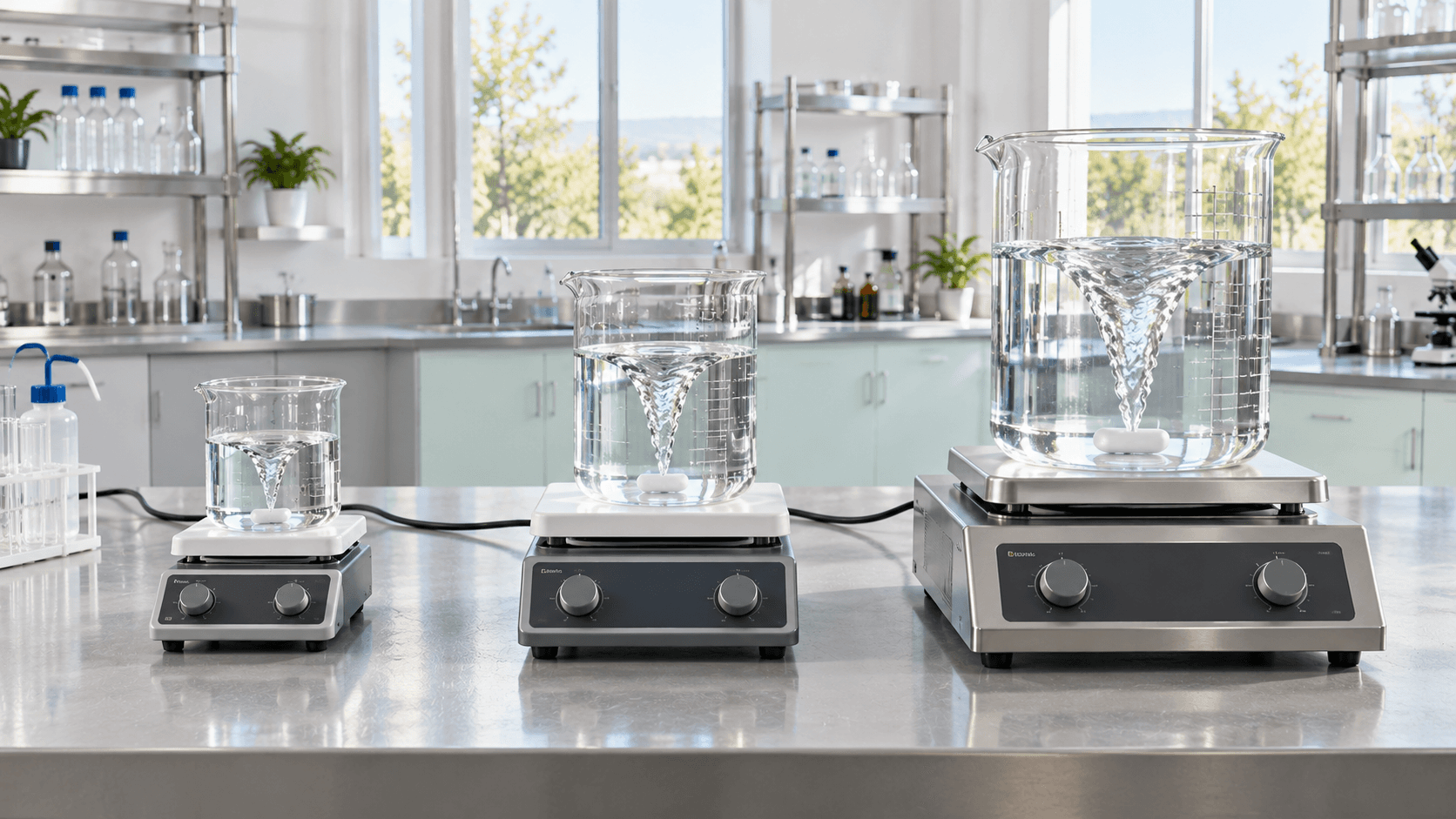
A hot plate with magnetic stirrer combines controlled heating with magnetic mixing in one compact system. Instead of using a separate overhead mixer, a magnetic field rotates a stir bar inside the vessel while the plate supplies heat from below. For compatible applications, that means less equipment on the bench and a straightforward way to maintain mixing during heating.
But hot plates aren't interchangeable. Maximum stirring volume, temperature range, speed range, plate material, vessel dimensions, control accuracy, solution viscosity, and safety features can all affect whether a unit is suitable.
GreenLabGear supplies laboratory heating, stirring, and temperature-control equipment for research and processing environments. Before choosing a hot plate with magnetic stirrer, define what you're heating, how much you're mixing, and how precisely the process needs to be controlled.
TLDR – Quick Guide
- Choose a hot plate with magnetic stirrer according to normal working volume, not maximum capacity alone.
- Verify that the stirring capacity is appropriate for your vessel size and solution viscosity.
- Check the required operating temperature rather than automatically choosing the highest-temperature model.
- Digital controls can make repeatable temperature and speed settings easier to manage.
- Plate material affects heat transfer, chemical resistance, durability, and cleaning.
- Magnetic stirring works best when the stir bar, vessel, speed, and liquid properties are properly matched.
- Higher viscosity can significantly reduce magnetic stirring performance.
- Consider external temperature sensing when actual liquid temperature matters more than plate-surface temperature.
- For larger or more demanding processes, alternative heating or mixing equipment may be more appropriate.
Detailed Breakdown
What Is a Hot Plate With Magnetic Stirrer?
A hot plate with magnetic stirrer combines two laboratory functions in one device.
The heating surface transfers thermal energy into a vessel placed on the plate. Beneath that surface, a rotating magnetic field drives a magnetic stir bar positioned inside the vessel.
The result is simultaneous heating and mixing without a mechanical stirrer shaft entering the container.
Laboratories use equipment from categories such as Heaters, Stirrers & Hot Plates for applications ranging from routine sample preparation to solution mixing and controlled heating.
A hot plate stirrer can be especially convenient when you need to maintain relatively uniform mixing while raising or holding a solution at a desired temperature.
Start With Your Required Working Volume
Capacity should be one of your first selection criteria.
Manufacturers may specify maximum stirring volumes, but the largest advertised number shouldn't automatically become your normal operating target. Real-world stirring performance depends on the material, viscosity, vessel geometry, stir bar, and operating speed.
Ask what volumes your laboratory actually processes most often.
If you routinely work with relatively small beakers, purchasing equipment optimized for much larger vessels may add unnecessary cost and bench space. If you're regularly mixing several liters, an undersized stirrer may struggle to maintain stable circulation.
GreenLabGear's 10L Heater & Stirrer is one example worth evaluating when your application calls for that general capacity class, subject to its specific operating specifications.
Always distinguish between nominal maximum capacity and a comfortable working range for your actual formulation.
Consider Solution Viscosity
Volume alone doesn't tell you how difficult a sample will be to stir.
Ten liters of a relatively low-viscosity liquid presents a very different mixing challenge from ten liters of a thick formulation.
As viscosity increases, the magnetic coupling between the drive and stir bar may become less effective at producing adequate bulk circulation. The stir bar can begin slipping, jumping, or losing synchronization at inappropriate speeds.
For more viscous applications, an overhead stirrer or another mechanical mixing system may be more appropriate.
Before selecting a hot plate with magnetic stirrer, determine:
- Typical viscosity
- Whether viscosity changes during heating
- Required mixing intensity
- Vessel geometry
- Working volume
If a material becomes dramatically thicker during the process, size your stirring equipment for the difficult part of the run—not the easy first five minutes.
Check the Temperature Range
A maximum temperature specification looks impressive, but what matters is whether the unit performs appropriately at your required operating temperature.
If most of your work occurs at moderate temperatures, an extremely high maximum plate temperature may offer little practical value.
Consider:
- Normal operating temperature
- Maximum required temperature
- Heat-up requirements
- Temperature stability needs
- Sample sensitivity
- Vessel compatibility
- Ambient operating conditions
Also distinguish between the temperature of the heating surface and the temperature of the liquid.
Those aren't automatically identical.
Heat is transferred from the plate through the vessel and into the sample, while heat is simultaneously lost to the surrounding environment. Actual sample temperature can therefore differ from the hot plate's surface condition.
Look at Temperature Measurement and Control
If temperature matters to the outcome of your process, pay close attention to how the equipment measures and controls it.
Some hot plates primarily regulate the heating surface. Other systems can work with an external probe or sensor to monitor the sample more directly, depending on the model.
External sensing can be useful when actual liquid temperature is the variable that needs to remain controlled.
When comparing equipment, check:
- Temperature display
- Control resolution
- Sensor compatibility
- Probe placement requirements
- Over-temperature protection
- Alarm or safety functions
Don't assume a display reading always represents the exact temperature everywhere inside the vessel.
Mixing helps improve uniformity, but measurement location still matters.
Choose an Appropriate Stirring Speed Range
Faster isn't automatically better.
The ideal stirring speed is the speed that creates sufficient circulation without causing instability, excessive vortexing, splashing, aeration, or loss of magnetic coupling.
Very low-speed applications may require stable operation at the lower end of the equipment's range. Other applications may require stronger agitation.
Check both minimum and maximum speed specifications.
A broad speed range can make one unit useful across more applications, but controllability is more important than chasing the biggest RPM number.
Stir Bar Selection Matters More Than You Might Think
A great magnetic stirrer can perform poorly with an inappropriate stir bar.
Stir-bar size and shape should match the vessel, liquid, and stirring requirements. If the magnetic coupling is inadequate, the bar may lose synchronization with the rotating field.
Common warning signs include:
- Rattling
- Erratic movement
- Repeated decoupling
- Poor circulation
- Inconsistent vortex formation
Position the vessel correctly on the stirring surface and begin at a lower speed before increasing agitation as appropriate.
The solution shouldn't sound like there's a tiny helicopter trying to escape from the beaker.
Evaluate the Hot Plate Surface
Surface material affects more than appearance.
Depending on the model, laboratory hot plates may use ceramic, coated metal, or other materials. Each design can offer different characteristics involving thermal transfer, durability, corrosion resistance, and cleaning.
Consider the chemicals routinely used around the equipment.
Chemical resistance is particularly important because spills happen. A surface that's difficult to clean or easily damaged by your normal reagents can become frustrating quickly.
Also check the usable plate dimensions against your normal vessels.
A large flask balanced awkwardly on a tiny heating surface is not a clever space-saving strategy.
Match the Equipment to Your Vessel
Beakers, flasks, and other laboratory vessels transfer heat differently based on material, geometry, wall thickness, and contact with the heating surface.
The vessel should be suitable for hot-plate use and stable on the equipment.
Check:
- Vessel diameter
- Bottom geometry
- Vessel material
- Working volume
- Weight when full
- Stir-bar compatibility
Don't exceed the manufacturer's specified loading or vessel requirements.
If your process uses round-bottom flasks or requires heating around a larger portion of the vessel, a conventional flat hot plate may not be the best heating method.
Hot Plate vs Water Bath vs Heating Mantle
A hot plate with magnetic stirrer is versatile, but it isn't the answer to every laboratory heating problem.
A water bath can provide indirect, relatively uniform heating around part of a vessel and may suit applications requiring controlled moderate temperatures. A heating mantle is designed to conform more closely around compatible round-bottom glassware.
A hot plate provides direct heating from below and can conveniently incorporate magnetic stirring.
Here's a simplified comparison:
Equipment
Best Suited To
Key Advantage
Hot Plate Stirrer
Compatible flat-bottom vessels and solutions requiring mixing
Heating and stirring in one unit
Water Bath
Controlled indirect heating
More surrounding heat transfer
Heating Mantle
Compatible round-bottom glassware
Conforms around flask geometry
GreenLabGear's Water Bath vs Heating Mantle guide provides a deeper comparison of alternative laboratory heating methods.
Choose the heating method around the vessel and process—not because one device happens to already be sitting on the bench.
When Should You Consider Other Temperature-Control Equipment?
Benchtop hot plates are excellent for many applications, but scaling up eventually changes the equation.
Larger reactors, temperature-sensitive processes, or workflows requiring controlled heating and cooling may benefit from circulating temperature-control equipment instead.
GreenLabGear's broader selection of Temperature Control Equipment includes systems intended for different laboratory and processing requirements.
Consider moving beyond a standard hot plate when:
- Batch volumes become too large.
- Vessel geometry isn't suitable.
- Precise circulating temperature control is required.
- Both heating and cooling are needed.
- Magnetic stirring can't handle the viscosity.
- The process requires integration with a reactor or other equipment.
Trying to force a benchtop hot plate into an industrial-scale job usually creates more problems than savings.
Don't Ignore Laboratory Safety
Heating equipment deserves thoughtful placement and operating procedures.
Hot surfaces can remain dangerous after a run ends, and spilled chemicals can introduce additional hazards. Laboratories should follow the equipment manufacturer's instructions and their own applicable safety procedures.
Before use:
- Inspect the unit and power cord.
- Verify vessel compatibility.
- Keep the work area stable and uncluttered.
- Confirm chemical compatibility.
- Avoid exceeding specified capacities.
- Use appropriate PPE for the materials and process.
- Keep incompatible flammable materials away from ignition or heat sources.
- Allow equipment to cool appropriately before cleaning.
Importantly, a standard laboratory hot plate should not automatically be assumed suitable for environments where flammable vapors may be present.
Equipment selection for hazardous locations requires the appropriate professional safety and engineering review.
How to Choose the Right Hot Plate With Magnetic Stirrer
Instead of starting with brands or prices, create a short application specification.
Record your typical and maximum:
Then compare equipment against those requirements.
Also consider how often the hot plate will be used. A unit running for hours every day may justify greater emphasis on durability, control, serviceability, and replacement-part availability than equipment used occasionally for simple sample preparation.
Common Buying Mistakes
The most common mistake is buying from a single maximum specification.
A hot plate advertised for a high temperature or large volume isn't automatically excellent at every condition below that limit.
Other mistakes include:
- Ignoring viscosity
- Selecting by maximum RPM alone
- Overlooking plate dimensions
- Assuming plate temperature equals sample temperature
- Using the wrong stir bar
- Choosing equipment without checking chemical compatibility
- Ignoring vessel geometry
- Buying too little capacity for routine work
- Dramatically oversizing for occasional experiments
A good hot plate with magnetic stirrer should comfortably handle your normal workload, not merely survive it on paper.
Key Takeaways
- Choose a hot plate with magnetic stirrer according to your actual application rather than one headline specification.
- Working volume should be evaluated alongside viscosity, vessel geometry, and stir-bar selection.
- Higher-viscosity materials can require more capable mixing equipment or an alternative to magnetic stirring.
- Required operating temperature matters more than the highest temperature a hot plate can theoretically reach.
- Plate temperature and actual liquid temperature aren't necessarily the same.
- Appropriate temperature sensing can improve process monitoring where sample temperature is critical.
- Stirring speed should provide adequate circulation without instability or decoupling.
- Plate dimensions and surface material should match your vessels and chemical environment.
- Hot plates, water baths, heating mantles, and circulating temperature-control systems serve different applications.
- Consider durability, safety features, maintenance, and serviceability alongside purchase price.
FAQs
What is a hot plate with magnetic stirrer used for?
A hot plate with magnetic stirrer simultaneously heats and mixes compatible laboratory samples. A magnetic field rotates a stir bar inside the vessel while the heating surface supplies thermal energy from below. It can be useful for solution preparation, sample processing, and other laboratory applications requiring combined heating and agitation.
What size hot plate with magnetic stirrer do I need?
Choose a unit whose working capacity comfortably accommodates your normal sample volume, vessel, and liquid properties. Maximum advertised volume shouldn't automatically be treated as the ideal operating volume for every formulation. Viscosity, stir-bar selection, vessel geometry, and required speed can all affect practical capacity.
Can a magnetic stirrer mix thick liquids?
Magnetic stirrers can handle some moderately viscous materials, but performance generally becomes more challenging as viscosity increases. The stir bar may lose magnetic coupling or fail to create adequate bulk circulation when the load becomes too demanding. An overhead stirrer or other mechanical mixing system may be more suitable for high-viscosity applications.
Is hot plate temperature the same as liquid temperature?
Not necessarily, because the heating surface transfers energy through the vessel while the sample simultaneously loses heat to its surroundings. Actual liquid temperature can therefore differ from the plate temperature and may also vary within the vessel. Use an appropriate temperature measurement method when precise sample temperature is important.
Is a hot plate better than a heating mantle?
Neither option is universally better because they are designed for different heating situations. A hot plate can work well with compatible flat-bottom vessels and offers convenient magnetic stirring, while a heating mantle can provide heating around compatible round-bottom glassware. Choose according to vessel geometry, temperature requirements, mixing needs, and the manufacturer's operating guidance.