How Does a Nutsche Filter Work and When Should Your Cannabis Lab Use One?
Learn how a Nutsche filter works, what it separates, its advantages, and when to choose filtration instead of centrifugation.
Introduction
Separating solids from liquids sounds simple until you're doing it repeatedly, at scale, with valuable process material on the line. That's where a Nutsche filter can become an important piece of laboratory separation equipment.
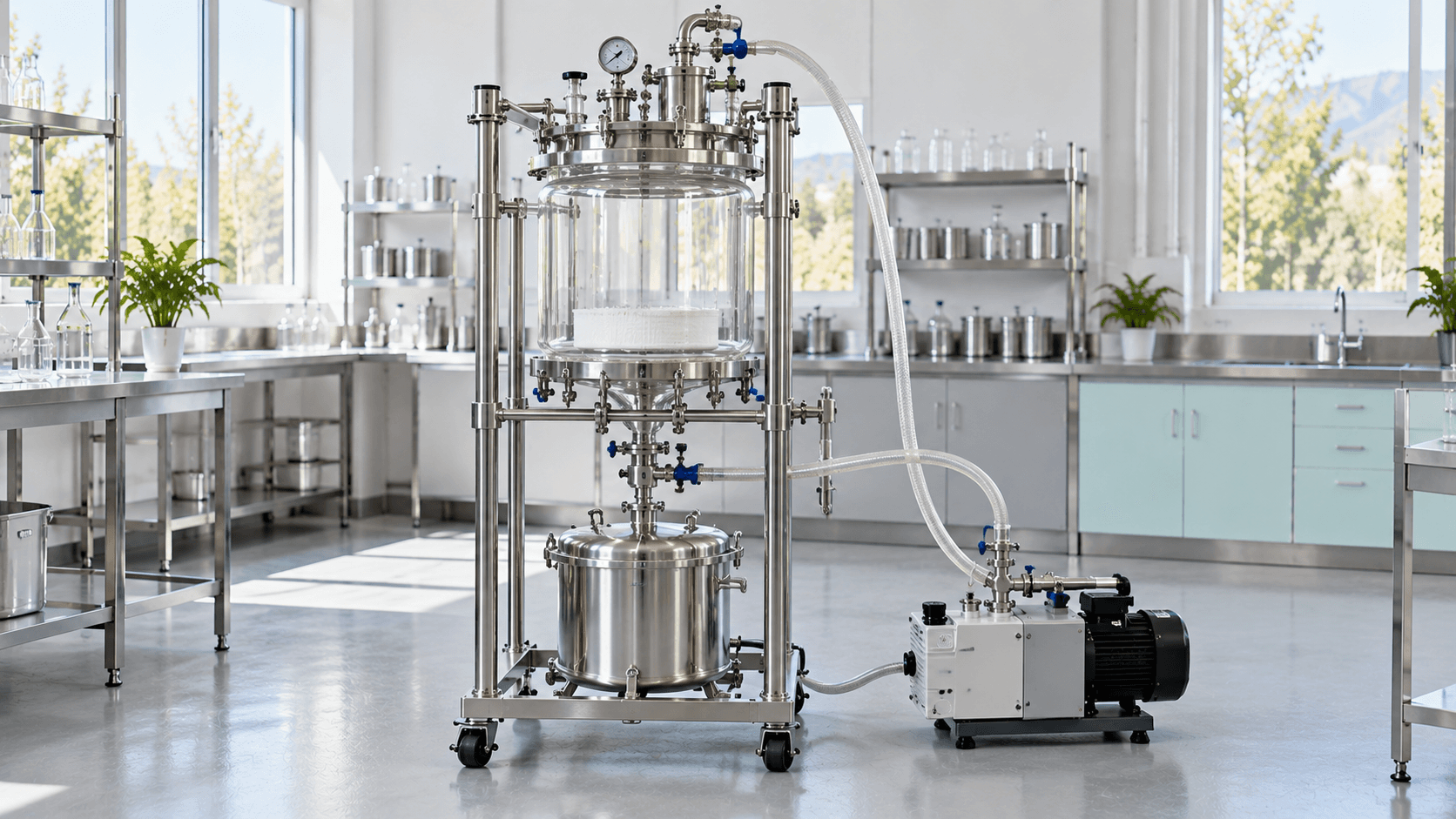
A Nutsche filter is essentially a batch filtration vessel designed to separate solids from a liquid using a filter medium and a pressure differential. Depending on the equipment and process, filtration may be assisted by vacuum below the filter or pressure above the material. More sophisticated systems can also support operations such as cake washing or drying within the same enclosed vessel.
For cannabis processing laboratories, the appeal is straightforward: controlled solid-liquid separation without relying exclusively on small funnels, filter papers, or repeated manual transfers.
GreenLabGear supplies professional laboratory separation and processing equipment, including Nutsche filtration systems in different capacity classes. Whether a Nutsche filter belongs in your workflow depends on what you're separating, batch volume, solids characteristics, required filtration quality, solvent compatibility, and how the equipment compares with alternatives such as centrifuges.
TLDR – Quick Guide
- A Nutsche filter separates suspended solids from liquid using a filter medium and a pressure differential.
- Material is introduced above the filter medium, liquid passes through, and retained solids form a filter cake.
- Vacuum or appropriately designed pressure systems can provide the driving force for filtration, depending on the equipment.
- Filter-medium selection depends on particle size, chemistry, desired retention, and process requirements.
- Nutsche filtration can be useful when recovering valuable solids, clarifying liquids, washing filter cakes, or containing process material.
- Larger systems, such as a 50L Nutsche filter, should be selected according to actual slurry and solids loading rather than vessel volume alone.
- Centrifuges and Nutsche filters both perform solid-liquid separation but use fundamentally different mechanisms.
- Solvent compatibility, pressure or vacuum ratings, cleaning, filter area, and downstream requirements should all be evaluated before purchasing.
Detailed Breakdown
What Is a Nutsche Filter?
A Nutsche filter is a batch solid-liquid separation device.
At its simplest, the system consists of a vessel containing a perforated support plate or similar structure that holds an appropriate filter medium. A slurry containing both liquid and solid material enters the vessel above that filtration surface.
A pressure difference then encourages liquid to pass through the filter while solids are retained.
GreenLabGear's Filters & Nutsche category includes filtration equipment intended for laboratory and processing applications.
Depending on the exact Nutsche design, the system may include:
- Main filtration vessel
- Filter support
- Replaceable filter medium
- Filtrate outlet
- Vacuum or pressure connections
- Valves
- Instrumentation
- Drain or discharge components
- Seals and gaskets
More advanced designs can incorporate additional processing capabilities, but specifications vary significantly between systems.
How Does a Nutsche Filter Work?
The basic operating principle is surprisingly straightforward.
A slurry containing liquid and suspended solids is placed into the filtration vessel. The liquid is driven through the filter medium by an appropriate pressure differential, while particles too large to pass through the selected medium accumulate on its surface.
Those accumulated solids form what is known as a filter cake.
The basic process can be viewed as:
Slurry → Filter medium → Solid cake retained → Liquid filtrate collected
As the cake develops, it can itself contribute to filtration by capturing additional particles.
However, there's a tradeoff.
A thicker or less permeable cake can also increase resistance to liquid flow, causing filtration to slow down. That means filter performance depends on much more than the vessel's nominal capacity.
Particle characteristics, cake structure, filter area, viscosity, temperature, pressure differential, and filter-medium properties can all affect performance.
Why the Filter Medium Matters
A Nutsche filter is only as useful as the filtration setup inside it.
Filter-medium selection influences which particles are retained, how quickly liquid passes through, how easily the filter can be cleaned, and what quality of filtrate is produced.
Choosing an extremely fine medium isn't automatically better.
Finer filtration can increase flow resistance and potentially extend filtration time. A medium that's too coarse, meanwhile, may allow undesirable particles into the filtrate.
Selection should consider:
- Particle-size distribution
- Desired solids retention
- Liquid viscosity
- Chemical compatibility
- Temperature
- Filter-cake characteristics
- Required filtrate quality
The best filter medium is the one that achieves the required separation efficiently and consistently—not necessarily the one with the smallest nominal opening.
What Is Filter Cake?
Filter cake is the layer of solid material retained on the filtration surface.
Understanding cake behavior is essential when selecting a Nutsche filter because different solids can form dramatically different cakes.
Some materials create relatively porous layers that allow liquid to pass through efficiently. Others can compact into dense, highly resistant cakes.
Cake characteristics can depend on:
- Particle size
- Particle shape
- Particle-size distribution
- Compressibility
- Solids concentration
- Liquid viscosity
- Operating conditions
As resistance increases, filtration can slow substantially.
This explains why two processes using the same 50-liter filtration vessel can have completely different cycle times.
Liters tell you how much material fits inside. They don't tell you how politely that material will filter.
Vacuum vs Pressure-Assisted Filtration
Nutsche filtration can use a pressure differential to drive liquid through the filter medium.
Depending on system design, that differential may be produced using vacuum beneath the filtration surface or appropriate pressure above the material.
Vacuum filtration effectively lowers pressure on the filtrate side, encouraging liquid to move through the cake and filter.
Pressure-assisted equipment can instead use positive pressure above the process material where the system is specifically engineered and rated for that operating mode.
The correct method depends on:
- Equipment design
- Vessel ratings
- Solvent or liquid properties
- Filtration resistance
- Process safety
- Facility requirements
Never pressurize a filtration vessel unless the complete system is explicitly designed and rated for the intended pressure and application.
When Would a Cannabis Lab Use a Nutsche Filter?
A cannabis-processing facility may consider Nutsche filtration when a process creates a solid-liquid mixture that needs controlled separation.
The specific use depends on the facility's extraction and refinement workflow, but potential separation objectives can include:
- Removing suspended solids
- Recovering valuable solid material
- Collecting clarified liquid
- Separating precipitated material
- Washing a retained filter cake
- Reducing manual filtration steps
A Nutsche filter can be particularly useful when the process is naturally batch-oriented and benefits from keeping filtration within a contained vessel.
That doesn't mean every cannabis laboratory needs one.
A facility's extraction method, product type, production volume, upstream process, and downstream equipment should determine whether Nutsche filtration creates enough value to justify the investment.
Choosing the Right Nutsche Filter Size
Sizing a Nutsche filter by vessel volume alone is risky.
GreenLabGear's 50L Nutsche Filter represents one available capacity class, but suitability depends on far more than whether your slurry volume fits inside the vessel.
Important sizing variables include:
Factor
Why It Matters
Slurry volume
Determines total material handled per batch
Solids concentration
Influences expected cake volume
Filter area
Affects available filtration surface
Cake thickness
Influences resistance and usable capacity
Particle properties
Affect permeability and retention
Liquid viscosity
Influences flow through the filter
Desired cycle time
Determines required processing rate
Washing requirements
May add liquid and process time
Filter area can be especially important.
Two vessels with similar volume can perform differently if their effective filtration areas or geometries differ.
When sizing equipment, provide the manufacturer or supplier with representative process information rather than simply saying, "We need 50 liters."
Filter Area vs Vessel Capacity
This distinction deserves extra attention.
Vessel capacity tells you how much material the equipment can contain. Filter area helps determine how much surface is available for separation.
For filtration, both matter.
If the process creates a substantial amount of solids, cake thickness may become a limiting factor. A deep cake can increase resistance and slow liquid flow.
That's why scaling filtration purely by liquid volume can produce disappointing results.
A useful sizing exercise should estimate:
Pilot testing with representative material can be extremely valuable when cake behavior is uncertain.
Where Does Separation Equipment Fit Into the Workflow?
Filtration is one of several ways laboratories separate process materials.
GreenLabGear's broader Separation Equipment category includes technologies designed for different separation requirements.
The right technology depends on what you're trying to separate.
Filtration works by passing liquid through a medium that retains solids. Centrifugation uses rotational forces to separate components according to differences in physical behavior such as density and particle characteristics.
Other processes may require different separation approaches entirely.
Start with the separation objective:
What needs to stay? What needs to pass through? How much material needs to be processed, and how quickly?
Once those questions are answered, equipment selection gets much easier.
Nutsche Filter vs Centrifuge
One of the most common equipment comparisons is Nutsche filter vs centrifuge.
Both can perform solid-liquid separation, but they do it differently.
Nutsche Filter
Centrifuge
Uses a filter medium
Uses rotational force
Produces retained filter cake
Separates material through centrifugal effects
Batch filtration workflow
Batch or other configurations depending on design
Performance depends strongly on cake permeability
Performance depends on factors including density, particle behavior, and rotational conditions
Filter medium requires maintenance/replacement
Rotating equipment introduces mechanical maintenance
Can support cake washing in suitable designs
Washing capability depends on centrifuge configuration
GreenLabGear's Nutsche Filter vs Centrifuge guide examines this decision in more detail.
Neither technology is automatically superior.
A Nutsche filter may be attractive when filter-cake handling and contained batch filtration align well with the process. A centrifuge may be more appropriate when its separation mechanism, throughput, and process configuration better match the material.
Consider Liquid Viscosity
Viscosity can have a major effect on filtration speed.
More viscous liquids generally resist movement through the filter medium and cake more strongly than lower-viscosity liquids.
This can increase filtration time even when particle characteristics remain unchanged.
If process temperature significantly affects viscosity, temperature management may influence filtration performance as well. However, temperature should only be adjusted within the material's validated processing requirements and equipment limits.
When comparing Nutsche systems, provide realistic viscosity information at the actual filtration conditions.
Testing everything with water and assuming the production material will behave the same way is an excellent method for creating an unpleasant surprise.
Think About Cake Washing
Some processes require more than separating the liquid once.
A retained cake may need to be washed to remove soluble contaminants, recover remaining product, or achieve another process objective.
A Nutsche configuration can be useful because filtration and compatible washing operations may occur within the same vessel, depending on system design.
The washing liquid contacts the cake and subsequently passes through the filtration medium.
Performance depends heavily on cake uniformity and the specific washing objective.
If cake washing is important to your workflow, make it part of the original equipment specification rather than assuming every Nutsche system provides identical functionality.
Material Compatibility Is Critical
The vessel may be stainless steel, glass, or another suitable material depending on the equipment, but that's only part of compatibility.
Process material can also contact:
- Filter media
- Gaskets
- O-rings
- Seals
- Valves
- Tubing
- Fittings
- Instrumentation
All wetted components need to be compatible with the liquid, solids, cleaning agents, temperatures, and operating conditions involved.
This is especially important in facilities handling flammable or chemically aggressive solvents.
Never assume that because the vessel material is compatible, the complete filtration system automatically is.
Plan for Vacuum Equipment and Vapor Management
If the Nutsche filter operates under vacuum, pump selection should reflect the complete process.
A vacuum pump's ultimate vacuum specification isn't enough.
Consider:
- Required operating vacuum
- Gas and vapor load
- Chemical compatibility
- Pumping speed
- Tubing diameter and length
- Condensers or traps
- Filters
- Gauge location
- Leak integrity
If volatile solvents are present, appropriate vapor management becomes particularly important.
The vacuum system must be designed for the process environment, and equipment potentially exposed to flammable vapors needs to be appropriate for its intended service and facility classification.
Cleaning and Changeover
A filtration system spends part of its life filtering and another part being cleaned.
For multi-product facilities, cleaning time can have a major impact on actual throughput.
Before buying a Nutsche filter, consider how operators access:
- Filter media
- Support plates
- Vessel walls
- Valves
- Discharge points
- Seals
- Product-contact fittings
Also determine how frequently the filter medium needs inspection or replacement.
If changing a filter requires a heroic maintenance expedition after every batch, that should influence equipment selection.
Calculate Complete Cycle Time
Don't evaluate throughput from filtration time alone.
A complete Nutsche filter cycle may include material loading, filtration, cake washing where required, additional liquid removal, cake discharge, cleaning, inspection, and preparation for the next batch.
So practical throughput is closer to:
Usable batch capacity × completed full cycles per operating period
This matters when comparing a Nutsche filter with a centrifuge or when choosing between different Nutsche capacities.
A larger vessel may process more material per batch but require longer loading, filtration, discharge, or cleaning.
Measure productivity at the complete-process level.
Common Nutsche Filter Buying Mistakes
The most common mistake is selecting equipment solely according to vessel volume.
Other problems include:
- Ignoring filter area
- Underestimating solids loading
- Assuming all filter cakes behave similarly
- Choosing filter media without sufficient process data
- Ignoring viscosity
- Forgetting cake-washing requirements
- Failing to evaluate chemical compatibility
- Undersizing vacuum equipment
- Ignoring vapor management
- Overlooking cleaning and changeover time
- Comparing Nutsche filtration with centrifugation based only on purchase price
A Nutsche filter is a process tool, not simply a container with a filter at the bottom.
Its performance depends on how well the entire filtration system matches the material.
Key Takeaways
- A Nutsche filter performs batch solid-liquid separation using a filter medium and pressure differential.
- Solids collect on the filtration surface as a filter cake while liquid passes through as filtrate.
- Filter-medium selection affects particle retention, flow resistance, chemical compatibility, and filtrate quality.
- Cake thickness and permeability can have a major impact on filtration speed.
- Nutsche filters may use vacuum or appropriately engineered positive pressure depending on system design.
- Cannabis labs may use Nutsche filtration when their workflow requires controlled separation, solids recovery, clarification, or cake washing.
- Vessel volume alone isn't enough to size a Nutsche filter; filter area and solids loading also matter.
- A 50L Nutsche filter should be evaluated against actual slurry volume, solids concentration, viscosity, and required cycle time.
- Nutsche filters and centrifuges use different separation mechanisms and should be compared according to the actual process.
- Chemical compatibility, vacuum equipment, vapor management, cleaning, and maintenance should all be considered before purchasing.
FAQs
How does a Nutsche filter work?
A Nutsche filter places a suitable filter medium between a solid-liquid slurry and the filtrate outlet. A pressure differential drives liquid through the medium while retained solids accumulate as a filter cake. Filtration performance depends on factors including filter area, particle characteristics, viscosity, cake permeability, and operating conditions.
What is a Nutsche filter used for in cannabis processing?
A Nutsche filter can be used in compatible cannabis-processing workflows that require controlled separation of suspended solids from liquid. Depending on the process, the objective may be recovering solids, collecting clarified liquid, separating precipitated material, or washing a retained cake. Suitability depends on the extraction method, chemistry, production volume, and desired downstream product.
How do I choose the right Nutsche filter size?
Start with slurry volume, solids concentration, expected cake volume, filter area, liquid viscosity, and required cycle time. Nominal vessel capacity alone doesn't indicate how quickly or effectively a specific material will filter. Representative process testing and manufacturer application data can help when cake behavior is difficult to predict.
Is a Nutsche filter better than a centrifuge?
Neither technology is universally better because Nutsche filters and centrifuges use different separation mechanisms. A Nutsche filter may be attractive when contained batch filtration and filter-cake handling fit the process, while a centrifuge may better suit applications benefiting from centrifugal separation. Compare throughput, material behavior, cleaning, maintenance, containment, and downstream requirements before choosing.
Can a Nutsche filter operate under vacuum?
Many Nutsche filtration systems can use vacuum as the pressure differential that draws liquid through the filter, but capability depends on the exact equipment design and rating. The vessel, seals, valves, tubing, pump, and any vapor-management components must all be appropriate for the intended process. Always follow manufacturer specifications and applicable facility safety requirements.