Passive vs Active Closed Loop Extractor: Which System Is Right for Your Lab?
Compare passive vs active closed loop extractor systems, including recovery speed, equipment needs, maintenance, cost, and lab applications.
Introduction
Choosing a closed-loop extraction system involves more than deciding vessel capacity and calling it a day. One of the bigger decisions is whether your laboratory should use passive vs active closed loop extractor technology.
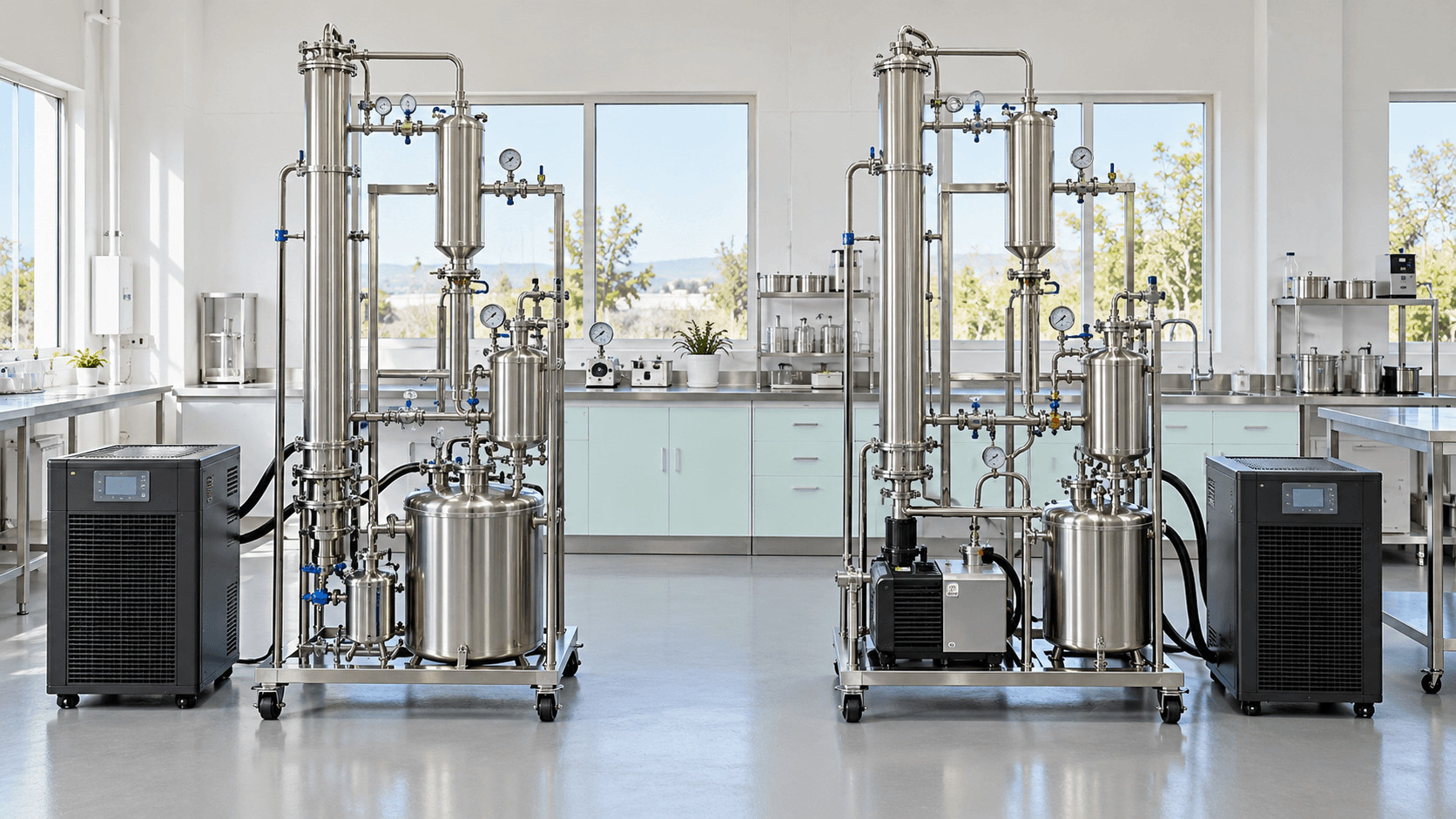
Both approaches can be used in professional hydrocarbon extraction, but they move and recover solvent differently. Passive systems generally rely on pressure and temperature differentials to drive solvent movement and recovery, while active systems incorporate a recovery pump or compressor to mechanically assist solvent recovery.
That difference can affect equipment complexity, recovery time, maintenance, workflow, and ultimately how well the system fits your production targets.
GreenLabGear provides extraction and processing equipment for professional cannabis laboratories, including closed-loop extraction and solvent recovery systems. If you're deciding between passive and active equipment, the right answer starts with throughput and process requirements—not simply which technology sounds more advanced.
TLDR – Quick Guide
- Passive closed-loop extraction generally uses controlled temperature and pressure differentials to move and recover solvent.
- Active closed-loop extraction adds a recovery pump or compressor to mechanically assist solvent recovery.
- Passive systems can have fewer mechanical recovery components, potentially simplifying maintenance.
- Active recovery can be useful when faster or more controlled recovery supports the production workflow.
- Active systems add equipment that requires appropriate maintenance and must be suitable for the intended solvent and installation.
- Temperature control remains important in both approaches.
- Solvent recovery capacity can become a major throughput bottleneck regardless of extractor size.
- Neither system is automatically better; selection should reflect production volume, facility design, operating requirements, and applicable safety rules.
Detailed Breakdown
What Is a Passive Closed Loop Extractor?
A passive closed loop extractor moves and recovers solvent primarily by manipulating pressure and temperature conditions within the designed system rather than relying on a mechanical solvent recovery pump.
In simplified terms, controlled heating and cooling can create conditions that encourage solvent to move from one part of the closed system to another. The exact process depends on the extractor, solvent, temperature-control equipment, and manufacturer's operating design.
Passive Closed Loop Extractors can be attractive because they may eliminate the need for a mechanical recovery pump.
Potential advantages include:
- Fewer mechanical recovery components
- Reduced recovery-pump maintenance
- Simpler equipment architecture in some configurations
- Fewer moving components in the solvent recovery path
"Passive," however, doesn't mean the equipment simply sits there and handles everything itself.
Successful operation still depends on properly designed temperature control, suitable equipment, trained operators, monitoring, and compliance with facility and safety requirements.
What Is an Active Closed Loop Extractor?
An active closed loop extractor uses a mechanical recovery device—typically an appropriate recovery pump or compressor—to assist in moving solvent through the recovery portion of the process.
The major distinction in the passive vs active closed loop extractor comparison is therefore the mechanism used to drive solvent recovery.
An active system may offer advantages when recovery speed and throughput are important to the operation. Instead of relying solely on temperature and pressure differentials, mechanical equipment actively assists solvent movement.
That can be useful for laboratories processing larger volumes or trying to reduce recovery-related bottlenecks.
The tradeoff is additional complexity.
Recovery equipment introduces another component that requires:
- Correct sizing
- Solvent compatibility
- Maintenance
- Inspection
- Appropriate installation
- Replacement parts
- Facility integration
A faster recovery method isn't automatically better if it creates unnecessary complexity for a low-throughput operation.
Passive vs Active Closed Loop Extractor: Side-by-Side
The differences become easier to understand when viewed together.
Factor
Passive System
Active System
Recovery Method
Temperature and pressure differentials
Mechanically assisted recovery
Recovery Pump
Generally not required
Required for active recovery
Mechanical Complexity
Typically lower
Typically higher
Temperature Control
Critical
Still important
Pump Maintenance
No dedicated recovery pump to maintain
Recovery equipment requires maintenance
Recovery Speed
Application and system dependent
Can support faster recovery in suitable systems
Throughput
Depends heavily on thermal/recovery design
Can suit higher-throughput workflows
Initial Equipment
Potentially simpler
Additional recovery hardware
Best Fit
Depends on workflow and production needs
Depends on workflow and production needs
These are general differences rather than guarantees. Actual performance depends on the specific extractor, recovery equipment, solvent, facility utilities, and validated process.
Why Solvent Recovery Matters So Much
Extraction gets plenty of attention, but solvent recovery can determine how quickly a laboratory is actually able to complete batches.
After solvent passes through the biomass and carries extracted compounds into the collection stage, that solvent must be separated and appropriately recovered.
If recovery takes substantially longer than extraction, the entire production cycle slows down.
That's why Solvent Recovery should be considered at the same time as extractor capacity.
Imagine an extractor capable of handling the desired biomass volume quickly, but a recovery stage that can't keep pace. Increasing extraction capacity doesn't solve the problem—it simply creates a larger queue for recovery.
Throughput is a system problem, not an extractor specification.
Is Passive Recovery Slower?
Passive recovery is often associated with longer recovery cycles, but blanket statements about speed can be misleading.
Performance depends heavily on system design, solvent properties, heat-transfer capability, cooling capacity, temperature differentials, vessel configuration, and operating conditions.
A properly matched passive system may provide completely adequate recovery for one facility. The same approach could become a bottleneck for another laboratory with substantially higher throughput targets.
When comparing systems, ask for meaningful performance information relevant to your intended process rather than assuming "active equals fast" and "passive equals slow."
The more useful question is: Can this recovery approach support our required batch schedule?
Does Active Recovery Always Improve Throughput?
Not necessarily.
A recovery pump can accelerate an important stage of the workflow, but overall throughput is still limited by the slowest critical process.
Suppose active recovery saves time but the laboratory's biomass preparation, chilling, filtration, post-processing, or cleaning process takes significantly longer. Increasing recovery speed won't magically eliminate those other constraints.
Evaluate total cycle time, including:
- Material preparation
- Equipment loading
- Extraction
- Solvent recovery
- Product removal
- Cleaning
- Setup between batches
- Downstream processing
This provides a much more realistic picture of production capacity.
Equipment Complexity and Maintenance
Passive systems may appeal to laboratories seeking fewer mechanical components in the solvent recovery path.
A recovery pump or compressor introduces moving parts and service requirements. Depending on the equipment, maintenance may involve inspections, seals, service components, or other manufacturer-specified procedures.
Passive systems aren't maintenance-free either.
Valves, seals, gaskets, vessels, connections, temperature-control equipment, instrumentation, and other components still require inspection and maintenance according to manufacturer requirements.
So the maintenance question isn't maintenance vs no maintenance.
It's which maintenance profile works better for your facility?
Temperature Control Is Critical in Both Systems
Temperature is central to hydrocarbon extraction and solvent recovery.
Passive systems depend particularly heavily on carefully managed thermal conditions to create the pressure differences that drive solvent movement. That makes heating and cooling capability an important part of system performance.
Active systems still need appropriate temperature management. Mechanical recovery equipment doesn't eliminate the need to control process conditions, manage condensation, and operate the extraction system within its designed parameters.
When comparing a passive vs active closed loop extractor, evaluate the entire thermal system alongside the extractor.
An impressive vessel surrounded by undersized temperature-control equipment can become an expensive stainless-steel bottleneck.
How Does Solvent Choice Affect the Decision?
Solvent characteristics influence extraction behavior, recovery requirements, facility engineering, and equipment selection.
Hydrocarbon extraction is commonly associated with solvents such as butane and propane, while ethanol extraction uses a very different workflow and supporting equipment.
Facilities still deciding which extraction method to build around should make that decision before becoming too focused on active versus passive hydrocarbon recovery.
GreenLabGear's guide to Hydrocarbon vs Ethanol Extraction provides a broader comparison of the two approaches.
The extraction method affects much more than the extractor. It can influence facility layout, solvent handling, temperature control, recovery equipment, downstream processing, and final product strategy.
Which System Is Better for a Small Laboratory?
A smaller laboratory with modest throughput requirements may find a passive system attractive when the selected equipment can meet its production needs without introducing unnecessary recovery machinery.
Fewer mechanical recovery components can mean fewer pump-specific maintenance tasks and a potentially simpler system.
But "small laboratory" doesn't automatically mean "passive."
A facility producing small batches on a demanding schedule may still value active recovery. Likewise, a larger operation may use a well-designed passive configuration if it fits the specific workflow.
Production targets matter more than square footage.
Which System Is Better for Higher Throughput?
Active recovery becomes worth investigating when solvent recovery time is a meaningful production constraint.
A properly selected recovery pump can mechanically assist the process and may help support faster cycle times. However, pump capacity must be considered alongside the rest of the extraction system.
This is where proper sizing matters.
GreenLabGear's Solvent Recovery System Size guide covers the broader issue of matching recovery equipment to laboratory capacity.
Before investing in additional recovery performance, determine whether recovery is actually your bottleneck. There's little benefit in making one stage twice as fast if the next stage still has half the required capacity.
Safety Considerations for Active and Passive Systems
Both systems involve significant hazards when used with flammable hydrocarbon solvents.
Closed-loop design helps contain solvent during intended operation, but it doesn't eliminate the possibility of leaks, equipment failures, incorrect connections, or human error.
Active systems add another consideration: any recovery equipment used with flammable solvent must be specifically appropriate for the intended application and installed as required.
Depending on the jurisdiction and process, hydrocarbon extraction facilities may require specialized ventilation, gas detection, fire protection, electrical classification, solvent-storage controls, permitting, inspections, and other engineered safeguards.
Operators also need appropriate training and documented procedures.
Equipment selection should therefore involve qualified professionals and the relevant local authorities. A closed-loop label is not a substitute for a compliant facility.
How to Choose Between Passive and Active Recovery
Don't make the decision based on one feature.
Start by documenting your expected production workflow and determining how much solvent must realistically be recovered during a typical operating period.
Then evaluate:
A spreadsheet comparing total workflow requirements is more useful than choosing whichever extractor has the biggest vessel.
Common Mistakes When Choosing a Recovery Method
The first mistake is assuming active recovery is automatically superior because it uses more equipment.
More components only add value when they solve a real production problem.
The opposite assumption—that passive recovery is always cheaper and simpler—isn't universally reliable either. If inadequate recovery capacity causes longer cycles and limits production, the operational cost can outweigh equipment savings.
Other mistakes include:
- Comparing extractor capacity without recovery capacity
- Ignoring heating and cooling requirements
- Selecting recovery equipment without checking solvent compatibility
- Underestimating maintenance
- Focusing on individual equipment instead of total cycle time
- Buying for today's volume without considering reasonable growth
- Treating closed-loop equipment as inherently risk-free
The right passive vs active closed loop extractor choice is the one that supports the complete process safely and efficiently.
Key Takeaways
- A passive vs active closed loop extractor comparison primarily comes down to how solvent recovery is driven.
- Passive systems generally use controlled temperature and pressure differentials for solvent movement and recovery.
- Active systems use suitable mechanical recovery equipment to assist solvent recovery.
- Passive systems can reduce mechanical complexity but still require careful temperature control and maintenance.
- Active systems can support faster recovery in suitable applications but introduce additional equipment and service requirements.
- Solvent recovery capacity should be matched to extraction throughput.
- Neither approach guarantees better overall productivity because downstream bottlenecks still matter.
- Temperature-control capacity is important for both active and passive systems.
- Hydrocarbon extraction requires professionally engineered equipment, facilities, procedures, and safety controls.
- Choose a recovery approach based on actual batch requirements, total cycle time, maintenance resources, scalability, and compliance—not labels alone.
FAQs
What is the difference between a passive and active closed loop extractor?
A passive closed loop extractor generally relies on controlled temperature and pressure differentials to move and recover solvent. An active system uses appropriate mechanical recovery equipment to assist the solvent recovery process. Both approaches can be viable when correctly designed for the application's production and safety requirements.
Is active solvent recovery faster than passive recovery?
Active recovery can provide faster solvent recovery in suitable systems because mechanical equipment assists solvent movement. Actual cycle time still depends on equipment sizing, solvent, temperature control, vapor load, and the rest of the extraction workflow. Compare manufacturer performance data under conditions relevant to your process rather than assuming a universal speed advantage.
Is a passive closed loop extractor easier to maintain?
Passive systems can eliminate the maintenance associated with a dedicated mechanical recovery pump or compressor. However, valves, seals, vessels, connections, temperature-control systems, and instrumentation still require routine inspection and maintenance. Maintenance requirements should be evaluated for the complete extraction system rather than the recovery method alone.
Which closed loop extractor is better for a small cannabis lab?
A passive system may be suitable for a smaller laboratory when its recovery performance comfortably meets required batch schedules. An active system may make more sense when recovery speed is important despite relatively modest production volume. The decision should be based on actual throughput, facility, maintenance, and compliance requirements rather than laboratory size alone.
How do I size solvent recovery for a closed loop extractor?
Start with the amount of solvent that must be recovered per batch and the maximum acceptable recovery time within your production schedule. Compare those requirements with the recovery performance of the complete system under relevant operating conditions. Also account for temperature-control capacity, downstream bottlenecks, planned growth, and manufacturer requirements before selecting equipment.