Ball Mill Particle Size: How Fine Can a Laboratory Ball Mill Grind?
Learn what affects ball mill particle size and how media, speed, time, material properties, and mill capacity influence grinding results.
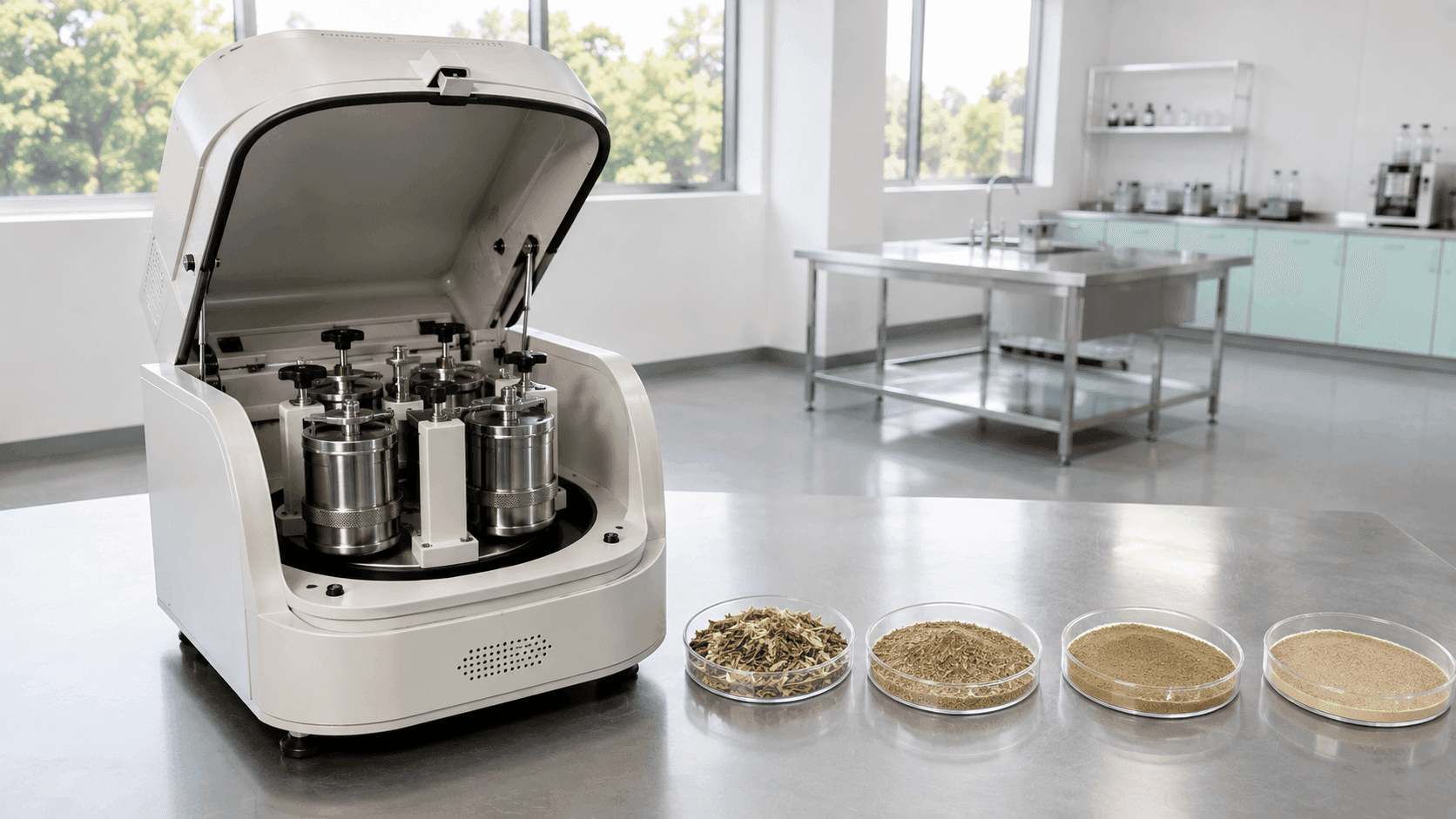
Introduction
One of the first questions laboratories ask when evaluating a ball mill is simple: How fine can it grind? Unfortunately, there isn't one universal number. Final ball mill particle size depends on the material, grinding media, operating conditions, processing time, mill design, and whether the process is wet or dry.
That's important because buying a laboratory ball mill based solely on an advertised minimum particle size can lead to disappointing results. A mill capable of producing very fine particles with one brittle material may deliver dramatically different results with a tough, fibrous, moisture-rich, or heat-sensitive sample.
Green Lab Gear supplies laboratory ball mills and other sample-processing equipment for research and production environments. When comparing equipment, the goal shouldn't simply be "the finest possible powder." The goal is to achieve the particle-size distribution your downstream process actually requires—consistently and efficiently.
This guide explains the major factors affecting ball mill particle size and how laboratories can optimize grinding performance.
TLDR – Quick Guide
- There is no single minimum particle size that applies to every laboratory ball mill and material.
- Final particle size depends heavily on material hardness, brittleness, moisture, and starting size.
- Smaller grinding media can increase contact points and support finer grinding in appropriate applications.
- Milling speed and processing time influence size reduction, but more isn't always better.
- Wet and dry milling can produce different particle-size results.
- Mill loading and the ratio of material to grinding media affect efficiency.
- Smaller particles often require longer processing and tighter control of operating variables.
- The best target is the particle size your next processing or analytical step requires.
Detailed Breakdown
How Fine Can a Laboratory Ball Mill Actually Grind?
Laboratory Ball Mills use repeated mechanical impacts and friction between grinding media, the material, and the grinding vessel to reduce particle size.
Depending on the specific mill and application, ball milling can take material from relatively coarse feed particles to fine powders. However, the achievable endpoint varies substantially.
Instead of asking only, "What's the minimum ball mill particle size?" ask three more useful questions:
Laboratories should verify performance claims against the specifications for the exact mill and, whenever possible, test the actual material.
The Material Has a Major Impact on Particle Size
Material properties are among the biggest variables affecting grinding performance.
Dry and brittle materials tend to fracture more readily under mechanical impact. Tough, elastic, fibrous, sticky, or moisture-rich materials may resist conventional size reduction or behave differently during milling.
Important characteristics include:
- Hardness
- Brittleness
- Toughness
- Abrasiveness
- Moisture content
- Density
- Heat sensitivity
- Starting particle size
Imagine grinding a brittle crystalline material and a flexible fibrous material using identical settings. Even if both begin with similar particle dimensions, there's no reason to expect identical results.
This is why manufacturer particle-size specifications should be treated in the context of the tested material and operating conditions.
Grinding Media Size Matters
Grinding media are responsible for transferring mechanical energy to the material, so their characteristics can significantly influence the resulting ball mill particle size.
Larger media generally provide greater impact energy, which can be useful during initial size reduction. Smaller media provide more individual contact points and can be advantageous when pursuing finer particles under suitable conditions.
In some applications, laboratories may use different media sizes as grinding progresses.
Media characteristics to consider include:
- Diameter
- Density
- Hardness
- Material composition
- Quantity
- Wear resistance
The correct choice depends on both the feed material and the desired final result.
Media composition also deserves attention when sample purity matters. Wear from grinding balls or vessels can potentially introduce material into the sample, so compatibility should be considered alongside grinding performance.
Milling Time: Longer Can Mean Finer—Until It Doesn't
Increasing grinding time can often reduce particle size because the material experiences additional impacts. However, the relationship isn't unlimited or perfectly linear.
At some point, additional processing may deliver diminishing returns. Extended milling can also increase energy consumption, equipment wear, and heat generation.
Depending on the material, very fine particles may also agglomerate, making apparent particle-size reduction more complicated.
Rather than simply running the mill longer, laboratories should test multiple processing times and measure the resulting particle-size distribution.
For example, compare samples after several controlled intervals. If doubling the milling time produces only a marginal improvement, the process may already be approaching a practical limit under those conditions.
Speed and Grinding Efficiency
Operating speed affects how grinding media move inside the vessel and therefore how energy is transferred to the sample.
If conditions aren't energetic enough, size reduction may be inefficient. But simply maximizing speed isn't necessarily the answer either. The optimal operating range depends on mill design, vessel geometry, media, loading, and material characteristics.
The most reliable approach is to follow manufacturer operating limits and establish a validated procedure for your material.
Once a successful combination of speed, media, loading, and time has been identified, document it. Repeatable settings are essential when consistent particle size matters between batches.
Wet Milling vs Dry Milling
Whether material is processed wet or dry can significantly affect the grinding process.
Dry milling is straightforward and avoids the need to remove a liquid phase afterward. However, fine dry powders may present issues such as agglomeration, dust generation, or heat accumulation depending on the application.
Wet milling suspends the material in a compatible liquid during grinding. In suitable applications, it can improve dispersion, control dust, and influence the production of fine particles.
The better method depends on:
- Material compatibility
- Desired particle size
- Downstream processing
- Contamination requirements
- Drying requirements
- Laboratory safety considerations
Neither method is universally superior.
Does Ball Mill Capacity Affect Particle Size?
Capacity can influence results indirectly through loading conditions and grinding efficiency.
Green Lab Gear offers different laboratory-scale options, including the Mantaisite BMQ 2L Ball Mill and Mantaisite BQM 5L Ball Mill.
A larger nominal volume doesn't automatically produce a finer powder. Likewise, a smaller mill isn't automatically more precise.
What matters is whether the equipment is operated within the recommended loading range with an appropriate combination of material, media, and available vessel volume.
Overloading can restrict effective media movement and reduce grinding efficiency. Underloading may also produce inefficient use of the equipment.
For that reason, laboratories should compare usable capacity and recommended loading—not simply the largest number in the product name.
Why Starting Particle Size Matters
A ball mill can only work with what you feed it.
If the starting material is substantially larger than recommended, pre-crushing or another size-reduction step may improve performance. Starting with a more appropriate feed size can reduce milling time and make final results more consistent.
A practical workflow may therefore involve:
Coarse material → pre-size reduction → ball milling → particle-size verification
This can be more efficient than asking the ball mill to perform every stage of size reduction itself.
How to Optimize Ball Mill Particle Size
Getting finer and more repeatable results usually requires systematic optimization rather than changing multiple variables at once.
Start with manufacturer-recommended conditions, then evaluate one variable at a time. You might test milling duration first while keeping media, speed, and loading constant. Once an efficient duration is identified, evaluate another parameter if additional refinement is needed.
Useful variables to document include:
Variable
Why It Matters
Starting particle size
Influences required grinding work
Material load
Affects media movement and grinding efficiency
Media diameter
Changes impact energy and contact frequency
Media material
Influences energy transfer, wear, and contamination
Operating speed
Affects media movement
Milling duration
Determines cumulative grinding exposure
Wet or dry method
Influences dispersion and material behavior
Temperature
May affect heat-sensitive materials
A controlled testing approach gives you something far more valuable than a one-time fine powder: a repeatable process.
Ball Milling vs Homogenization
Particle-size reduction and homogenization sometimes overlap, but they aren't identical goals.
Ball mills are primarily mechanical grinding and blending systems. Laboratory Homogenizers are typically used when the objective involves creating uniform mixtures, dispersions, emulsions, or reducing particle or droplet size within a liquid system.
A ball mill may be more appropriate for turning solid feed material into a fine powder. A homogenizer may be more suitable when the desired result is a uniform liquid formulation or dispersion.
Some workflows may use both technologies at different stages.
Choosing between them should start with the desired final material—not the equipment name.
Don't Chase the Smallest Particle Size Without a Reason
"Finer" sounds better on a specification sheet, but excessive grinding can create unnecessary costs.
Producing particles smaller than your application requires may result in:
- Longer processing cycles
- Higher energy consumption
- Increased equipment wear
- Greater heat generation
- More difficult powder handling
- Potential agglomeration
- Reduced throughput
Instead, define an acceptable particle-size range based on the downstream process.
If your application performs optimally at a particular distribution, grinding substantially beyond that point isn't an improvement. It's extra work.
Measuring Particle Size Matters
Visual inspection isn't enough when particle size affects product performance or analytical results.
Laboratories can use appropriate particle-size measurement techniques to verify grinding performance. The best measurement method depends on the material, size range, and required precision.
Most importantly, measure consistently.
If the same validated measurement approach is used after each milling trial, you can determine whether changes in media, speed, time, or loading genuinely improve the process.
Without measurement, "looks finer" isn't much of a process specification.
Key Takeaways
- Final ball mill particle size depends on the mill, material, media, operating conditions, and processing method.
- No universal minimum particle size applies to every ball mill or sample.
- Material hardness, brittleness, moisture, and starting particle size strongly influence grinding performance.
- Grinding media diameter, composition, and loading can affect both fineness and contamination risk.
- Longer milling can reduce particle size, but diminishing returns may eventually occur.
- Wet and dry milling can produce different results and should be selected according to the application.
- Larger-capacity mills don't automatically produce finer particles.
- Particle-size measurement is essential when consistent results matter.
- Laboratories should optimize one milling variable at a time and document successful parameters.
- The best particle size is the one that meets downstream requirements efficiently and consistently.
FAQs
What particle size can a laboratory ball mill achieve?
There isn't one universal ball mill particle size because results depend on the material, mill design, grinding media, loading, speed, and processing time. Different materials can produce substantially different results under identical operating conditions. Check the specific mill's specifications and validate performance using your actual material.
Does longer ball milling produce smaller particles?
Longer milling often reduces particle size because the sample experiences more grinding events. However, the process can eventually reach diminishing returns while increasing heat, energy consumption, and equipment wear. Controlled testing is the best way to identify an efficient milling duration.
Do smaller grinding balls produce finer particles?
Smaller media can provide more contact points and may support finer grinding in appropriate applications. Larger media can provide greater impact energy and may be more effective during initial size reduction. The ideal media size depends on the material, feed size, mill design, and target particle size.
Does a 5L ball mill grind finer than a 2L ball mill?
Not simply because it has greater capacity. Particle size depends more directly on material characteristics, media, operating conditions, loading, and equipment design than nominal vessel volume alone. Choose between 2L and 5L systems primarily according to processing requirements and recommended capacity.
What is the difference between a ball mill and a homogenizer?
A ball mill typically uses grinding media to mechanically reduce the size of solid materials and can also support blending. A homogenizer is generally used to create uniform mixtures, dispersions, or emulsions, particularly in liquid systems. The appropriate equipment depends on whether your primary goal is solid grinding or formulation uniformity.