Cannabis Distillation Equipment: What You Need for High-Purity Distillate Production
Learn which cannabis distillation equipment is required to produce high-purity distillates efficiently, safely, and at scale.
Producing high-quality cannabis distillates requires more than premium biomass and extraction expertise. The right cannabis distillation equipment is essential for removing impurities, refining cannabinoids, and creating products that meet strict quality standards.
As demand grows for high-potency vape oils, concentrates, edibles, and infused products, manufacturers must invest in equipment that delivers consistent purity, efficiency, and scalability. Selecting the appropriate distillation setup can significantly impact production yields, operating costs, and final product quality.
Many operators partner with industry suppliers like GreenLabGear to build complete distillation workflows that support both small-scale processing and commercial production goals.
In this guide, we'll explore the essential cannabis distillation equipment used in modern extraction labs, how each component contributes to the process, and what to consider when designing an efficient distillation operation.
TLDR – Quick Guide
- Cannabis distillation equipment removes impurities and concentrates cannabinoids.
- Distillation is typically performed after extraction and solvent recovery.
- Vacuum systems play a critical role in protecting cannabinoids from heat degradation.
- Rotary evaporators are commonly used before distillation for solvent removal.
- Chillers, heaters, and stirrers help maintain precise process control.
- Equipment should be selected based on throughput goals and production volume.
- Proper system integration improves efficiency and product quality.
- Scalable equipment supports future facility growth.
Detailed Breakdown
What Is Cannabis Distillation?
Cannabis distillation is a purification process used to separate cannabinoids from unwanted compounds such as:
- Residual solvents
- Waxes
- Lipids
- Chlorophyll
- Plant contaminants
The result is a highly refined concentrate with significantly increased cannabinoid potency.
Distillation allows manufacturers to create products with:
- Higher purity
- Improved consistency
- Better flavor control
- Enhanced product stability
High-quality distillates often exceed 85% to 95% cannabinoid concentration, depending on the extraction method and refinement process.
Why Cannabis Distillation Equipment Matters
The effectiveness of your distillation process depends heavily on equipment quality and configuration.
Properly selected cannabis distillation equipment helps operators:
- Maximize cannabinoid recovery
- Reduce product loss
- Improve purity levels
- Increase throughput
- Maintain consistent production quality
Poor equipment selection can result in:
- Lower yields
- Longer processing times
- Product degradation
- Increased operating costs
For this reason, equipment planning should be approached strategically rather than focusing solely on upfront costs.
Core Cannabis Distillation Equipment Components
A complete distillation workflow typically includes several interconnected systems.
Distillation Equipment
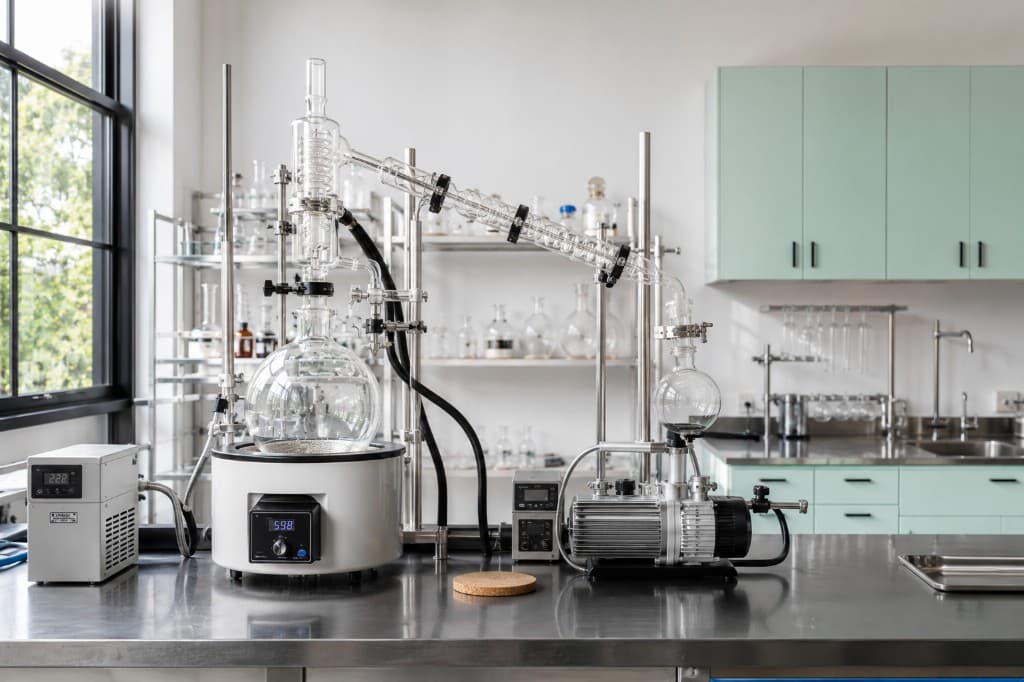
The centerpiece of any distillation operation is the primary Distillation Equipment system.
Depending on production goals, operators may use:
- Short-path distillation systems
- Wiped-film distillation systems
- Fractional distillation systems
These systems separate compounds based on differences in boiling points while maintaining cannabinoid integrity.
Key considerations include:
- Processing volume
- Throughput requirements
- Product specifications
- Scalability
Vacuum Pumps
Vacuum pressure is critical during cannabinoid distillation.
Vacuum Pumps reduce system pressure, allowing cannabinoids to evaporate at lower temperatures.
Benefits include:
- Reduced thermal degradation
- Improved cannabinoid preservation
- Increased efficiency
- Higher product quality
Without sufficient vacuum performance, cannabinoid degradation and reduced yields become more likely.
Vacuum systems are often considered one of the most important supporting components in a distillation workflow.
Heaters & Stirrers
Temperature consistency is essential for successful distillation.
Many operators utilize Heaters & Stirrers to maintain uniform heat distribution throughout processing.
Advantages include:
- Improved temperature control
- Reduced hot spots
- Better product consistency
- Enhanced process efficiency
Precise heating allows operators to target specific compounds while minimizing damage to cannabinoids.
Rotary Evaporators
Before distillation begins, many facilities use Rotary Evaporators to remove residual solvents from extracted material.
Rotovaps are commonly used during:
- Solvent recovery
- Winterization workflows
- Pre-distillation preparation
Benefits include:
- Faster solvent removal
- Improved process efficiency
- Reduced downstream workload
- Better preparation for refinement
For many extraction facilities, rotary evaporation serves as a critical bridge between extraction and distillation.
Recirculating Chillers
Temperature management extends beyond heating.
Recirculating Chillers help maintain cooling performance during solvent condensation and distillation processes.
Advantages include:
- Improved condensation efficiency
- Stable operating temperatures
- Enhanced equipment performance
- Greater process consistency
Chillers help ensure the entire system operates efficiently under varying production conditions.
Understanding the Cannabis Distillation Workflow
A successful distillation operation involves multiple stages.
Step 1: Extraction
Cannabinoids are initially extracted from plant material using methods such as:
- Ethanol extraction
- Hydrocarbon extraction
- CO2 extraction
The resulting crude oil contains cannabinoids along with unwanted compounds.
Step 2: Winterization
Winterization removes fats, lipids, and waxes from the crude extract.
This process improves the efficiency of downstream refinement.
Step 3: Solvent Recovery
Residual solvents are removed using solvent recovery systems and rotary evaporators.
Proper solvent removal is essential before distillation begins.
Step 4: Distillation
The purified extract enters the distillation system where cannabinoids are separated and concentrated.
This stage produces the high-purity distillate used in numerous cannabis products.
Step 5: Product Formulation
Distillates may then be used to manufacture:
- Vape cartridges
- Edibles
- Tinctures
- Concentrates
- Topicals
Each stage depends on properly selected cannabis distillation equipment.
Factors to Consider When Selecting Cannabis Distillation Equipment
Every facility has unique production requirements.
Production Volume
Small laboratories and large-scale commercial facilities require different equipment capacities.
Consider:
- Daily throughput
- Batch sizes
- Growth projections
Product Goals
Different products may require varying levels of refinement and cannabinoid purity.
Facility Infrastructure
Evaluate:
- Electrical capacity
- HVAC systems
- Utility access
- Available floor space
Scalability
Selecting equipment with future growth in mind can reduce upgrade costs later.
Common Cannabis Distillation Equipment Mistakes
Avoid these common pitfalls.
Underestimating Vacuum Requirements
Insufficient vacuum performance can reduce efficiency and affect product quality.
Choosing Equipment Based Only on Cost
Lower-priced systems may result in higher long-term operating expenses.
Ignoring Future Growth
Facilities often outgrow equipment sooner than expected.
Overlooking Supporting Equipment
Distillation performance depends on integrated systems including pumps, chillers, heaters, and solvent recovery equipment.
Inadequate Process Planning
Even premium equipment can underperform when workflows are poorly designed.
Building an Efficient Distillation Lab
An effective distillation operation balances equipment performance, workflow efficiency, and scalability.
Best practices include:
- Designing around process flow
- Selecting appropriately sized equipment
- Maintaining precise temperature control
- Utilizing high-quality vacuum systems
- Planning for future expansion
- Integrating all support systems effectively
Facilities that prioritize workflow and equipment compatibility often achieve better yields and lower operating costs.
Key Takeaways
- Cannabis distillation equipment is essential for producing high-purity cannabinoid distillates.
- Distillation removes impurities and increases cannabinoid concentration.
- Vacuum pumps help protect cannabinoids from heat-related degradation.
- Rotary evaporators support solvent removal before distillation.
- Heaters, stirrers, and chillers improve process control and consistency.
- Equipment selection should align with production goals and facility requirements.
- Proper system integration improves efficiency and product quality.
- Scalable equipment helps support long-term operational growth.
FAQs
What is cannabis distillation equipment used for?
Cannabis distillation equipment is used to purify cannabinoid extracts by removing unwanted compounds and concentrating cannabinoids. The process helps produce high-potency distillates for various cannabis products. Proper equipment selection is critical for achieving consistent quality and efficiency.
Why are vacuum pumps important during cannabis distillation?
Vacuum pumps lower system pressure, allowing cannabinoids to vaporize at lower temperatures. This helps reduce thermal degradation and preserve product quality. Effective vacuum systems also improve overall distillation efficiency.
Are rotary evaporators necessary before distillation?
In many workflows, rotary evaporators are used to remove residual solvents before distillation begins. This prepares the extract for refinement and reduces the workload on distillation equipment. They are commonly used in both laboratory and commercial extraction environments.
What type of distillation equipment is most commonly used in cannabis processing?
Short-path and wiped-film distillation systems are among the most common options. Each offers unique advantages depending on production volume and product goals. The ideal system depends on throughput requirements and operational objectives.
How do recirculating chillers improve distillation performance?
Recirculating chillers maintain stable temperatures during condensation and solvent recovery processes. Consistent cooling improves efficiency and system reliability. Proper temperature management contributes to higher-quality distillate production.