Laboratory Equipment Replacement Parts: Which Spares Should You Keep on Hand?
Learn which laboratory equipment replacement parts to keep on hand to reduce downtime, simplify maintenance, and avoid costly production delays.
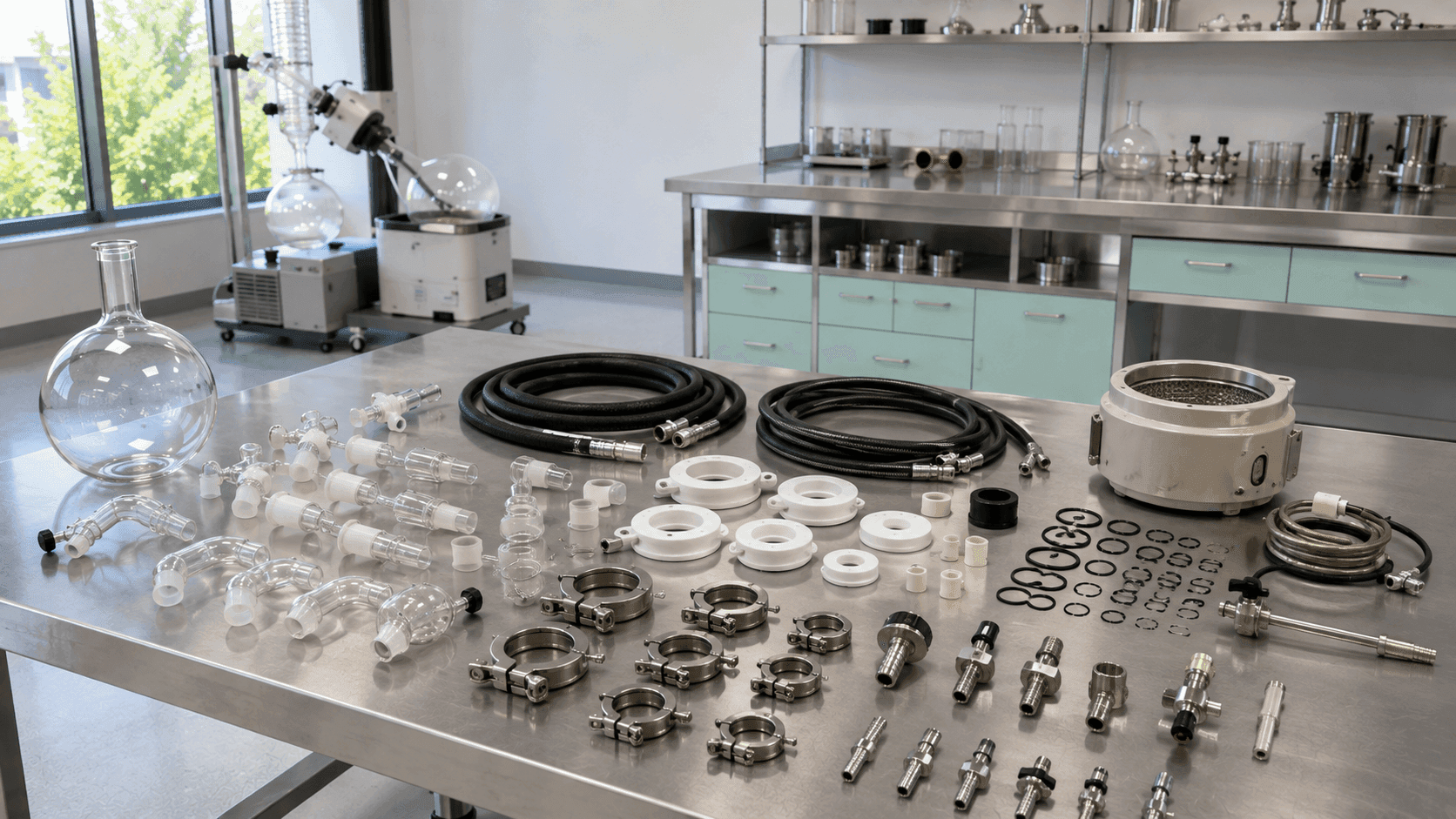
Introduction
Laboratory equipment rarely breaks down at a convenient time. A worn vacuum seal, damaged gasket, failed hose, or broken glass component can turn a productive day into hours—or days—of waiting for replacement parts.
Keeping the right laboratory equipment replacement parts on hand can dramatically reduce that disruption. The trick isn't stocking every possible component. It's identifying inexpensive, frequently replaced, and operationally critical parts that can stop an entire workflow when they fail.
Green Lab Gear supplies laboratory equipment, accessories, and replacement components for processing facilities, research laboratories, and cannabis operations. Building a practical spare-parts inventory around your actual equipment can help technicians perform routine maintenance faster while reducing emergency orders.
This guide covers which laboratory equipment replacement parts deserve shelf space, how to prioritize spares, and how to create an inventory that protects uptime without turning your storeroom into an expensive parts museum.
TLDR – Quick Guide
- Keep frequently worn seals, gaskets, O-rings, tubing, and similar consumables available.
- Stock critical glass components when a breakage could shut down essential equipment.
- Vacuum pump consumables should reflect the pump model and manufacturer maintenance schedule.
- Rotary evaporator seals, glassware, tubing, and other model-specific wear components are useful spares.
- Prioritize inexpensive parts that can cause expensive downtime.
- Don't overstock costly components with low failure rates and short storage lives.
- Label parts with equipment model, part number, and storage requirements.
- Review spare-parts inventory during preventive maintenance instead of waiting for something to fail.
Detailed Breakdown
Why Keep Laboratory Equipment Replacement Parts in Stock?
A $20 component can bring a much more expensive piece of laboratory equipment to a standstill.
That makes spare-parts planning a question of downtime risk rather than simply component cost. If a small seal fails and the replacement takes several days to arrive, the true cost includes lost processing time, delayed testing, employee hours, and potentially missed production schedules.
A practical inventory of Laboratory Accessories & Parts can help laboratories:
- Reduce unexpected downtime
- Complete maintenance faster
- Avoid emergency shipping costs
- Maintain equipment more consistently
- Simplify troubleshooting
- Keep critical workflows running
The best spare-parts inventory is selective. Stock what you're realistically likely to need, not one of everything in the catalog.
Start With Seals, Gaskets, and O-Rings
Seals are among the first components worth evaluating for spare inventory because they're commonly exposed to compression, chemicals, temperature changes, movement, or vacuum.
Depending on your equipment, examples may include:
- O-rings
- Vacuum seals
- Gaskets
- Flange seals
- Shaft seals
- Lid seals
Even a small defect can affect vacuum performance or cause leakage.
Compatibility matters. Two O-rings that look almost identical can have different dimensions or material compositions, and substituting the wrong component can create new problems.
Keep manufacturer-approved or otherwise specified replacement parts identified by equipment model and part number.
Keep Common Tubing and Hose Components Available
Tubing is another relatively inexpensive component capable of creating disproportionate downtime.
Laboratory tubing can harden, discolor, crack, deform, or lose flexibility depending on the material, chemical exposure, temperature, and age.
Useful spares may include equipment-specific:
- Vacuum tubing
- Fluid-transfer tubing
- Cooling lines
- Hose connectors
- Clamps
- Fittings
Don't assume any tubing with the correct diameter is suitable. Chemical compatibility, vacuum rating, temperature range, and pressure requirements should match the application.
When tubing shows cracking, brittleness, deformation, or other deterioration, replace it according to manufacturer guidance rather than waiting for a leak.
Stock Critical Glassware Strategically
Glassware is one of the more obvious categories of laboratory equipment replacement parts, particularly for systems that can't operate without a specific flask, condenser, receiving vessel, or reactor component.
Glass can be damaged through impact, thermal stress, improper assembly, cleaning, or ordinary handling.
Keeping spares may be worthwhile for components that are:
- Frequently handled
- Essential for equipment operation
- Relatively prone to accidental breakage
- Difficult to substitute
- Associated with long replacement lead times
That doesn't mean every laboratory needs duplicates of every glass component. Prioritize the pieces whose failure would immediately stop an important process.
Inspect replacement glassware before installation and store it where it won't become damaged while waiting to save the day.
Vacuum Pump Replacement Parts and Consumables
Vacuum systems are essential to many laboratory processes, making Vacuum Pumps an important part of spare-parts planning.
Required spares depend heavily on pump design and manufacturer recommendations. Depending on the model, maintenance items could include seals, filters, oil or other service fluids, tubing, fittings, and manufacturer-specified wear components.
Start with the maintenance manual for each pump and create an equipment-specific list.
A useful approach is to classify pump parts according to:
- Routine replacement interval
- Typical wear rate
- Consequence of failure
- Supplier lead time
- Storage life
A critical part with a long lead time deserves more consideration than a rarely needed component available for next-day delivery.
What Rotary Evaporator Spares Should You Keep?
A rotary evaporator combines moving components, vacuum, glassware, seals, heating, and cooling, so several relatively small components can affect system performance.
For laboratories that rely heavily on Rotary Evaporators, useful spare categories may include:
- Vacuum seals
- Gaskets and O-rings
- Compatible tubing
- Clamps and connectors
- Frequently handled glass components
- Manufacturer-specified wear parts
The exact inventory should be model-specific.
For example, stocking a seal simply labeled "rotovap seal" isn't enough if your facility operates multiple models with different dimensions. Label each spare with the exact equipment model and manufacturer part number whenever possible.
One correctly identified spare beats a drawer full of mystery gaskets.
Don't Forget Basic Laboratory Support Items
Equipment downtime isn't always caused by a major mechanical failure. Missing connectors, damaged clamps, or unavailable support components can also interrupt work.
Review your Laboratory Support Equipment and identify smaller items that frequently move, wear, or become damaged.
Depending on your laboratory, useful inventory might include compatible:
- Clamps
- Connectors
- Fittings
- Fasteners
- Tubing accessories
- Equipment-specific hardware
These components are often relatively inexpensive and easy to store.
The key word, again, is compatible. Don't replace specified hardware with whatever happens to be in the maintenance drawer.
Which Parts Should Get the Highest Priority?
A simple risk-based system can prevent both understocking and overstocking.
Priority
Type of Spare
Suggested Approach
Critical
Failure completely stops essential equipment
Keep appropriate stock on-site
High
Common wear item that significantly reduces performance
Maintain routine inventory
Medium
Needed occasionally and readily available
Keep limited stock or reorder early
Low
Expensive, rarely fails, and is quickly available
Usually order when required
You can make this more precise by considering three variables: failure likelihood, downtime impact, and lead time.
A cheap part that fails frequently and takes two weeks to arrive is an obvious stocking candidate. An expensive component that almost never fails and is available locally may not be.
How Many Replacement Parts Should You Keep?
There's no universal number because inventory requirements depend on equipment usage and supply-chain conditions.
A laboratory running equipment continuously may need several replacement sets, while a small research facility using the same equipment occasionally may only require one emergency spare.
Consider:
- Number of identical machines
- Equipment operating hours
- Historical failure rate
- Preventive maintenance frequency
- Supplier lead times
- Shipping reliability
- Part shelf life
- Consequence of equipment downtime
Historical maintenance records are particularly valuable. If your laboratory replaced the same seal four times last year, that's much better inventory data than someone's best guess.
Organize Spare Parts by Equipment, Not Just Component Type
A box labeled "O-rings" is technically organized. It's also a fantastic way to spend 45 minutes trying to determine whether any of them actually fit.
Each replacement component should ideally be labeled with:
- Part name
- Part number
- Compatible equipment
- Equipment model
- Quantity
- Date received
- Storage requirements
- Reorder point
Barcode or digital inventory systems can help larger facilities, but even a simple spreadsheet is dramatically better than an unlabeled drawer.
Store sensitive components according to manufacturer requirements. Rubber, elastomers, filters, lubricants, and other materials may degrade when stored improperly.
Connect Spare Parts to Preventive Maintenance
Replacement inventory works best when it's integrated with your preventive maintenance program.
If a particular seal is scheduled for inspection or replacement every defined interval, the required part should already be available before maintenance begins.
A simple process looks like this:
This transforms spare-parts management from emergency reaction into routine planning.
Common Spare-Parts Inventory Mistakes
The first mistake is waiting for equipment to fail before ordering anything. That approach works perfectly—right until the part you need has a three-week lead time.
Another mistake is overstocking.
Laboratories sometimes purchase large quantities of parts "just in case," only to discover that the equipment is replaced, the components deteriorate in storage, or the inventory was never compatible with the actual model.
Other problems include:
- Failing to record part numbers
- Mixing components for different models
- Ignoring shelf-life requirements
- Using unverified substitutes
- Forgetting to reorder after a spare is consumed
- Storing fragile glassware poorly
- Keeping parts for equipment no longer in service
A quarterly inventory review can eliminate much of this clutter.
Build a Spare-Parts Kit for Critical Equipment
For equipment that would significantly disrupt operations if it stopped working, consider creating a dedicated spare-parts kit.
A kit might contain the most commonly needed seals, gaskets, tubing, fittings, and other approved wear components for one specific machine or equipment family.
This approach has two advantages.
First, technicians can find the correct parts quickly. Second, it becomes immediately obvious when the kit needs replenishment.
Combine the kit with the equipment manual, current parts list, and maintenance documentation, and troubleshooting becomes substantially less chaotic.
Key Takeaways
- Laboratory equipment replacement parts should be stocked according to failure risk, downtime impact, and supplier lead time.
- Seals, gaskets, O-rings, tubing, and fittings are often sensible items to keep available.
- Critical glassware may deserve backup inventory when breakage would stop an essential process.
- Vacuum pump spares should reflect the exact pump design and manufacturer maintenance recommendations.
- Rotary evaporator replacement parts should be matched to the specific equipment model.
- Inexpensive components capable of causing expensive downtime deserve high inventory priority.
- Every spare should be clearly labeled with its compatible equipment and part number.
- Storage conditions and component shelf life should be considered when determining inventory quantities.
- Spare-parts management should be integrated with preventive maintenance.
- A small, well-planned inventory is usually more valuable than shelves packed with unidentified components.
FAQs
What laboratory equipment replacement parts should I keep on hand?
Prioritize commonly worn and operationally critical components such as seals, gaskets, O-rings, tubing, fittings, and manufacturer-specified consumables. Critical glassware may also be worth stocking when its failure would completely stop an important process. The final list should be based on your specific equipment models, maintenance requirements, and supplier lead times.
How many replacement parts should a laboratory keep in stock?
The right quantity depends on equipment usage, historical failure rates, maintenance schedules, lead times, and the consequences of downtime. High-use laboratories may need several units of common wear parts, while occasional-use equipment may only justify one emergency spare. Set minimum inventory levels using actual maintenance data whenever possible.
What spare parts should I keep for a rotary evaporator?
Common categories can include vacuum seals, O-rings, gaskets, compatible tubing, clamps, connectors, glassware, and other manufacturer-specified wear components. Exact requirements vary by rotary evaporator model and configuration. Use the equipment manual and manufacturer part numbers to avoid stocking incompatible components.
Should I keep vacuum pump replacement parts in stock?
Yes, when the vacuum pump is critical to laboratory operations and certain maintenance items have meaningful lead times. The appropriate inventory depends on pump type and may include specified filters, seals, service fluids, tubing, fittings, or other wear components. Follow the pump manufacturer's maintenance schedule when determining what to stock.
How should laboratory replacement parts be organized?
Label parts with the component name, manufacturer part number, compatible equipment model, quantity, and any relevant storage information. Set reorder points for frequently consumed or critical items and update inventory whenever a part is used. Organizing spares by equipment can also help technicians quickly locate the correct component during maintenance.