Magnetic Stirrer Distillate Guide: How Is It Used in Cannabis Processing?
Learn how magnetic stirrer distillate processing works, when it is useful, its limitations, and how to choose suitable lab equipment.
Introduction
Cannabis distillate creates an interesting mixing problem: it's thick, temperature-sensitive, and often difficult to blend uniformly when cool. That makes equipment selection more important than simply dropping a stir bar into a flask and turning a dial.
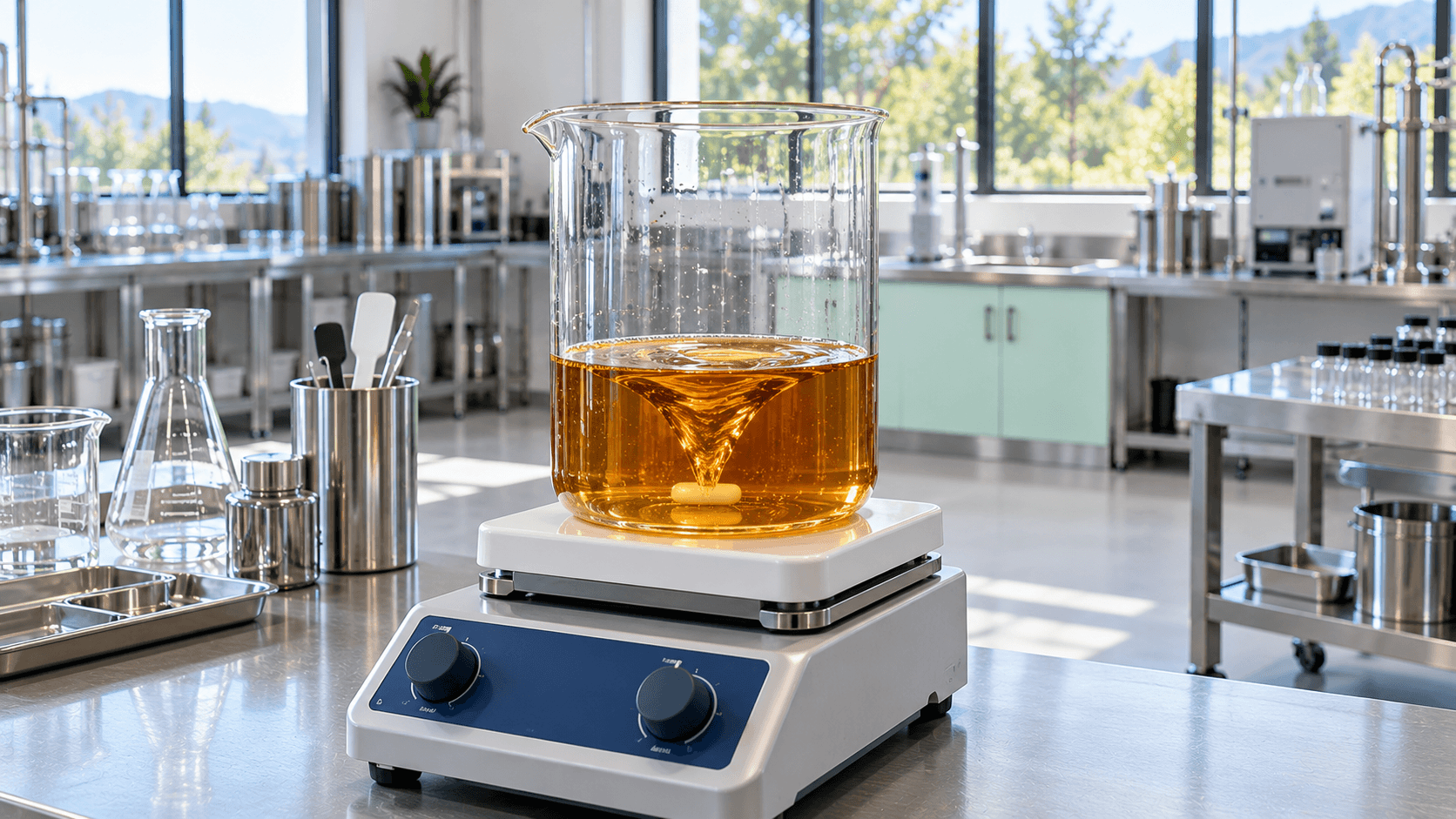
A magnetic stirrer distillate setup combines magnetic agitation with, in many cases, controlled heating to support laboratory mixing and handling. Gentle warming can reduce the resistance of viscous material to mixing, while the rotating magnetic stir bar helps circulate compatible formulations without requiring a mixer shaft through the top of the vessel.
But there's an important limitation: magnetic stirrers aren't designed for every viscosity, vessel size, or production scale.
GreenLabGear supplies laboratory heating, stirring, and distillation equipment for cannabis processing and other laboratory applications. Choosing the right magnetic stirrer distillate setup starts with understanding where stirring fits into the broader process—and when another mixing technology makes more sense.
TLDR – Quick Guide
- A magnetic stirrer distillate setup can provide simultaneous heating and agitation for compatible cannabis-processing applications.
- Cannabis distillate can become highly viscous, making magnetic coupling and circulation more difficult.
- Controlled warming can make some viscous materials easier to mix, but process temperatures should follow validated product requirements.
- Vessel size, working volume, viscosity, stir-bar design, and stirring speed all influence performance.
- A hot plate stirrer is different from distillation equipment; it does not perform the distillation process by itself.
- Higher-viscosity or larger-volume applications may require overhead stirring, homogenization, or other mixing technologies.
- Temperature measurement matters because hot-plate surface temperature isn't necessarily the same as material temperature.
- Equipment should be selected around the complete workflow rather than maximum temperature or volume specifications alone.
Detailed Breakdown
What Is a Magnetic Stirrer Used for in Cannabis Processing?
A magnetic stirrer uses a rotating magnetic field beneath a vessel to spin a compatible magnetic stir bar inside it.
When the equipment also includes a heating surface, the same unit can provide heating and agitation. GreenLabGear's selection of Heaters, Stirrers & Hot Plates includes equipment designed for different laboratory heating and mixing applications.
In cannabis-processing environments, a magnetic stirrer may be considered for compatible small- to moderate-scale mixing tasks where maintaining circulation while heating is useful.
The key word is compatible.
Cannabis distillate can be considerably more viscous than the low-viscosity solutions commonly associated with magnetic stirring. As resistance increases, a magnetic stir bar may struggle to maintain effective circulation.
That means a magnetic stirrer should be selected based on the material being mixed—not simply because the vessel fits on the plate.
Why Cannabis Distillate Can Be Difficult to Mix
Viscosity is one of the central challenges in magnetic stirrer distillate applications.
At cooler conditions, distillate can resist flow strongly. This creates greater resistance against the rotating stir bar.
If the magnetic drive can't maintain coupling, several problems can appear:
- The stir bar stops rotating smoothly.
- The bar jumps or rattles.
- Mixing becomes localized around the stir bar.
- Bulk material remains poorly circulated.
- Increasing speed causes decoupling instead of better mixing.
This is why maximum stirring volume can be misleading.
A stirrer advertised for a large volume of water won't necessarily provide equivalent mixing performance with the same volume of a substantially more viscous material.
Viscosity matters just as much as liters.
How Heating Changes Mixing Behavior
Heating and stirring are frequently combined because temperature can change material viscosity.
As an appropriate material warms, reduced viscosity may make circulation easier. That can allow a magnetic stirrer to maintain more effective movement than it could with the same material at a lower temperature.
However, more heat isn't automatically better.
Cannabis-derived materials and formulation ingredients can have temperature-dependent properties, and excessive or poorly controlled heating may negatively affect product quality. Appropriate limits depend on the specific material, formulation, equipment, and validated process.
For that reason, a magnetic stirrer distillate workflow should emphasize controlled temperature management, not simply maximum heater output.
Hot Plate Temperature vs Material Temperature
One of the easiest mistakes is assuming the temperature shown by the heating equipment perfectly represents the distillate temperature.
It may not.
Heat travels from the plate into the vessel and then through the material. At the same time, energy is lost to the surrounding environment, and temperature gradients can develop within the vessel.
The actual product temperature can therefore differ from the heating-surface temperature.
For processes where material temperature is important, use an appropriate temperature-measurement approach and follow the equipment manufacturer's instructions.
Some laboratory heating systems support external temperature probes or sensors. Where available and appropriate, direct process-temperature monitoring can provide more useful information than relying solely on the heating-surface setting.
Choosing the Right Stirring Capacity
GreenLabGear's 10L Heater & Stirrer represents one capacity class available for laboratory heating and stirring applications.
But a nominal capacity shouldn't be interpreted as a guarantee that every 10-liter material can be stirred equally well.
When evaluating a magnetic stirrer, consider:
Factor
Why It Matters
Working volume
Determines the amount of material being mixed
Viscosity
Higher resistance makes magnetic stirring harder
Vessel geometry
Influences circulation and magnetic coupling
Stir-bar design
Affects mixing behavior and coupling
Speed range
Determines available agitation conditions
Heating capability
Influences viscosity and temperature control
Plate dimensions
Must accommodate the intended vessel
Process duration
Can affect equipment and temperature requirements
Evaluate specifications under conditions resembling your intended application whenever possible.
The maximum volume printed on a specification sheet is a starting point—not a universal performance promise.
Stir Bar Selection Can Affect Performance
The stir bar is tiny compared with the rest of the equipment, but it has an outsized effect on mixing.
Size, shape, magnetic strength, and compatibility with the vessel can influence how successfully rotational force is transferred into the material.
A poorly matched bar can lose synchronization with the magnetic drive, especially as viscosity or stirring speed increases.
Bigger isn't automatically better either.
The goal is to select a stir bar appropriate for the vessel, material, and equipment according to manufacturer guidance.
Stable circulation beats chaotic spinning.
Don't Use RPM as Your Only Mixing Metric
It's tempting to assume that more RPM equals better mixing.
Not necessarily.
If speed is increased beyond what the magnetic coupling can support, the stir bar may lose synchronization. Excessive speed can also create undesirable vortexing or introduce other process problems depending on the formulation.
The useful speed is one that maintains stable, effective circulation for the intended material.
For viscous distillate, simply cranking the speed higher may accomplish very little.
This is another reason to judge mixing by actual process performance rather than the largest RPM number in a product listing.
Magnetic Stirring vs Overhead Stirring
Magnetic stirring has several practical advantages.
There is no mixer shaft passing through the top of the vessel, equipment can be compact, and combining heat with stirring can simplify a benchtop setup.
Its limitations become more obvious as viscosity and batch size increase.
An overhead stirrer mechanically drives an impeller or mixing element inside the material. Depending on the equipment and process, this can provide substantially greater torque for demanding formulations.
A general comparison looks like this:
Magnetic Stirrer
Overhead Stirrer
Compact benchtop design
More mechanical components
No drive shaft through vessel top
Uses a shaft and mixing element
Convenient for compatible volumes
Can suit more demanding mixing loads
Magnetic coupling limits available torque
Direct mechanical drive provides higher torque options
Heating can be integrated into hot plate
Heating generally requires separate equipment
For thick material that repeatedly causes stir-bar decoupling, upgrading to a stronger magnetic stirrer isn't always the answer.
The application may simply require a different mixing method.
Magnetic Stirring vs Homogenization
A magnetic stirrer and homogenizer shouldn't be treated as interchangeable.
Magnetic stirring primarily creates bulk circulation and blending. Homogenization is designed for more intensive processing where reducing droplets, dispersing phases, or creating a more uniform mixture requires higher shear.
For straightforward blending of compatible materials, a magnetic stirrer may be sufficient.
For formulations where dispersion quality or emulsion characteristics are critical, a homogenizer may be more appropriate.
Start with the desired final product characteristics, then choose the mixing mechanism.
Where Does Distillation Equipment Fit?
A common source of confusion is the relationship between a magnetic stirrer and cannabis distillation.
They are different equipment categories.
Distillation Equipment is designed to separate or refine materials using differences in volatility under a controlled process. A magnetic stirrer provides agitation and, when combined with a hot plate, heating.
A magnetic stirrer doesn't turn an ordinary vessel into professional cannabis distillation equipment.
GreenLabGear's Cannabis Distillation Equipment guide provides a broader overview of equipment considerations for distillation workflows.
The distinction matters when planning a facility because mixing, heating, distillation, and formulation are separate process requirements even when they occur within the same production operation.
Match Vessel Geometry to the Stirrer
Vessel selection also affects magnetic stirring performance.
The vessel must sit appropriately relative to the magnetic drive, while the stir bar needs enough space to rotate and produce useful circulation.
Consider:
- Vessel diameter
- Bottom shape
- Material
- Working volume
- Stir-bar clearance
- Contact with the heating surface
A vessel dramatically larger than the active magnetic or heating area may produce less uniform results.
Likewise, equipment intended for round-bottom vessels may use a different heating arrangement than a conventional flat hot plate.
Choose the heater, stirrer, and vessel as a system.
When Is a Magnetic Stirrer Distillate Setup the Wrong Choice?
A magnetic stirrer isn't the right tool simply because you're processing distillate.
Consider another mixing method when the material is too viscous to maintain reliable magnetic coupling, the batch volume exceeds the equipment's practical capability, or the process requires greater shear than magnetic stirring provides.
Warning signs include repeated stir-bar decoupling, poor circulation away from the center of the vessel, significant temperature nonuniformity, and extremely long mixing times.
Don't try to solve every one of these problems by increasing temperature or RPM.
Sometimes the equipment is telling you, quite clearly, that it has reached its limits.
Safety and Material Compatibility
Heating cannabis-processing materials requires equipment appropriate for the intended environment.
Laboratories should consider chemical compatibility, vessel ratings, electrical requirements, hot-surface hazards, ventilation, and manufacturer operating instructions.
A standard laboratory hot plate or magnetic stirrer should not automatically be considered suitable for a hazardous environment containing flammable solvent vapors.
If flammable solvents may be present, facility and equipment selection requires appropriate professional review, including consideration of applicable electrical classifications, ventilation, fire protection, and other safety requirements.
Distillate handling and solvent extraction may happen within the same overall facility, but that doesn't mean ordinary benchtop equipment belongs in every processing area.
How to Choose a Magnetic Stirrer for Distillate Applications
Start by documenting the actual process rather than browsing equipment by price.
Define:
Then compare those requirements against manufacturer specifications.
For applications near the limits of magnetic stirring, discuss the material and process requirements with the equipment supplier before purchasing.
A properly sized unit costs less than buying an undersized stirrer and then replacing it when the stir bar spends more time rattling than mixing.
Key Takeaways
- A magnetic stirrer distillate setup can combine heating and agitation for compatible cannabis-processing applications.
- Cannabis distillate viscosity can make magnetic stirring considerably more challenging than mixing low-viscosity laboratory solutions.
- Controlled warming may reduce viscosity and improve mixing, but temperature should remain within validated process requirements.
- Nominal stirring volume alone isn't enough to determine equipment suitability.
- Vessel geometry, stir-bar design, viscosity, speed, and temperature all influence performance.
- Hot-plate temperature shouldn't automatically be treated as actual material temperature.
- Increasing RPM doesn't guarantee better mixing and can cause magnetic decoupling.
- High-viscosity or larger-volume processes may require overhead stirring or other mixing equipment.
- Magnetic stirring and homogenization perform different processing functions.
- A magnetic stirrer is not a substitute for dedicated distillation equipment.
- Equipment used around flammable solvents or vapors must be appropriate for the environment and applicable safety requirements.
FAQs
Can you use a magnetic stirrer for cannabis distillate?
A magnetic stirrer can be used for compatible cannabis-processing mixing applications when the material, vessel, volume, and viscosity fall within the equipment's capabilities. High viscosity can make maintaining magnetic coupling and adequate circulation more difficult. Evaluate actual process requirements rather than relying solely on the stirrer's maximum volume specification.
Why is cannabis distillate difficult to stir?
Cannabis distillate can have relatively high viscosity, particularly under cooler conditions, which increases resistance against the rotating stir bar. If resistance becomes too great, the bar may lose synchronization with the magnetic drive or provide poor bulk circulation. Appropriate temperature management and correctly selected mixing equipment can help address the challenge.
Does heating make distillate easier to mix?
Controlled warming can reduce the viscosity of compatible materials and make circulation easier. The appropriate temperature depends on the specific product, formulation, equipment, and validated processing requirements. More heat should not be used as a substitute for properly sized mixing equipment.
What size magnetic stirrer is best for distillate?
The appropriate size depends on working volume, viscosity, vessel geometry, temperature requirements, and the mixing performance needed by the process. A nominal maximum volume doesn't guarantee adequate performance with a highly viscous material at that same volume. Choose equipment using manufacturer specifications and application-specific requirements.
Is a magnetic stirrer the same as cannabis distillation equipment?
No, a magnetic stirrer provides mixing and may include a heating function, while distillation equipment performs a separation or refinement process based on volatility. The two equipment categories can serve different roles within a cannabis-processing facility. Select each according to the specific stage and objective of the production workflow.