How to Choose the Right Recirculating Chiller for Your Extraction System
Learn how to choose the right recirculating chiller for extraction workflows, temperature control, and cannabis processing efficiency.
Introduction
Temperature control is one of the most important but underestimated parts of cannabis extraction. While many processors focus heavily on extraction systems and solvent recovery, unstable cooling infrastructure can quietly create workflow bottlenecks, inconsistent product quality, and operational inefficiencies across the entire lab.
This is why selecting the right recirculating chiller for extraction workflows is critical.
Recirculating chillers help maintain stable temperatures during:
- extraction
- solvent recovery
- condensation
- post-processing
- refinement
Without dependable thermal control, cannabis labs may experience:
- inconsistent extraction conditions
- reduced solvent efficiency
- terpene degradation
- unstable condensation
- lower throughput consistency
The right chiller setup depends on:
- extraction method
- processing volume
- cooling demand
- workflow integration
- future scalability
At Green Lab Gear, our extraction and post-processing equipment ecosystem is designed to support scalable cannabis workflows with dependable temperature management and practical operational integration.
Understanding how chillers affect extraction performance can help facilities build more efficient and stable production environments while avoiding costly workflow limitations later.
TLDR – Quick Guide
- Chillers are critical for extraction efficiency, consistency, and solvent recovery.
- Temperature requirements vary by extraction method and equipment.
- Undersized chillers can create production bottlenecks.
- Focus on cooling capacity, operating temperature range, and reliability.
- Consider future expansion when selecting a chiller.
- A properly sized chiller protects both product quality and equipment performance.
Detailed Breakdown
What Is a Recirculating Chiller?
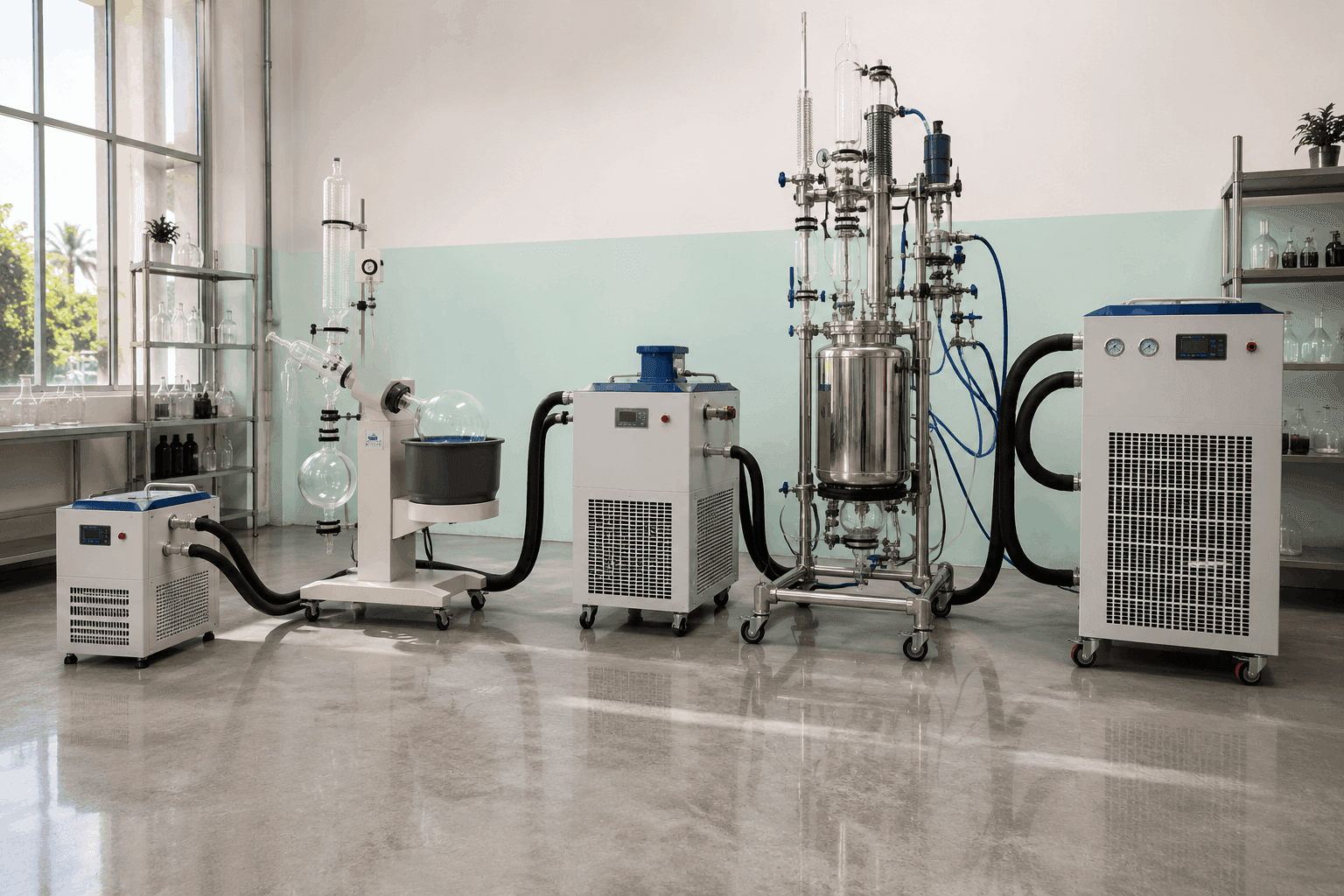
Recirculating Chillers are temperature-control systems designed to circulate cooled fluid through extraction and post-processing equipment.
These systems help maintain stable thermal conditions throughout cannabis processing workflows.
Chillers are commonly integrated into:
- extraction systems
- condensers
- reactors
- rotary evaporators
- solvent recovery equipment
The cooling fluid absorbs heat from connected equipment and cycles it back through the chiller for temperature regulation.
Stable cooling helps improve:
- process consistency
- solvent management
- operational reliability
- equipment efficiency
As extraction throughput increases, cooling infrastructure becomes increasingly important.
Why Temperature Control Matters in Cannabis Extraction
Temperature directly affects:
- cannabinoid preservation
- terpene retention
- solvent behavior
- extraction efficiency
- condensation performance
Poor thermal control can create:
- unstable extraction conditions
- inconsistent recovery
- reduced solvent efficiency
- lower product quality
Different extraction methods often require different temperature ranges depending on:
- solvent type
- throughput volume
- post-processing workflow
Facilities that invest in stable cooling infrastructure typically achieve:
- more predictable production
- stronger extraction consistency
- improved operational efficiency
Temperature management is not secondary equipment infrastructure. It is a core part of workflow stability.
How Chillers Support Extraction Workflows
Solvent Temperature Stability
Many cannabis extraction workflows rely on chilled solvents for improved extraction performance.
Stable temperatures help:
- reduce unwanted compound extraction
- improve cannabinoid selectivity
- support terpene preservation
- stabilize solvent behavior
Cold extraction environments are especially important in ethanol workflows where lower temperatures help reduce:
- chlorophyll pickup
- wax extraction
- lipid contamination
Chillers help maintain these controlled solvent conditions consistently.
Condensation Support
Condensation systems rely heavily on proper cooling performance.
Without stable chilling, facilities may experience:
- inefficient solvent recovery
- vapor instability
- slower recovery cycles
- throughput bottlenecks
Efficient cooling improves:
- condensation speed
- solvent recovery consistency
- workflow reliability
As throughput increases, cooling demand often rises significantly.
Rotary Evaporators and Cooling Requirements
Rotary Evaporators rely heavily on chillers for efficient solvent recovery.
Rotary evaporation uses:
- controlled heat
- vacuum pressure
- cooled condensers
The condenser must remain cold enough to efficiently convert vaporized solvent back into liquid form.
Poor cooling performance can reduce:
- recovery efficiency
- throughput speed
- solvent condensation consistency
This often creates:
- slower workflows
- operational bottlenecks
- unstable recovery cycles
As solvent recovery volume increases, rotary evaporator cooling demands become more significant.
Balanced cooling infrastructure is essential for maintaining stable post-processing efficiency.
Glass Reactors and Thermal Stability
Glass Reactors commonly depend on recirculating chillers for controlled temperature management during:
- winterization
- formulation
- cannabinoid isolation
- refinement workflows
Glass reactors use jacketed temperature-control systems that circulate chilled fluid around the vessel.
Stable thermal management helps improve:
- processing precision
- formulation consistency
- cannabinoid preservation
- workflow control
Temperature fluctuations inside reactor systems may affect:
- reaction stability
- refinement quality
- product consistency
Reliable chillers help maintain more controlled and repeatable post-processing conditions.
How to Choose the Right Recirculating Chiller for Extraction
Evaluate Total Cooling Load
One of the biggest mistakes cannabis labs make is sizing chillers only for one machine instead of evaluating total workflow demand.
Facilities should calculate:
- extractor cooling requirements
- condenser demand
- reactor cooling load
- solvent recovery volume
- future expansion needs
Undersized chillers often create:
- unstable temperatures
- reduced efficiency
- inconsistent processing
Balanced cooling capacity is critical for scalable extraction workflows.
Consider Temperature Range
Different workflows require different cooling temperatures.
Labs should evaluate:
- minimum operating temperatures
- thermal stability requirements
- solvent compatibility
- environmental conditions
Some extraction workflows require extremely low temperatures for:
- chilled ethanol extraction
- terpene preservation
- condensation efficiency
Choosing the wrong temperature range may limit workflow performance significantly.
Plan for Future Scalability
Many facilities purchase chillers based only on current production volume.
As extraction throughput increases, cooling demand often grows faster than expected.
Scalable cooling systems help facilities:
- expand production gradually
- maintain workflow stability
- avoid costly infrastructure replacement
Planning moderate future growth usually creates stronger long-term operational efficiency.
Common Chiller Selection Mistakes
Buying Based Only on Price
Low-cost chillers may struggle to maintain stable cooling under demanding extraction workloads.
Poor cooling performance often creates:
- inconsistent extraction conditions
- solvent instability
- operational downtime
Reliable thermal infrastructure provides stronger long-term value.
Ignoring Workflow Integration
Some facilities purchase chillers without evaluating:
- total cooling demand
- future equipment additions
- throughput coordination
Cooling infrastructure should support the full extraction ecosystem rather than isolated machines alone.
Underestimating Recovery Cooling Needs
Solvent recovery systems often require more cooling capacity than operators initially expect.
As throughput scales, recovery cooling demand increases significantly.
Facilities that underestimate condenser requirements frequently experience:
- slower recovery cycles
- workflow bottlenecks
- reduced operational efficiency
Building a Stable Cooling Workflow
Efficient extraction environments integrate cooling systems into every major stage of production.
Stable cooling infrastructure supports:
- extraction consistency
- solvent recovery
- refinement precision
- throughput stability
Facilities that prioritize coordinated thermal management often achieve:
- stronger operational reliability
- better cannabinoid preservation
- improved scalability
- lower workflow disruption
Cooling infrastructure should always be viewed as a central production asset rather than secondary support equipment.
Key Takeaways
Choosing the right recirculating chiller for extraction workflows is essential for maintaining stable cannabis processing environments and efficient post-processing performance.
Recirculating chillers help support:
- solvent temperature stability
- extraction consistency
- condenser performance
- reactor thermal control
- workflow scalability
Equipment such as rotary evaporators and glass reactors rely heavily on dependable cooling infrastructure for stable operation and efficient processing.
At Green Lab Gear, our extraction and post-processing equipment ecosystem is designed to support scalable cannabis workflows with dependable thermal management and practical operational integration.
FAQs
What does a recirculating chiller do in cannabis extraction?
A recirculating chiller helps maintain stable temperatures during extraction and post-processing workflows. It circulates cooled fluid through connected equipment to regulate thermal conditions. Stable cooling improves extraction consistency and operational efficiency.
Why are chillers important for rotary evaporators?
Rotary evaporators rely on chilled condensers to recover solvents efficiently during evaporation. Poor cooling performance can reduce condensation efficiency and slow solvent recovery cycles. Stable chilling improves throughput and recovery consistency.
How do chillers support glass reactors?
Glass reactors use jacketed cooling systems that circulate chilled fluid around the vessel. Stable thermal control improves refinement precision and formulation consistency. Temperature management is critical during winterization and cannabinoid processing workflows.
How do I choose the right recirculating chiller for extraction?
Labs should evaluate cooling load, temperature range, workflow integration, and future scalability. The ideal system depends on extraction throughput and total processing demand. Balanced cooling infrastructure supports stronger long-term operational efficiency.
What happens if a cannabis lab uses an undersized chiller?
Undersized chillers may struggle to maintain stable temperatures during extraction and solvent recovery workflows. This can create inconsistent processing conditions and operational bottlenecks. Poor cooling performance may also reduce solvent recovery efficiency and product consistency.