Vacuum Pump Accessories: Which Components Does Your Lab Setup Need?
Learn which vacuum pump accessories your lab needs, from tubing and traps to gauges, filters, fittings, and maintenance parts.
Introduction
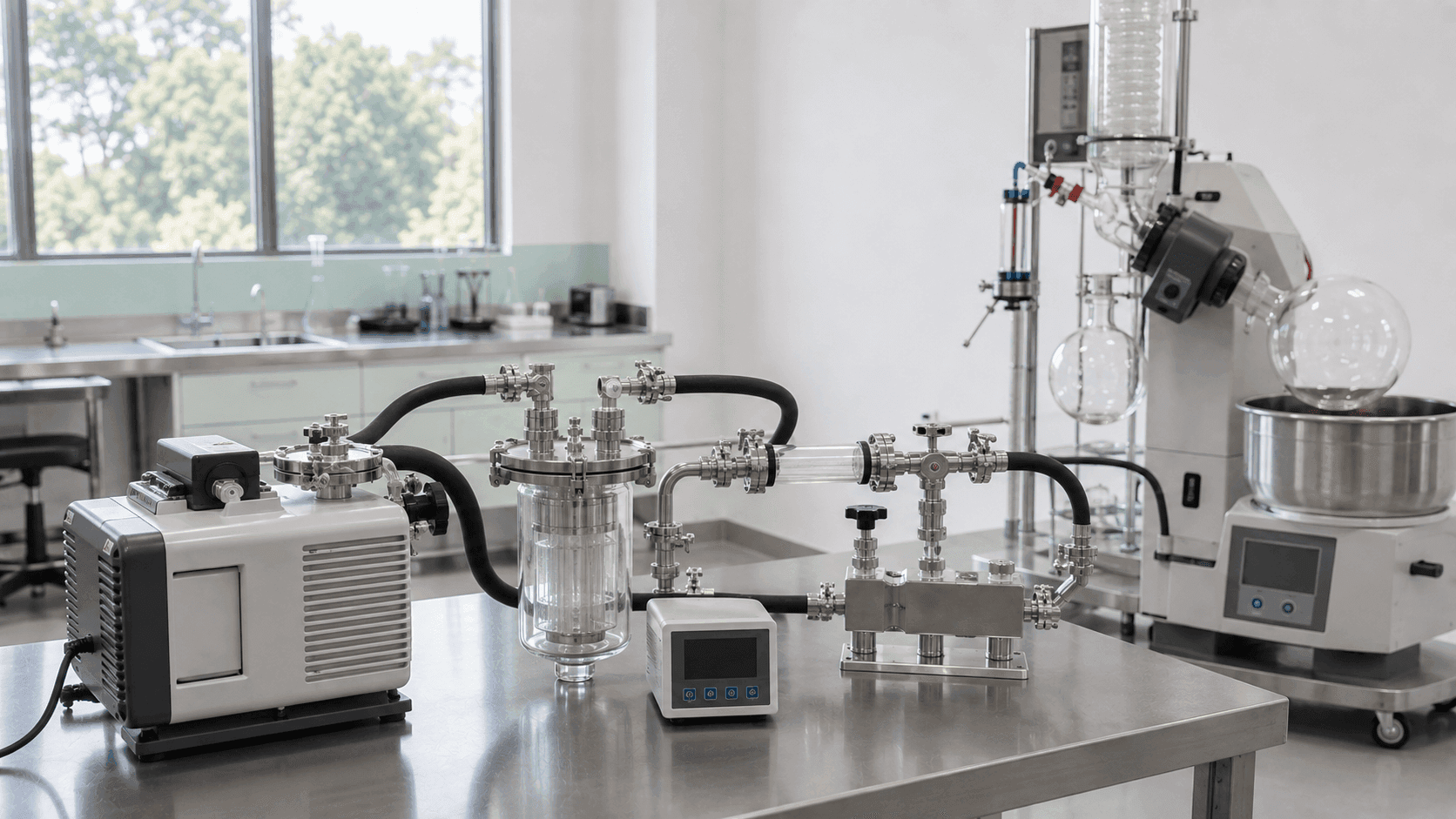
A vacuum pump may be the heart of a laboratory vacuum system, but the pump alone doesn't make the setup work. Tubing, fittings, traps, gauges, valves, filters, and other vacuum pump accessories can determine whether your system reaches the required vacuum level, protects the pump from contamination, and operates reliably day after day.
This matters in laboratories running rotary evaporation, vacuum distillation, filtration, solvent recovery, and other reduced-pressure processes. A high-quality pump connected with poorly matched tubing or leaking fittings can still produce frustratingly poor performance.
Green Lab Gear supplies vacuum pumps, laboratory equipment, and replacement components for processing and research environments. Building an effective vacuum system starts by matching the pump and accessories to the application rather than collecting components and hoping they play nicely together.
This guide covers the most important vacuum pump accessories, what each component does, and how to decide which ones your laboratory actually needs.
TLDR – Quick Guide
- Choose vacuum-rated tubing compatible with the chemicals, temperatures, and vacuum levels in your process.
- Use correctly sized fittings, connectors, and clamps to minimize leaks and flow restrictions.
- Vacuum gauges help operators monitor actual system pressure instead of guessing from pump behavior.
- Cold traps or other appropriate inlet protection can help prevent vapors and condensates from reaching certain pumps.
- Filters may help protect equipment depending on the pump type and process.
- Control valves can make vacuum adjustment, isolation, and system operation easier.
- Keep commonly used seals, O-rings, tubing, and other wear components available as spares.
- Always verify accessory compatibility with the specific vacuum pump and laboratory application.
Detailed Breakdown
Why Vacuum Pump Accessories Matter
A pump's specifications describe what the pump can achieve under defined conditions. They don't guarantee that your complete laboratory system will perform at the same level.
Every connection between the Vacuum Pumps and process equipment introduces variables. Tubing diameter, hose length, fittings, seals, valves, vapor loads, and leaks can all influence real-world performance.
The right accessories can help:
- Maintain vacuum integrity
- Protect pumps from process contamination
- Monitor system pressure
- Improve process control
- Simplify maintenance
- Reduce unplanned downtime
- Make equipment connections more reliable
The goal isn't to add as many components as possible. Every accessory should solve a specific process or equipment requirement.
Start With the Right Vacuum Tubing
Tubing looks simple, but it's one of the most important vacuum pump accessories in the system.
Ordinary flexible tubing may collapse under vacuum or prove incompatible with solvents and other process chemicals. Laboratory vacuum tubing should be selected for the intended operating conditions.
Consider:
- Vacuum rating
- Internal diameter
- Wall thickness
- Chemical compatibility
- Temperature range
- Flexibility
- Connection type
Tubing diameter deserves particular attention. An unnecessarily narrow line can restrict conductance and negatively affect performance, especially over longer distances.
Keep runs reasonably short and direct where practical. Long hoses, unnecessary bends, and restrictive connections can make a capable pump perform like a much less capable one.
Fittings, Connectors, and Clamps
A vacuum system is only as leak-tight as its connections.
Fittings and adapters allow pumps, tubing, vessels, traps, gauges, and other equipment to work together. The correct components depend on the connection standards and sizes used by your equipment.
Common accessory categories include:
- Hose adapters
- Vacuum fittings
- Connectors
- Clamps
- Flanges
- Reducers
- Tees
- Sealing components
When sourcing Laboratory Accessories & Parts, verify dimensions and material compatibility rather than assuming two components that look similar are interchangeable.
Avoid creating a chain of adapters unless necessary. Every additional connection creates another potential leak point.
Vacuum Gauges: Know What Your System Is Actually Doing
Without a suitable vacuum gauge, troubleshooting often becomes guesswork.
A gauge lets operators measure pressure within the system and determine whether the equipment is reaching and maintaining the vacuum required for the process.
This information can help identify:
- System leaks
- Poor pump performance
- Process changes
- Blocked or restricted lines
- Unexpected vapor loads
The appropriate gauge technology and measurement range depend on the vacuum level you're trying to monitor.
Gauge placement matters as well. Pressure measured directly at the pump inlet may not perfectly represent conditions at the process vessel when tubing and components create restrictions between them.
For process control, measurement should provide meaningful information about conditions where they matter.
Vacuum Traps and Condensers
In many laboratory applications, the gas entering a pump isn't simply clean air. It can contain solvent vapor, moisture, or other process materials.
An appropriately selected trap or condenser positioned upstream of the pump can help capture condensable vapors before they reach the pump.
This may help:
- Reduce pump contamination
- Protect internal components
- Reduce solvent entering pump exhaust
- Improve maintenance intervals
- Support cleaner operation
Trap selection depends on the substances being handled and the process conditions.
Cold traps also require appropriate operating procedures. A trap can lose effectiveness as it fills, and collected materials must be handled according to applicable laboratory and chemical-safety procedures.
Filters and Pump Protection
Filters can be useful in some vacuum systems, but they're not universal accessories that every laboratory should install automatically.
Depending on pump design and application, filters may help control particulate contamination or support pump protection. Some systems may also require exhaust-side components.
The tradeoff is flow restriction. An improperly selected or poorly maintained filter can negatively affect vacuum performance.
Before adding one, determine:
- What contaminant you're trying to capture
- Where the filter should be located
- Whether it is compatible with the process
- How much flow restriction it creates
- How frequently it requires replacement
Follow the pump manufacturer's recommendations for filtration and service components.
Valves Make Vacuum Systems Easier to Control
Valves can transform a basic pump-and-hose arrangement into a much more manageable vacuum system.
Depending on the setup, valves may allow operators to:
- Isolate the pump
- Isolate the process vessel
- Adjust vacuum
- Vent the system in a controlled manner
- Switch between connected equipment
The correct valve must be compatible with the expected vacuum level and process chemicals.
Control becomes particularly valuable when the process doesn't require the pump to operate at its maximum achievable vacuum continuously.
A controllable system is usually more useful than one with only two settings: "off" and "everything the pump has."
Accessories for Rotary Evaporator Vacuum Systems
Rotary Evaporators are a good example of why vacuum accessories should be treated as part of the complete system.
A typical rotovap vacuum arrangement may involve:
Rotary evaporator → vapor protection/trap as appropriate → vacuum line → control and measurement components → vacuum pump
The exact arrangement varies according to equipment and application.
Useful accessory categories can include:
- Vacuum-rated tubing
- Compatible fittings
- Vacuum control components
- Gauges
- Traps
- Seals and gaskets
- Replacement connectors
Stable vacuum control can be particularly valuable during rotary evaporation because boiling behavior depends on pressure and temperature.
If vacuum fluctuates because of leaks or poorly matched components, maintaining a repeatable evaporation process becomes more difficult.
Accessories for Vacuum Distillation
Vacuum requirements can become even more important in Distillation Equipment.
A vacuum distillation system needs appropriately matched components capable of maintaining the intended operating pressure while handling the process vapor load.
Accessories may include:
- Vacuum tubing or piping
- Vacuum-rated fittings
- Isolation valves
- Pressure measurement equipment
- Condensation or trapping systems
- Seals
- Pump-protection components
For these systems, don't select accessories independently of the pump and process equipment.
The pump's ultimate vacuum rating is only one specification. Pumping speed at relevant pressures, vapor compatibility, system conductance, and process load can all affect actual performance.
Seals, Gaskets, and O-Rings
Small sealing components deserve a surprisingly large amount of attention.
A damaged O-ring or worn gasket can create a leak that prevents an otherwise healthy system from reaching its target pressure.
Keep manufacturer-specified replacements for frequently serviced connections, especially when equipment downtime is expensive.
Inspect sealing components for:
- Cracking
- Flattening
- Chemical deterioration
- Cuts
- Loss of elasticity
- Surface contamination
Material compatibility is essential. Different elastomers react differently to solvents, oils, temperatures, and other operating conditions.
The correct size in the wrong material is still the wrong seal.
Which Accessories Should You Keep as Spares?
Some vacuum pump accessories are worth keeping on-site because they're inexpensive, frequently replaced, or capable of stopping a process when unavailable.
A practical inventory might include compatible:
Spare Category
Why Keep It?
O-rings and seals
Small failures can cause major vacuum leaks
Vacuum tubing
Can crack, harden, or become contaminated
Clamps and connectors
Frequently handled during equipment changes
Gaskets
Essential for maintaining sealed connections
Filters
May require routine replacement where used
Pump consumables
Support scheduled maintenance
Common fittings
Prevent delays during repairs or configuration changes
Don't stock components based on generic descriptions. Record the manufacturer part number and compatible equipment whenever possible.
How to Choose Vacuum Pump Accessories
Before ordering accessories, map the entire vacuum path from process vessel to pump.
Then answer these questions:
This approach prevents a common problem: buying individually compatible components that don't form an efficient system when connected together.
Common Vacuum Setup Mistakes
One common mistake is focusing entirely on the pump while treating accessories as an afterthought.
Another is using tubing that's too narrow, too long, chemically incompatible, or not designed for vacuum service.
Other avoidable mistakes include:
- Adding unnecessary adapters
- Ignoring small vacuum leaks
- Using damaged seals
- Selecting incompatible O-ring materials
- Running condensable vapors directly into an unsuitable pump
- Installing restrictive filters without considering performance
- Operating without meaningful pressure measurement
- Neglecting accessory inspection during maintenance
When vacuum performance deteriorates, don't immediately assume the pump has failed. Check the entire system first.
Build the Vacuum System Around the Application
The best laboratory vacuum setup isn't necessarily the one with the most powerful pump.
It's the system where the pump, tubing, fittings, seals, controls, traps, and process equipment work together at the required pressure and throughput.
For a small filtration setup, that could mean a relatively simple configuration. A rotary evaporator may require more precise control and vapor management. Vacuum distillation can demand another level of system planning.
Start with the process requirements, then select the pump and vacuum pump accessories as one integrated system.
That's much easier than trying to fix a poorly matched setup one adapter at a time.
Key Takeaways
- Vacuum pump accessories directly affect laboratory vacuum performance, control, reliability, and maintenance.
- Vacuum-rated tubing should match the required pressure, chemical exposure, temperature, and connection size.
- Proper fittings, connectors, and clamps help reduce leaks and unnecessary restrictions.
- Vacuum gauges provide essential information for process monitoring and troubleshooting.
- Appropriate traps or condensers can help protect pumps from condensable process vapors.
- Filters should be selected according to the pump and contamination risk rather than installed automatically.
- Valves can improve isolation, venting, and vacuum control.
- Rotary evaporation and vacuum distillation may require different accessory configurations.
- Keep frequently used seals, O-rings, tubing, fittings, and specified maintenance parts available as spares.
- Design the vacuum system around the application rather than selecting the pump and accessories separately.
FAQs
What vacuum pump accessories does a laboratory need?
The exact accessories depend on the process, but common components include vacuum-rated tubing, fittings, connectors, seals, gauges, valves, and appropriate pump-protection equipment. Some applications may also require traps, filters, or condensers. Every component should be compatible with the pump, chemicals, and intended operating pressure.
Does a rotary evaporator need a vacuum trap?
A trap or other appropriate vapor-management component can be useful when condensable vapors could reach and contaminate the vacuum pump. Whether one is required depends on the rotary evaporator setup, solvent, condenser performance, and pump design. Follow the equipment and pump manufacturers' recommendations when configuring the system.
Why does vacuum tubing size matter?
Tubing dimensions affect conductance between the process equipment and vacuum pump. Lines that are unnecessarily narrow, long, or restrictive can reduce effective pumping performance at the process vessel. Select tubing according to the equipment connections and system requirements rather than simply using whatever hose is available.
Do I need a vacuum gauge?
A suitable gauge is valuable whenever operators need to confirm or control the actual pressure of a vacuum process. It can also make troubleshooting leaks, restrictions, and process changes much easier. The appropriate gauge type depends on the pressure range and required measurement accuracy.
Which vacuum pump accessories should I keep as spare parts?
Common candidates include equipment-specific seals, O-rings, gaskets, tubing, clamps, connectors, filters, and manufacturer-recommended maintenance consumables. Prioritize inexpensive parts whose failure could stop critical laboratory equipment. Clearly label every spare with its compatible equipment model and part number.