Ball Mill vs Homogenizer: Which Is Better for Particle Size Reduction?
Compare a ball mill vs homogenizer for particle size reduction, including materials, applications, consistency, capacity, and processing goals.
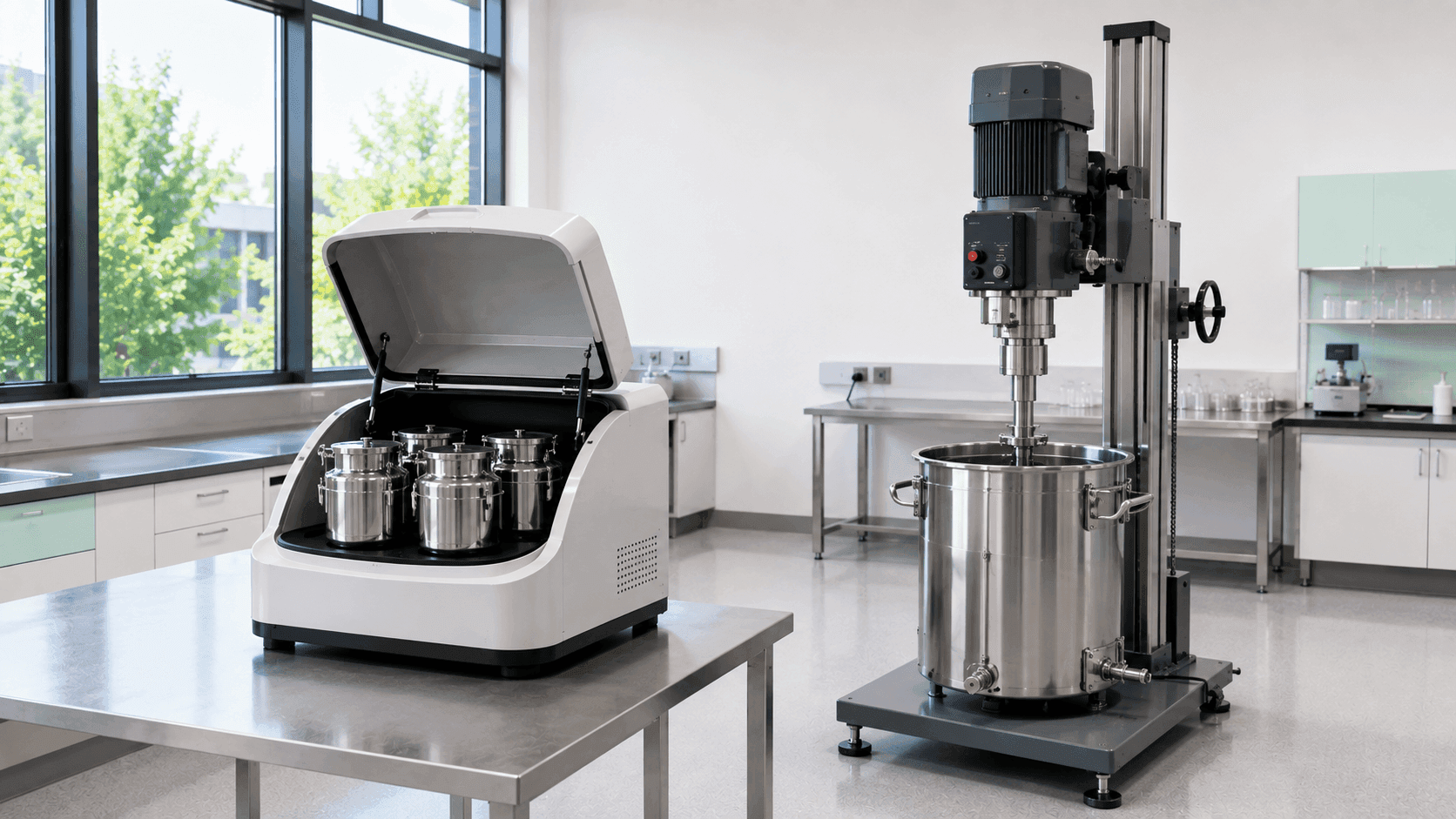
Introduction
Particle size can influence everything from sample preparation and formulation consistency to downstream processing performance. But when it's time to invest in equipment, laboratories often face a fundamental question: ball mill vs homogenizer—which is better?
The answer depends largely on what you're processing. Ball mills are generally suited to grinding, pulverizing, and blending solid materials using mechanical impact and friction. Homogenizers are typically better suited to liquid or semi-liquid systems where the goal is uniform dispersion, emulsification, or reducing particles or droplets suspended within a fluid.
In other words, neither technology wins every round.
Green Lab Gear provides both grinding and homogenization equipment for laboratories with different processing requirements. Choosing between the two starts with defining your feed material, desired final state, target particle size, batch volume, and downstream application.
This ball mill vs homogenizer guide breaks down the differences so you can select equipment based on your process rather than simply chasing the smallest advertised particle size.
TLDR – Quick Guide
- Ball mills are generally better suited to grinding and reducing the particle size of solid materials.
- Homogenizers are commonly used for liquid formulations, suspensions, dispersions, and emulsions.
- Ball mills reduce size through mechanical impact and friction involving grinding media.
- Homogenizers typically use high shear or other mechanical forces to create a more uniform mixture.
- The physical state of your material should be one of the first selection criteria.
- Grinding media selection is critical to ball mill performance and contamination control.
- Homogenizer performance depends on factors such as formulation properties, operating settings, and processing time.
- Some laboratory workflows can benefit from using both technologies at different processing stages.
- Choose equipment according to the required final product, not simply which machine appears more powerful.
Detailed Breakdown
What Is a Ball Mill?
A laboratory ball mill is a mechanical size-reduction system that processes materials inside a grinding vessel containing grinding media. As the equipment operates, the media interacts with the material through impact and friction, gradually breaking larger particles into smaller ones.
Laboratory Ball Mills can be useful for applications such as:
- Grinding dry solids
- Producing fine powders
- Sample preparation
- Powder blending
- Material research
- Homogenizing certain solid mixtures
- Preparing material for downstream analysis
Ball mill performance depends on several interconnected variables, including starting particle size, material hardness, grinding media, operating speed, milling duration, and loading.
For a dry, brittle material that needs to become a fine powder, a ball mill is often the more logical starting point in a ball mill vs homogenizer comparison.
What Is a Laboratory Homogenizer?
A homogenizer is designed primarily to create uniform mixtures by applying mechanical forces to a sample. Depending on the homogenizer technology, this can involve high shear, rotor-stator action, pressure, or other mechanisms.
Laboratory Homogenizers are frequently used for:
- Liquid formulations
- Suspensions
- Dispersions
- Emulsions
- Sample preparation
- Product development
- Mixing materials that would otherwise separate
Instead of grinding a bulk solid into powder, a homogenizer often reduces particles, droplets, or aggregates within a liquid system while improving distribution throughout the formulation.
That distinction is important. A ball mill's job is frequently grinding, while a homogenizer's job is usually creating uniformity within a formulation.
Ball Mill vs Homogenizer: Key Differences
Here's a practical comparison:
Factor
Ball Mill
Homogenizer
Typical Feed
Solid materials
Liquids, suspensions and semi-liquid formulations
Primary Goal
Grinding and particle size reduction
Dispersion and homogenization
Main Mechanism
Impact and friction
High shear or other mechanical action
Grinding Media
Usually required
Typically not
Dry Powder Processing
Strong application
Generally not the primary application
Emulsion Production
Limited
Strong application
Particle/Droplet Dispersion
Application-dependent
Strong application
Sample Preparation
Yes
Yes
Main Selection Question
How fine must the solid become?
How uniform must the formulation become?
The right answer becomes much clearer once the required final state is defined.
When Is a Ball Mill Better?
A ball mill is generally the stronger candidate when the primary objective is reducing the physical size of solid particles.
Imagine starting with a brittle solid that must be converted into a fine powder before analytical testing. A homogenizer isn't usually the obvious tool because there may be no liquid phase to homogenize.
A ball mill can instead repeatedly expose the material to mechanical grinding forces.
Ball milling may be appropriate when:
- The feed is primarily solid.
- Fine powder is required.
- The material responds well to mechanical grinding.
- Powder blending is part of the process.
- Controlled milling parameters can be established.
Material characteristics still matter. Fibrous, sticky, elastic, or heat-sensitive materials may behave differently than dry, brittle samples, so application testing and equipment specifications remain important.
When Is a Homogenizer Better?
A homogenizer becomes more attractive when the material is already liquid or contains particles or droplets dispersed within a liquid phase.
Consider a formulation containing ingredients that tend to separate. The objective may not be turning those ingredients into dry powder at all. Instead, you need a uniform dispersion or emulsion.
That's where equipment such as the MTST UH-150 Homogenizer can be evaluated against the requirements of the application.
Homogenization may be appropriate for:
- Creating dispersions
- Producing emulsions
- Breaking up agglomerates in suitable liquid systems
- Improving formulation uniformity
- Laboratory product development
- Preparing liquid samples for analysis
Always confirm the specific homogenizer's operating range, compatible materials, processing volume, and performance specifications before selecting it for an application.
Which Produces a Smaller Particle Size?
This is where the ball mill vs homogenizer question gets tricky.
Neither technology has a universally smaller particle-size limit because they process materials differently. Results depend on the specific equipment, sample, operating parameters, and definition of "particle size."
For ball milling, influential variables include:
- Grinding media diameter and material
- Feed particle size
- Milling duration
- Speed
- Material loading
- Wet versus dry milling
- Material properties
For homogenization, results can depend on:
- Homogenizer design
- Operating speed or pressure
- Processing duration
- Formulation viscosity
- Starting particle or droplet size
- Temperature
- Number of processing cycles
Don't compare two pieces of equipment using a minimum particle-size number without examining how that number was achieved.
A spectacular specification measured with one test material may tell you very little about how your actual sample will behave.
Grinding Media vs High-Shear Processing
Another major difference is how energy reaches the sample.
Ball mills generally rely on grinding media. Media diameter, density, hardness, composition, and loading can significantly affect size reduction. Smaller media may provide more contact points for fine grinding, while larger media can provide stronger impacts for initial size reduction.
Media can also create contamination concerns because it directly contacts the sample.
Many laboratory homogenizers, by contrast, use high mechanical shear without loose grinding balls. This can simplify certain workflows, although product-contact components still require appropriate cleaning and material compatibility.
Your decision should therefore consider more than particle size. Ask what happens to the sample during processing and whether that method is compatible with your quality requirements.
What About Processing Time and Throughput?
Speed is application-specific.
A homogenizer may process certain liquid formulations relatively quickly, while fine ball milling can require extended processing depending on the material and target particle size. But comparing cycle time alone can be misleading because the systems may be performing fundamentally different jobs.
Instead, calculate useful throughput:
Useful throughput = acceptable material produced per cycle × successful cycles per operating period
If a faster process doesn't produce material that meets your specifications, its theoretical throughput doesn't help much.
Batch size matters too. Select equipment that fits normal production volumes rather than forcing every application into an oversized system.
Cleaning and Cross-Contamination
Cleaning deserves serious consideration, especially in laboratories processing multiple materials.
Ball mills require cleaning of product-contact components such as grinding vessels and media. Fine powders can collect on surfaces, and grinding media may create additional cleaning steps.
Homogenizers also require careful cleaning of product-contact components. Depending on the design and formulation, residues can accumulate around processing heads or other wetted components.
Before purchasing either system, ask:
- How quickly can product-contact parts be accessed?
- Are components removable?
- Are materials compatible with your cleaning agents?
- Could residues become trapped?
- How will cleaning be documented?
The equipment with the fastest processing cycle isn't necessarily the fastest overall if changeovers take forever.
Can You Use a Ball Mill and Homogenizer Together?
Absolutely. In some workflows, comparing a ball mill vs homogenizer as an either-or decision misses the point.
The technologies can perform complementary processing steps.
For example:
This type of staged workflow allows each machine to perform the job it was designed to do.
When planning a larger system, reviewing the broader range of Laboratory Processing Equipment can help identify potential bottlenecks before individual machines are selected.
How to Decide Which Equipment You Need
Start with the end result.
If your desired output is fine dry powder, investigate ball mills first.
If your desired output is a uniform liquid dispersion or emulsion, investigate homogenizers first.
Then evaluate:
- Starting material
- Desired particle or droplet size
- Batch volume
- Viscosity
- Temperature sensitivity
- Contamination requirements
- Processing time
- Cleaning requirements
- Available laboratory space
- Downstream processing
For critical applications, test the actual material whenever practical rather than relying entirely on generalized equipment specifications.
Common Selection Mistakes
The biggest mistake is assuming particle size reduction is one universal process.
Grinding a solid crystal into powder isn't the same as reducing droplets within an emulsion. Both involve "making things smaller," but the mechanics and desired results are fundamentally different.
Other common mistakes include:
- Selecting equipment based solely on minimum particle-size claims.
- Ignoring the physical state of the feed material.
- Overlooking contamination from grinding media.
- Failing to account for viscosity during homogenization.
- Comparing capacity without considering usable batch volume.
- Ignoring cleaning and changeover time.
- Buying equipment without considering downstream processing.
Define the process first. The equipment decision becomes much easier afterward.
Key Takeaways
- A ball mill vs homogenizer comparison should begin with the physical state of the material and desired final product.
- Ball mills are generally better suited to grinding solid materials into smaller particles or powders.
- Homogenizers are commonly better suited to dispersions, suspensions, emulsions, and liquid formulations.
- Ball mills typically use grinding media and mechanical impact or friction.
- Homogenizers commonly use high shear or other mechanical forces to improve formulation uniformity.
- Neither technology has a universal advantage for minimum particle size.
- Processing time, capacity, cleaning, contamination, and material properties should influence equipment selection.
- Some workflows benefit from ball milling followed by homogenization.
- Laboratory testing with the actual material can provide more useful information than comparing headline specifications.
- Choose the technology that produces the required material characteristics, not simply the smallest number on a specification sheet.
FAQs
What is the main difference between a ball mill and a homogenizer?
A ball mill typically uses grinding media and mechanical forces to reduce solid materials into smaller particles or powders. A homogenizer is generally designed to create uniform dispersions, suspensions, or emulsions, often within a liquid system. The best choice depends on your starting material and desired final product.
Is a ball mill better than a homogenizer for fine powders?
A ball mill is generally the more appropriate option when the primary goal is grinding a suitable solid material into fine powder. Final particle size still depends on material properties, grinding media, loading, speed, time, and mill design. Application testing is recommended when a specific particle-size distribution is required.
Can a homogenizer reduce particle size?
Yes, suitable homogenizers can reduce particles, droplets, or aggregates while improving their distribution within a formulation. Performance depends on homogenizer design, material properties, operating conditions, and processing time. Homogenization shouldn't automatically be treated as equivalent to dry grinding in a ball mill.
Can you use a ball mill and homogenizer in the same process?
Yes, the two technologies can complement each other in certain workflows. A ball mill might first reduce a solid to a controlled powder before a homogenizer disperses that material into a liquid formulation. Whether both are necessary depends on the required final product and processing sequence.
How do I choose between a ball mill and homogenizer?
Start by determining whether you're primarily grinding a solid or creating a uniform liquid or semi-liquid formulation. Then compare particle-size requirements, batch volume, material properties, cleaning, contamination risk, and downstream processing. The equipment that best matches those requirements is usually the better choice.