Closed Loop Extractor Size Guide: What Size Does Your Cannabis Lab Need?
Learn how to choose closed loop extractor size based on biomass volume, batch frequency, recovery capacity, workflow, and future growth.
Introduction
Choosing a closed loop extractor size sounds straightforward: figure out how much biomass you want to process, buy an extractor with that capacity, and start planning production.
In reality, extractor sizing is a workflow problem.
A larger extractor can process more material per batch, but that doesn't automatically mean your facility will produce more finished extract per day. Solvent recovery, chilling and heating capacity, material preparation, cleaning, downstream refinement, staffing, and facility limitations all affect practical throughput.
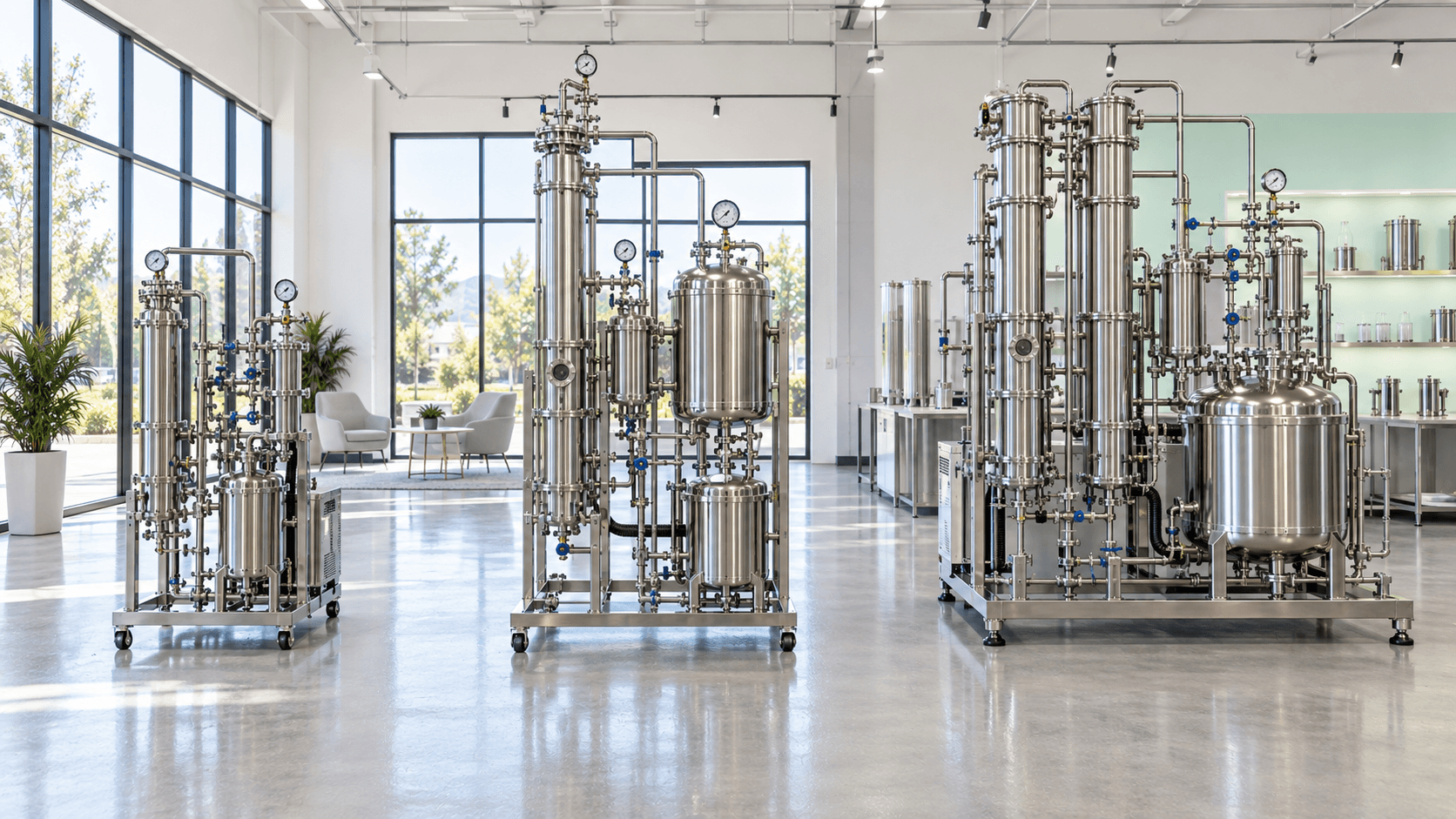
GreenLabGear offers closed-loop extraction systems in multiple capacities, including 1 lb, 5 lb, and 10 lb configurations. The right choice depends less on getting the biggest extractor your budget allows and more on matching capacity to the rest of your operation.
This closed loop extractor size guide explains how to estimate capacity, compare common system sizes, and avoid creating an expensive bottleneck somewhere else in your lab.
TLDR – Quick Guide
- Choose closed loop extractor size based on required daily throughput, not vessel size alone.
- A 1 lb system can make sense for smaller-volume, R&D, or specialized processing workflows where its specifications fit the application.
- A 5 lb system offers substantially greater nominal batch capacity and may suit growing production environments.
- A 10 lb system can reduce the number of extraction batches required for larger daily biomass volumes.
- Nominal capacity should not automatically be treated as guaranteed usable capacity for every material or process.
- Solvent recovery and temperature-control systems must be able to support the extractor.
- Larger systems can require more facility space, supporting equipment, utilities, solvent management, and operational planning.
- Calculate realistic complete-cycle time before comparing daily production.
- Leave room for reasonable growth without dramatically oversizing the system.
- Hydrocarbon extraction requires compliant equipment, professionally engineered facilities, trained operators, and appropriate safety controls.
Detailed Breakdown
What Does Closed Loop Extractor Size Actually Mean?
When an extractor is described as a 1 lb, 5 lb, or 10 lb system, the number generally provides a nominal biomass-processing capacity for the extraction column or system configuration.
It should not be interpreted as a universal guarantee that every operator can load exactly that amount of every type of biomass under every process condition.
Actual loading can depend on factors such as:
- Material density
- Biomass preparation
- Column dimensions
- Equipment configuration
- Manufacturer requirements
- Validated operating procedures
Always use the manufacturer's specifications for the exact equipment being considered.
GreenLabGear's broader selection of Closed Loop Extractors makes it possible to compare capacities before determining which configuration best aligns with production goals.
Start With Daily Biomass Throughput
The most useful starting point for choosing closed loop extractor size is how much material you realistically need to process during an operating day.
Suppose Facility A expects to process 5 lb per day, while Facility B needs to process 50 lb. Those laboratories probably shouldn't begin equipment selection with the same extractor.
A basic planning calculation is:
Required batches per day = Daily biomass target ÷ Nominal biomass capacity per batch
For example, using nominal capacities purely for planning:
Daily Biomass Target
1 lb System
5 lb System
10 lb System
5 lb
5 batches
1 batch
1 partial-capacity batch*
10 lb
10 batches
2 batches
1 batch
20 lb
20 batches
4 batches
2 batches
40 lb
40 batches
8 batches
4 batches
*Whether partial loading is appropriate depends on the specific system and manufacturer operating requirements.
This table reveals why nominal capacity matters—but it still doesn't tell the entire story.
Twenty theoretical extraction batches aren't useful if the facility only has enough time, recovery capacity, or staffing to complete eight.
When Does a 1 lb Closed Loop Extractor Make Sense?
A 1lb Closed Loop Extractor can be worth evaluating when relatively small batch sizes align with the facility's production goals.
Potential use cases may include:
- Research and development
- Small-batch processing
- Product-development work
- Facilities with relatively low daily biomass requirements
- Operations where frequent smaller batches are desirable
Smaller capacity can also make sense when a laboratory wants to avoid committing space and supporting infrastructure to substantially more extraction capacity than it currently needs.
The tradeoff is obvious: as daily production increases, the number of batches can climb quickly.
If you need to process 20 lb per day using a nominal 1 lb system, that's potentially many extraction cycles before cleaning, recovery, setup, and other process stages are even considered.
Small equipment isn't necessarily inefficient. It's inefficient when it's mismatched to the workload.
When Is a 5 lb Closed Loop Extractor a Better Fit?
A 5lb Closed Loop Extractor provides a middle-ground capacity worth considering for laboratories that need more production than a small system can comfortably support.
At a 20 lb daily biomass target, for example, nominal 5 lb batches would translate to four extraction batches rather than twenty nominal 1 lb batches.
That can substantially change:
- Operator workload
- Number of equipment loading cycles
- Cleaning schedules
- Production planning
- Solvent-management requirements
- Daily workflow
However, don't automatically jump from "fewer batches" to "better system."
A larger extractor may create larger solvent and thermal loads and place greater demands on recovery and supporting equipment. Facility planning needs to scale with the extractor.
When Does a 10 lb Closed Loop Extractor Make Sense?
A 10lb Closed Loop Extractor may be appropriate for operations with larger and more consistent production requirements.
At a nominal 40 lb daily biomass target, a 10 lb system could theoretically reduce the extraction requirement to approximately four full-capacity batches.
For a production-focused facility, fewer larger batches may simplify scheduling compared with processing the same volume through a substantially smaller extractor.
But larger equipment raises equally important questions:
- Can solvent recovery keep up?
- Is temperature-control capacity adequate?
- Is there enough compliant facility space?
- Can downstream equipment handle the output?
- Is staffing sufficient?
- Will the system regularly operate near an efficient capacity?
- Does the facility have appropriate solvent storage and handling infrastructure?
A 10 lb extractor that's regularly underutilized may simply be expensive unused capacity.
Closed Loop Extractor Size vs Daily Throughput
Here's the mistake to avoid:
Extractor capacity ≠ daily production capacity.
Daily production depends on the complete cycle.
A more useful conceptual calculation is:
Daily throughput = usable biomass per batch × completed batches per day
And completed batches depend on more than extraction time.
A production cycle can involve material preparation, loading, extraction, solvent recovery, unloading, cleaning, inspection, and setup for the next batch.
If a nominal 10 lb system takes significantly longer to complete its entire workflow than anticipated, multiplying 10 lb by the number of hours in a shift will dramatically overestimate production.
Build your capacity model using complete-cycle data relevant to the actual equipment and process.
Solvent Recovery Can Determine the Right Extractor Size
One of the easiest ways to oversize extraction equipment is to ignore solvent recovery.
The extractor may process a larger biomass batch, but the associated solvent still has to be appropriately recovered. If recovery equipment cannot handle that load within the required production schedule, the extraction system waits.
Now your shiny new high-capacity extractor has become very expensive furniture.
When evaluating closed loop extractor size, compare:
- Expected solvent load per batch
- Recovery capacity
- Required recovery time
- Desired batches per shift
- Temperature-control capability
- Solvent storage capacity
Extraction and recovery should be sized as interconnected stages rather than separate purchasing decisions.
Don't Ignore Heating and Cooling Capacity
Hydrocarbon extraction workflows can depend heavily on controlled thermal conditions.
A larger extractor can increase the demands placed on chillers, heaters, heat exchangers, and other temperature-control components. If supporting equipment is undersized, theoretical extractor capacity may never translate into expected throughput.
This is particularly important when moving from a smaller system to a larger one.
Don't assume that support equipment selected for a 1 lb extractor will automatically be appropriate for a 5 lb or 10 lb system.
Review the manufacturer's requirements for the complete configuration.
Your Downstream Equipment Has to Keep Up
Extraction isn't the finished product.
Depending on what your facility manufactures, extracted material may require additional recovery, separation, refinement, distillation, formulation, or other post-processing stages.
If extraction output doubles while downstream capacity stays the same, material can begin accumulating between stages.
When comparing a 1 lb, 5 lb, and 10 lb closed loop extractor, map capacity across the complete process:
Biomass preparation → Extraction → Recovery → Post-processing → Refinement → Finished product
Estimate how much material each stage can realistically handle during the same operating period.
Your practical production capacity is constrained by the bottleneck.
Factor in Cleaning and Changeover Time
A capacity spreadsheet can look fantastic when it assumes equipment runs continuously with zero downtime.
Laboratories don't work that way.
Loading, unloading, inspection, cleaning, maintenance, and batch documentation all consume time. Different products or materials may also require more extensive changeover procedures.
If a laboratory can technically perform a certain number of extraction cycles but staffing only allows half that number once cleaning and recovery are included, the staffing model—not extractor size—is determining throughput.
Use realistic cycle times when forecasting capacity.
A little pessimism in a spreadsheet is cheaper than disappointment after installation.
Should You Buy Larger for Future Growth?
Some extra capacity can make sense.
If your laboratory currently processes 8 lb per day but expects demand to reach 15 or 20 lb relatively soon, buying equipment sized exclusively around today's workload could create an early upgrade requirement.
But there's a difference between planning for growth and buying dramatically oversized equipment.
Oversizing can mean:
- Higher initial investment
- More floor-space requirements
- Larger supporting equipment
- Greater facility demands
- More unused capacity
- Potentially less convenient operation for small batches
Create realistic low, expected, and high production scenarios for the next several years.
Then choose a closed loop extractor size that handles expected demand while providing sensible expansion room.
Facility Size and Safety Requirements Matter
Physical space can limit equipment choices before throughput calculations do.
A larger closed-loop extraction system can require additional room for the extractor, temperature-control equipment, solvent recovery, service access, storage, and operator movement.
Hydrocarbon solvents also introduce serious fire and explosion hazards.
Commercial facilities may be subject to requirements involving engineered ventilation, gas detection, classified electrical installations, fire protection, solvent storage, equipment approvals, permits, and inspections depending on the jurisdiction and process.
Work with qualified engineers, equipment manufacturers, and applicable local authorities when designing the facility.
Never choose a 10 lb system simply because it technically fits through the door.
A Simple Closed Loop Extractor Sizing Process
Before purchasing equipment, work through a structured capacity calculation:
Then compare those requirements with manufacturer specifications for available extractor configurations.
This approach provides a much stronger answer than selecting equipment based on nominal pounds alone.
Common Closed Loop Extractor Sizing Mistakes
The most common mistake is assuming bigger automatically means better.
A larger system is valuable when the laboratory has enough material, infrastructure, staffing, recovery capability, and downstream capacity to use it.
Other common mistakes include:
- Calculating throughput from extraction time alone
- Ignoring solvent recovery
- Underestimating cleaning time
- Forgetting temperature-control capacity
- Ignoring downstream bottlenecks
- Assuming nominal capacity equals usable capacity for every material
- Failing to account for maintenance downtime
- Oversizing based on unrealistic growth projections
- Choosing equipment before completing facility planning
The right closed loop extractor size should make the entire workflow more efficient—not just make the extraction column bigger.
Key Takeaways
- Choose closed loop extractor size according to complete daily throughput requirements rather than nominal capacity alone.
- A 1 lb extractor can be worth considering for smaller-batch, R&D, and lower-volume workflows.
- A 5 lb extractor can provide a practical middle ground for growing production requirements.
- A 10 lb extractor can reduce required batch counts when higher-volume production supports the additional capacity.
- Nominal biomass capacity doesn't guarantee the same usable loading for every material or process.
- Complete cycle time should include loading, extraction, recovery, unloading, cleaning, and setup.
- Solvent recovery can become the bottleneck if it isn't matched to extractor capacity.
- Heating and cooling systems must scale appropriately with extraction requirements.
- Downstream processing capacity should be evaluated before increasing extraction capacity.
- Plan for realistic growth, but don't pay for dramatically more equipment than your workflow can use.
- Hydrocarbon extraction requires properly designed facilities, qualified oversight, trained operators, and appropriate safety controls.
FAQs
What size closed loop extractor do I need?
The right closed loop extractor size depends on daily biomass volume, complete batch-cycle time, solvent recovery, operating hours, and downstream capacity. Start by calculating how many realistic batches are required to meet your production target. Then compare that requirement with manufacturer specifications for the equipment you're considering.
Is a 1 lb closed loop extractor enough for a small lab?
A nominal 1 lb system may be appropriate for R&D, specialized batches, or lower-throughput operations when its specifications fit the intended process. It can become inefficient when daily biomass requirements require an impractical number of repeated batches. Calculate complete cycle time rather than judging suitability from batch capacity alone.
When should I choose a 5 lb closed loop extractor?
A nominal 5 lb extractor may make sense when smaller systems require too many daily batches but a larger system would provide unnecessary capacity. Recovery, temperature control, facility infrastructure, and downstream equipment still need to support the larger batch size. Compare total daily throughput and operating requirements before selecting the system.
Is a 10 lb closed loop extractor better for commercial production?
A nominal 10 lb extractor can reduce batch counts for facilities with sufficiently high and consistent biomass throughput. Larger capacity only improves productivity when recovery, temperature control, staffing, and downstream processing can keep pace. An oversized extractor may provide little benefit when another part of the workflow remains the limiting factor.
Should I buy a larger closed loop extractor for future growth?
Building some additional capacity into your equipment plan can reduce the need for an early replacement as production grows. However, excessive oversizing can increase equipment, facility, and supporting-system costs while leaving capacity unused. Forecast realistic low, expected, and high production scenarios before deciding how much growth capacity to purchase.