How to Choose a Laboratory Ball Mill for the Right Grinding Application
Learn how to choose a laboratory ball mill based on material, capacity, particle size, speed, grinding media, and processing goals.
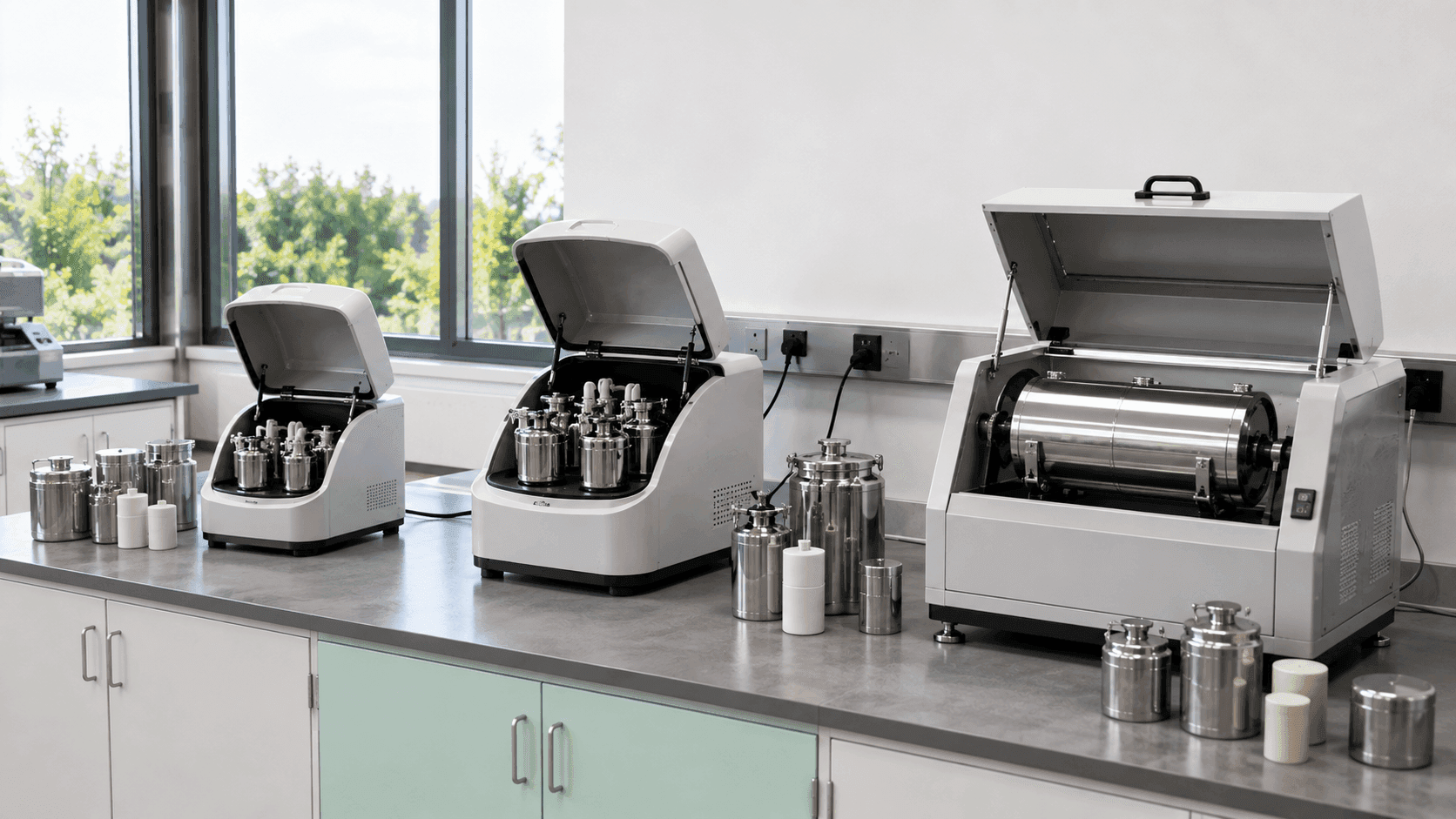
Introduction
Choosing laboratory grinding equipment sounds simple until particle size, material hardness, batch capacity, grinding media, and processing time enter the equation. A ball mill that's perfect for one material can be inefficient—or simply wrong—for another. Understanding how to choose a laboratory ball mill can help you achieve more consistent particle sizes without paying for capacity or features your workflow doesn't need.
Laboratory ball mills use rotating or oscillating grinding containers filled with media to crush, grind, blend, or homogenize materials. They're useful across research, chemical, pharmaceutical, botanical, materials science, and other laboratory environments where repeatable sample preparation matters.
Green Lab Gear offers ball mills and other processing systems for different laboratory applications. The right model, however, should be selected around what you're actually grinding and the result you need—not simply which mill has the largest chamber or most powerful motor.
This guide explains the variables that matter most, from feed material and target particle size to capacity, grinding media, operating speed, and scalability.
TLDR – Quick Guide
- Start with the material you're grinding and the particle size you need to achieve.
- Consider material hardness, brittleness, moisture, and abrasiveness before selecting a mill.
- Match mill capacity to realistic batch sizes rather than buying the largest option available.
- Grinding media size and material can significantly affect performance and contamination risk.
- Evaluate speed, operating mode, and available process controls.
- Consider whether the mill will be used for grinding, mixing, homogenization, or multiple tasks.
- Compare smaller and larger systems based on usable capacity and workflow requirements.
- Think about cleaning, maintenance, noise, footprint, and future production before purchasing.
Detailed Breakdown
What Is a Laboratory Ball Mill?
A laboratory ball mill is a size-reduction and mixing device that uses grinding media inside a container to mechanically process materials. As the system operates, the media repeatedly impacts and interacts with the material, reducing particle size and promoting mixing.
Depending on the equipment and application, Ball Mills may be used for:
- Particle-size reduction
- Sample preparation
- Powder blending
- Material homogenization
- Research and development
- Process testing
- Formulation development
The desired result matters because "grinding" can mean very different things. One laboratory may need coarse size reduction before analysis, while another may be targeting a much finer and more uniform powder.
That difference should influence virtually every equipment decision that follows.
Start With the Material You Need to Grind
The first step in how to choose a laboratory ball mill is understanding the physical characteristics of your feed material.
Important variables include hardness, brittleness, density, abrasiveness, moisture content, and initial particle size. A dry, brittle material behaves differently during milling than a fibrous, sticky, or moisture-rich material.
Before comparing models, document:
- Starting particle size
- Desired final particle size
- Material hardness
- Whether the material is abrasive
- Whether wet or dry processing is required
- Temperature sensitivity
- Potential contamination concerns
If a material is heat-sensitive, for example, extended grinding can become a concern because mechanical processing may generate heat. If contamination is critical, the material used for the grinding jar and media deserves extra attention.
The more precisely you define the material, the easier it becomes to eliminate unsuitable equipment.
Determine Your Target Particle Size
Don't buy a ball mill simply because the manufacturer describes it as capable of "fine grinding." Define what fine means for your process.
Your target particle-size distribution can influence grinding time, media selection, speed, and even whether a particular type of ball mill is appropriate.
Consider whether your application requires:
- Coarse grinding
- Fine powder production
- Highly uniform particles
- Simple sample preparation
- Homogenization rather than extreme size reduction
Smaller particles aren't automatically better. Grinding beyond what your downstream process requires can waste time and energy while increasing equipment wear.
The best target is the particle size that supports the next stage of your workflow.
Choose the Right Ball Mill Capacity
Capacity is another major purchasing factor.
A mill that's too small can force operators to run excessive batches, creating a bottleneck. A mill that's much larger than necessary may occupy additional space and require a larger investment without improving real-world productivity.
Green Lab Gear offers different capacity options, including the Mantaisite BMQ 2L Ball Mill and Mantaisite BQM 5L Ball Mill.
Rather than comparing 2L and 5L solely by their numbers, calculate how much material you actually need to process.
For example, imagine one laboratory needs to prepare relatively small R&D samples several times per week, while another routinely handles larger batches. The smaller-capacity option may give the first lab better space and workflow efficiency, whereas additional capacity could reduce batch frequency for the second.
Remember that nominal container volume isn't necessarily the same as usable material capacity. Grinding media and required headspace occupy part of the container, so always verify recommended loading specifications for the exact equipment.
Grinding Media Can Make or Break Performance
The mill is only half the equation. Grinding media directly interacts with your material and can influence particle size, processing time, wear, and contamination.
Common media variables include:
- Material
- Diameter
- Density
- Hardness
- Quantity
- Size distribution
Larger media can provide greater impact energy, while smaller media can increase contact points and may be useful for finer grinding. In some workflows, a combination of sizes may be appropriate.
Media composition is equally important. If trace contamination from the media could affect your analysis or final material, choose media and vessel materials with compatibility in mind.
Follow the equipment manufacturer's recommendations rather than improvising media loading. Too little or too much media can reduce grinding effectiveness.
Consider Speed, Time, and Process Control
Ball mill performance depends on the interaction between operating speed, processing time, loading, and media.
More speed isn't automatically better.
Depending on mill design, inappropriate operating conditions can reduce grinding efficiency or place unnecessary stress on the equipment. The goal is controlled, repeatable processing—not simply maximum motor output.
When comparing models, look for controls that support your workflow, such as adjustable operating parameters and timers where available. Repeatable settings are particularly useful for laboratories developing standardized sample-preparation procedures.
If one technician processes a sample for 15 minutes and another decides 35 minutes "looks about right," reproducibility quickly disappears. Defined process parameters make laboratory work easier to validate and repeat.
Think About the Entire Processing Workflow
A laboratory ball mill rarely operates in isolation. Material must be prepared before grinding, transferred into the mill, collected afterward, and often moved into another processing or analytical step.
Review your broader Laboratory Processing Equipment when selecting a mill.
Ask:
- How will material reach the mill?
- Does it require pre-cutting or pre-grinding?
- How will finished powder be collected?
- Will the material require sieving afterward?
- How frequently must the mill be cleaned?
- Is cross-contamination between batches a concern?
- Where does the ground material go next?
A fast mill doesn't create an efficient workflow if loading, cleaning, or downstream processing becomes the new bottleneck.
Don't Ignore Cleaning and Cross-Contamination
For laboratories processing multiple materials, cleaning can have as much impact on productivity as grinding speed.
Grinding jars, media, seals, and other product-contact surfaces should be evaluated for accessibility and compatibility with your cleaning procedures. Materials that cling to surfaces or generate fine powders can make changeovers particularly important.
If you're comparing two mills with similar grinding performance, the system that's easier to clean may deliver greater real-world productivity.
This is especially important for analytical and research applications where carryover from a previous sample could compromise results.
Factor in Footprint, Noise, and Maintenance
Technical specifications don't tell you whether a mill will be pleasant—or practical—to operate every day.
Before purchasing, evaluate:
- Equipment dimensions
- Bench or floor-space requirements
- Electrical requirements
- Noise and vibration
- Routine maintenance
- Replacement media availability
- Replacement parts
- Operator access
Ball milling is a mechanical process, so noise and vibration deserve consideration when planning equipment placement.
A laboratory processing frequent batches may also benefit from locating the mill away from concentration-heavy work areas when facility design and manufacturer requirements permit.
How to Compare Ball Mills Before Buying
Once you've defined your application, create a short equipment-selection matrix rather than comparing product pages by instinct.
Selection Factor
Question to Ask
Material
Is the mill suitable for the material's properties?
Feed Size
Can it accept the starting material efficiently?
Final Particle Size
Can it achieve the required result?
Capacity
Does it match typical batch volume?
Grinding Media
Are compatible media options available?
Process Control
Can operators create repeatable milling cycles?
Cleaning
Can product-contact surfaces be cleaned efficiently?
Footprint
Does it fit the laboratory layout?
Scalability
Can the workflow support future demand?
Maintenance
Are wear components and support readily available?
Score each option against actual requirements. This prevents one impressive specification from overshadowing several practical shortcomings.
Common Ball Mill Selection Mistakes
One of the most common mistakes is buying according to capacity alone. A larger mill doesn't automatically produce finer material or better results.
Another mistake is ignoring grinding media. The wrong media can reduce efficiency, introduce unwanted contamination, or fail to produce the desired particle characteristics.
Labs should also avoid assuming every material will behave the same way. A milling protocol that works beautifully for one powder may perform poorly with another material.
Finally, don't overlook scalability. If today's R&D process could become tomorrow's regular production workflow, document successful parameters now so they can be evaluated when capacity requirements increase.
Key Takeaways
- Understanding how to choose a laboratory ball mill begins with defining the material and required final particle size.
- Material hardness, abrasiveness, moisture, and heat sensitivity can affect equipment selection.
- Match mill capacity to actual batch requirements rather than choosing the largest available option.
- Grinding media composition and size can significantly influence performance and contamination risk.
- Speed, processing time, and loading should be controlled for repeatable results.
- Nominal chamber capacity shouldn't be confused with usable material capacity.
- Cleaning and cross-contamination requirements are important for multi-product laboratories.
- Footprint, noise, maintenance, and equipment integration affect real-world usability.
- Compare ball mills using a requirements-based selection matrix instead of relying on a single specification.
- The best ball mill is the one that produces the required result consistently within your laboratory's actual workflow.
FAQs
How do I choose a laboratory ball mill?
Start by defining your feed material, starting particle size, target particle size, and typical batch volume. Then compare capacity, grinding media compatibility, operating controls, cleaning requirements, and facility needs. The best mill is one that consistently meets the process requirements without unnecessary capacity or complexity.
What size laboratory ball mill do I need?
The appropriate size depends on how much material you need to process per batch and how frequently you'll operate the equipment. Remember that grinding media and necessary headspace reduce the amount of material that can be loaded compared with the vessel's nominal volume. Always confirm usable loading recommendations for the specific mill and application.
Is a 5L ball mill better than a 2L ball mill?
Not necessarily, because additional capacity only helps when your workflow requires it. A 2L system may be more practical for smaller R&D batches, while a 5L system may reduce batch frequency for higher-volume applications. Compare usable capacity, material requirements, laboratory space, and throughput before deciding.
How does grinding media affect ball mill performance?
Grinding media transfers mechanical energy to the material, so its size, density, hardness, composition, and quantity can influence grinding efficiency. Media selection can also affect contamination and equipment wear. Follow the mill manufacturer's recommendations and validate the combination with your particular material.
Can one laboratory ball mill grind every type of material?
No single ball mill or milling protocol is ideal for every material. Hardness, brittleness, moisture, abrasiveness, temperature sensitivity, and desired particle size can all change the required setup. Testing the application and reviewing manufacturer specifications are important before standardizing a grinding process.