How to Choose a Jacketed Glass Reactor for Your Laboratory Process
Learn how to choose a jacketed glass reactor based on volume, temperature control, mixing, vacuum, materials, and laboratory workflow.
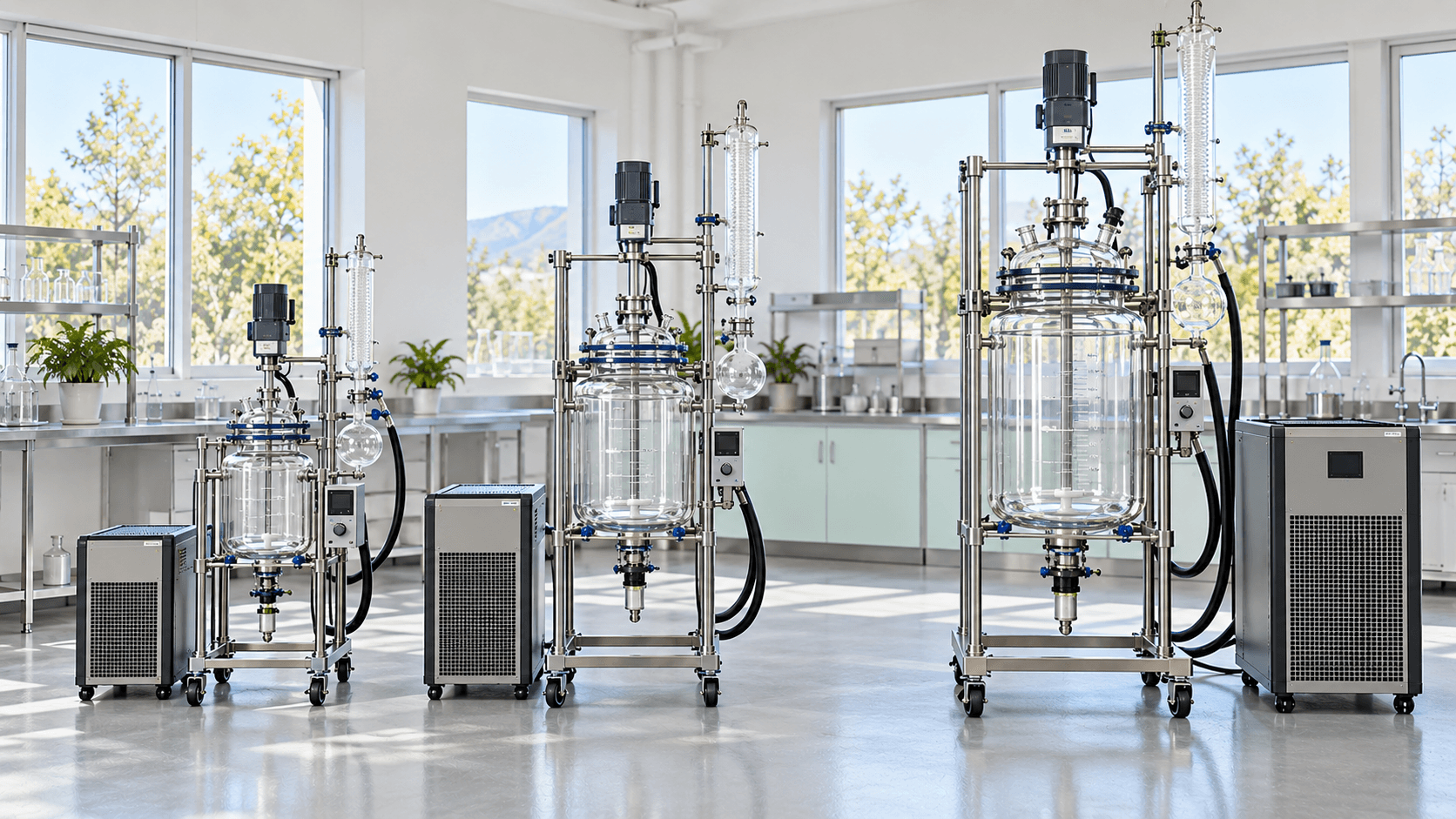
Introduction
Choosing a jacketed glass reactor isn't just a matter of deciding whether your lab needs 20 liters, 50 liters, or 100 liters of capacity. Reactor volume matters, but temperature control, mixing, vacuum requirements, glass compatibility, working volume, supporting equipment, and future production needs can matter just as much.
The big advantage of glass is visibility. Operators can observe mixing, phase changes, color, foaming, precipitation, and other process behavior directly through the vessel. Combine that visibility with a jacket connected to temperature-control equipment, and you have a versatile platform for controlled laboratory and pilot-scale processing.
GreenLabGear offers laboratory processing equipment across multiple capacities, including jacketed glass reactor systems. The best reactor isn't necessarily the biggest model your facility can afford—it's the system that matches your actual process.
This guide explains what to evaluate before choosing a jacketed glass reactor and how to avoid buying a reactor that creates problems everywhere else in your workflow.
TLDR – Quick Guide
- Choose a jacketed glass reactor according to usable working volume rather than vessel capacity alone.
- Leave appropriate headspace instead of assuming nominal vessel volume equals usable batch volume.
- Match the jacket and temperature-control system to your actual heating and cooling requirements.
- Consider viscosity, mixing intensity, impeller design, and motor capability together.
- Verify chemical compatibility for glass, seals, valves, tubing, and wetted components.
- Vacuum requirements should be evaluated using the complete reactor system, not the vessel alone.
- A 20L reactor may suit smaller-batch and development workflows, while 100L systems can support larger processing requirements.
- Larger reactors require appropriately scaled chillers, heaters, vacuum equipment, space, and downstream capacity.
- Compare glass with stainless steel when durability, pressure capability, scale, or process environment becomes more important than visibility.
Detailed Breakdown
What Is a Jacketed Glass Reactor?
A jacketed glass reactor consists of an inner process vessel surrounded by an outer jacket through which a compatible temperature-control fluid can circulate.
The process material stays inside the main vessel while thermal fluid flows through the jacket. Connected heating or cooling equipment can then transfer energy through the glass wall without directly contacting the process material.
Professional Jacketed Glass Reactors may incorporate components such as a mixing assembly, drain valve, condenser, feed ports, temperature measurement, support frame, and other accessories depending on the configuration.
This design can support processes involving controlled:
- Mixing
- Heating
- Cooling
- Reaction
- Dissolution
- Crystallization
- Evaporation
- Vacuum processing
Exact suitability depends on the reactor's specifications and the chemistry involved.
Start With Working Volume, Not Maximum Volume
Capacity is usually the first specification buyers notice.
Unfortunately, it's also one of the easiest to misunderstand.
A reactor labeled 20L has a nominal vessel capacity, but that doesn't necessarily mean every process should use 20 liters of material. Processes can require headspace for mixing, foaming, vapor generation, additions, or other operational requirements.
Instead of asking, "What's the biggest batch that physically fits?" ask:
What working volume does our process require under normal operating conditions?
That number gives you a much better starting point.
A reactor that's dramatically oversized can create inefficient mixing or temperature-control challenges for small batches. An undersized reactor can force unnecessary batch repetition and become an obvious production bottleneck.
When Does a 20L Jacketed Glass Reactor Make Sense?
A 20L Jacketed Glass Reactor may be worth evaluating for laboratories operating at smaller batch volumes or moving beyond benchtop glassware into a more integrated processing system.
Potential applications can include:
- Research and development
- Pilot processing
- Process optimization
- Small-batch production
- Formulation development
- Controlled reaction or mixing work
A smaller reactor can also make process changes easier when a facility frequently switches formulations or materials.
However, don't choose a 20L system purely because your current batch is relatively small.
If production is expected to increase rapidly, calculate how many batches would be required at forecasted volume. Repeating a small process ten times may eventually cost more in labor and turnaround time than operating fewer appropriately sized batches.
When Is a 100L Jacketed Glass Reactor Appropriate?
A 100L Jacketed Glass Reactor moves the process into a substantially larger capacity class.
A system of this size may be considered for larger pilot or production workflows where increased batch capacity aligns with demand.
But scaling from 20L to 100L isn't simply "the same process, five times bigger."
Larger systems can change:
- Mixing behavior
- Heat-transfer requirements
- Heating and cooling times
- Vacuum requirements
- Material-transfer logistics
- Cleaning procedures
- Facility footprint
- Operator workflow
Supporting equipment also has to scale appropriately.
A 100L reactor connected to temperature-control equipment intended for a much smaller thermal load may never deliver the cycle times expected on the production spreadsheet.
Size the Temperature-Control System With the Reactor
The jacket doesn't generate heating or cooling by itself.
It provides a surface through which a compatible circulating fluid can transfer heat between the reactor and external temperature-control equipment.
Depending on the process, this may involve a chiller, heater, or heating-and-cooling circulator.
When matching equipment, consider:
- Required process temperature
- Starting temperature
- Desired heating or cooling time
- Process heat load
- Jacket volume
- Circulation flow requirements
- Thermal-fluid compatibility
- Ambient conditions
- Heat generated by the process
Don't choose a chiller based only on its minimum advertised temperature.
Cooling capacity usually changes with operating temperature, so the relevant question is whether the unit provides enough cooling power at the temperature your process actually requires.
Mixing Performance Matters
A jacketed glass reactor is also a mixing system.
Stirrer motor capability, shaft design, impeller configuration, rotational speed, viscosity, vessel geometry, and working volume can all affect mixing performance.
A low-viscosity solution may circulate relatively easily. A thick formulation can demand considerably more torque.
When comparing reactors, determine:
What materials will be mixed?
How does viscosity change during the process?
How much circulation is required?
Does the selected mixing system support that load?
The answer should come from application requirements and manufacturer specifications—not from assuming that a bigger motor automatically produces better results.
Consider Chemical Compatibility
Glass has excellent compatibility with many laboratory chemicals, which is one reason glass reactors are widely used.
But "glass reactor" doesn't mean every component exposed to the process is glass.
A system may also contain:
- Seals
- Gaskets
- O-rings
- Valves
- Stirrer components
- Tubing
- Fittings
- Sensors
Each wetted component needs to be compatible with the materials, temperatures, and operating conditions involved.
Before purchasing a jacketed glass reactor, create a list of every chemical the system is expected to contact. Then confirm compatibility across the entire wetted path.
The weakest incompatible gasket still wins the argument, no matter how chemically resistant the vessel is.
Understand Vacuum Requirements
Some jacketed glass reactor workflows use vacuum to support evaporation or other process objectives.
If your application requires vacuum, evaluate the entire vacuum system rather than purchasing a pump based solely on its ultimate vacuum specification.
Important factors include:
- Required operating vacuum
- Vessel and system ratings
- Pumping speed
- Vapor load
- Chemical compatibility
- Tubing diameter and length
- Condensers or cold traps
- Vacuum control
- Gauge location
- Leak integrity
Vacuum performance at the pump isn't automatically the same as vacuum performance inside the reactor.
Restrictions, vapor loads, fittings, valves, and leaks can all affect system performance.
Most importantly, never operate glass equipment outside its specified vacuum or pressure ratings.
Reactor Glass Requires Careful Inspection
Visibility is a major advantage of glass, but glass also requires appropriate handling and inspection.
Before operation, inspect critical glass components according to manufacturer and facility procedures.
Damage that can justify removing equipment from service may include:
- Cracks
- Significant chips
- Deep scratches
- Damaged joints
- Chemical etching or attack
- Other visible structural deterioration
This becomes especially important when the reactor operates under vacuum or experiences thermal cycling.
Makeshift repairs are not an appropriate solution for compromised process glassware used under demanding operating conditions.
If there's uncertainty about damage, follow the manufacturer's guidance and qualified safety procedures.
Glass vs Stainless Steel Reactor
At some point, many growing laboratories face a larger question: should the next reactor still be glass?
GreenLabGear's Glass vs Stainless Steel Reactor guide explores the comparison in more detail.
At a high level:
Factor
Glass Reactor
Stainless Steel Reactor
Process Visibility
Excellent
Limited without viewing ports
Chemical Compatibility
Strong for many applications
Depends on alloy and chemistry
Impact Resistance
More fragile
More robust
Process Observation
Easy
More instrumentation-dependent
Scale
Common in lab/pilot workflows
Often advantageous at larger industrial scale
Pressure Capability
Model-specific and generally limited
Can support demanding pressure designs when properly engineered
Cleaning
Visual inspection is convenient
Can suit robust industrial cleaning workflows
Neither material is universally better.
Glass can be excellent when visibility and chemical resistance are priorities. Stainless steel may become more attractive where physical durability, larger scale, or engineered pressure capability is important.
Use actual process requirements to make the decision.
Think About Condensation and Vapor Management
Processes involving evaporation or volatile materials may require condensation equipment.
A condenser can remove heat from vapor so that material condenses for collection or return, depending on the process configuration.
Condenser performance depends on factors such as:
- Vapor load
- Condenser surface area
- Coolant temperature
- Coolant flow
- Vapor properties
- System pressure
An undersized condenser can place additional load on downstream vacuum equipment and reduce overall process performance.
This is another reason reactor sizing can't happen in isolation.
When reactor volume increases, vapor-management requirements may increase too.
Factor in Facility Space
The vessel capacity printed on the product page doesn't tell you how much laboratory space the complete installation needs.
A jacketed reactor system can require room for:
- Support frame
- Stirrer assembly
- Temperature-control equipment
- Vacuum pump
- Condenser connections
- Collection vessels
- Tubing and hoses
- Electrical connections
- Operator access
- Cleaning and maintenance
Check overall equipment dimensions and required service clearances before ordering.
Measure doors and hallways too.
A 100L reactor is considerably less useful when its first major laboratory experiment is discovering that it won't fit into the room.
Plan for Material Transfer
As batch volume increases, loading and unloading become more important.
Moving a few hundred milliliters around a bench is simple. Moving tens of liters of material through a production workflow requires more deliberate planning.
Consider how raw materials enter the reactor and how finished material leaves it.
Think about:
- Feed ports
- Bottom discharge
- Transfer equipment
- Receiving vessels
- Spill prevention
- Ergonomics
- Cleaning between batches
Material transfer can become a hidden source of downtime when scaling a laboratory process.
Cleaning and Maintenance Should Influence Your Choice
A reactor that performs beautifully but takes forever to clean may not be the productivity win you expected.
Evaluate accessibility to process-contact surfaces, valves, seals, ports, and other components requiring routine maintenance.
Also investigate replacement-part availability.
Useful spares may include manufacturer-approved:
- Seals
- Gaskets
- O-rings
- Valves
- Clamps
- Tubing
- Selected glass components
The exact inventory should reflect the specific reactor model, failure consequences, replacement lead times, and manufacturer maintenance recommendations.
How to Choose Your Jacketed Glass Reactor
A practical selection process begins with the application.
Document these requirements before comparing equipment:
Then compare those requirements with the exact manufacturer specifications for each reactor under consideration.
This approach is considerably more reliable than starting with "20L or 100L?" and working backward.
Common Jacketed Glass Reactor Buying Mistakes
The biggest mistake is selecting a reactor based exclusively on nominal volume.
Other common errors include:
- Assuming vessel capacity equals working capacity
- Ignoring process headspace
- Undersizing the chiller or heater
- Forgetting viscosity when evaluating the stirrer
- Ignoring condenser capacity
- Choosing a vacuum pump without considering the complete vacuum path
- Failing to verify chemical compatibility
- Underestimating cleaning requirements
- Forgetting replacement glass and seals
- Buying for today's batch without considering realistic growth
- Assuming a larger reactor automatically increases daily throughput
A well-matched jacketed glass reactor should make the complete process easier to control and scale.
If adding reactor capacity simply moves the bottleneck to heating, cooling, filtration, or downstream processing, you've enlarged the vessel without solving the production problem.
Key Takeaways
- A jacketed glass reactor provides process visibility, mixing, and indirect temperature control for compatible laboratory applications.
- Choose capacity according to usable working volume rather than nominal vessel size alone.
- Smaller systems such as a 20L reactor can suit development and lower-volume processing, while 100L systems can support larger workflows.
- Scaling reactor volume also increases demands on temperature control, mixing, vacuum, condensation, material transfer, and facility space.
- Chillers and heaters should be sized according to actual thermal loads at required operating conditions.
- Mixing equipment must account for viscosity, working volume, impeller design, and required circulation.
- Verify chemical compatibility across every wetted component, not just the glass vessel.
- Vacuum equipment should be designed around the complete reactor system.
- Glass components require inspection for cracks, chips, scratches, and other potentially significant damage.
- Glass and stainless steel reactors have different strengths, so material selection should follow process requirements.
- Plan cleaning, replacement parts, operator access, and future production before purchasing.
FAQs
What is a jacketed glass reactor used for?
A jacketed glass reactor provides a controlled vessel for compatible laboratory processes involving mixing, heating, cooling, reactions, and other processing operations. Thermal fluid circulating through the outer jacket transfers heat to or from material inside the reactor. The transparent glass vessel also allows operators to observe process behavior directly.
How do I choose the right jacketed glass reactor size?
Start with your normal working volume, peak batch size, required headspace, and desired number of batches per day. Then confirm that temperature-control, mixing, vacuum, condensation, and downstream equipment can support the selected reactor capacity. Nominal vessel volume should not automatically be treated as usable process volume.
Is a 20L or 100L jacketed glass reactor better?
A 20L reactor may be appropriate for smaller-batch, development, or pilot workflows, while a 100L reactor can support substantially larger batch requirements. The larger reactor also places greater demands on temperature control, mixing, material handling, facility space, and supporting equipment. Neither size is better unless it matches the actual process.
Do jacketed glass reactors need a chiller?
A jacketed reactor requires an appropriate source of temperature-controlled circulating fluid when the process calls for active cooling or controlled thermal management. The required equipment depends on process temperature, thermal load, circulation requirements, and desired cooling time. Select the temperature-control system according to the reactor manufacturer's requirements and actual operating conditions.
Can a jacketed glass reactor operate under vacuum?
Some jacketed glass reactor systems are designed for specified vacuum operation, but capability depends entirely on the exact model and complete system configuration. Pumps, tubing, valves, condensers, seals, gauges, and the vessel itself must all be suitable for the intended conditions. Never exceed the manufacturer's vacuum or pressure ratings.