Why Is Your Laboratory Freeze Dryer Not Reaching Vacuum?
Laboratory freeze dryer not reaching vacuum? Discover common causes, troubleshooting steps, pump issues, and maintenance tips to restore performance.
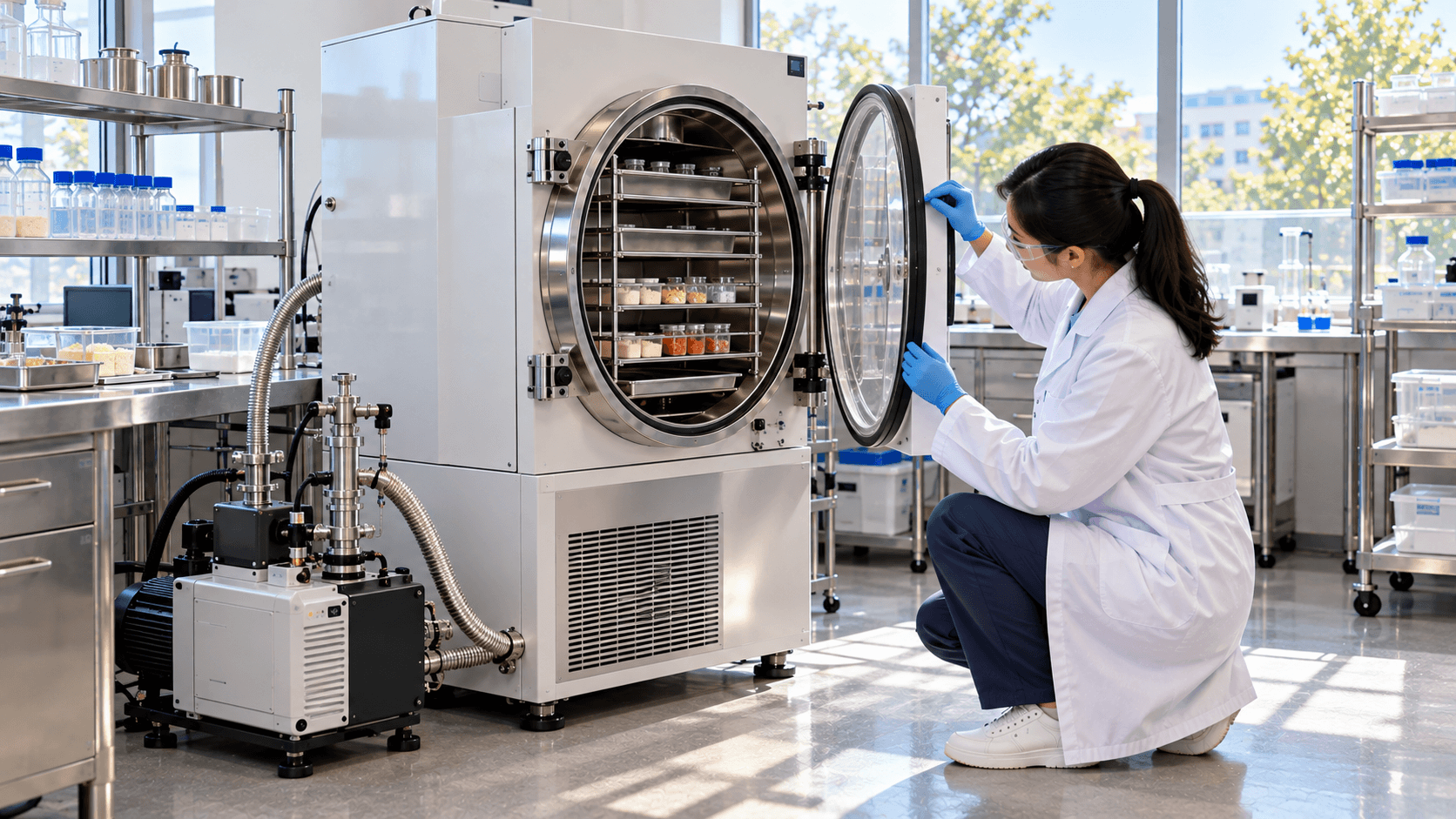
Introduction
Your samples are frozen. The freeze dryer is running. The vacuum pump is humming away like everything is going according to plan.
But the pressure gauge tells a different story.
Your laboratory freeze dryer isn't reaching its required vacuum level, and the drying cycle is going nowhere fast.
Vacuum problems are among the most frustrating challenges in lyophilization. They can delay processing, increase operating costs, compromise drying performance, and create uncertainty about whether a batch meets its requirements.
Here's the catch: a laboratory freeze dryer that won't reach vacuum doesn't necessarily have a faulty vacuum pump.
Damaged door seals, loose connections, excessive vapor loads, inadequate condenser cooling, contaminated pump oil, and incorrect operating conditions can all contribute to the problem.
At GreenLabGear, laboratories can explore professional freeze-drying and vacuum equipment for different processing applications.
Before replacing expensive components, it's worth understanding how the complete freeze-drying system works—and where vacuum problems typically begin.
TLDR – Quick Guide
If your laboratory freeze dryer isn't reaching vacuum, check these common causes:
- Chamber leaks: Damaged gaskets, loose fittings, or improperly sealed doors can allow air into the system.
- Vacuum pump problems: Contaminated oil, worn components, or incorrect pump operation can reduce performance.
- Insufficient condenser cooling: A warm or underperforming condenser may allow excessive water vapor to reach the pump.
- Excessive sample load: Too much material can overwhelm the system's vapor-handling capacity.
- Incomplete freezing: Improperly prepared samples can create unexpected vapor loads and process problems.
- Restricted vacuum lines: Blocked tubing, filters, or traps can reduce effective pumping performance.
- Faulty pressure sensors: Inaccurate readings may make normal operation appear defective.
- Incorrect settings: The programmed pressure or operating sequence may not match the equipment's capabilities.
- Maintenance issues: Worn seals, neglected oil changes, and contaminated components can contribute to vacuum loss.
- Equipment mismatch: The pump, condenser, and chamber must work together to support the intended process.
Start with manufacturer-approved inspections before attempting internal repairs.
Detailed Breakdown
How Does a Laboratory Freeze Dryer Create Vacuum?
A laboratory freeze dryer removes moisture from frozen material through a process called lyophilization.
During primary drying, ice within the product sublimates, changing directly from solid ice into water vapor under suitable temperature and pressure conditions.
A refrigerated condenser captures much of that water vapor as ice.
Meanwhile, the vacuum system removes noncondensable gases and helps establish the reduced-pressure environment required by the process.
The main components include:
- Drying chamber
- Refrigerated condenser
- Vacuum pump
- Pressure measurement system
- Temperature controls
- Seals and gaskets
- Vacuum tubing and valves
- Control system
Each component affects overall performance.
A powerful vacuum pump cannot compensate indefinitely for a major chamber leak or an inadequate condenser.
That's why troubleshooting should focus on the complete system.
1. Check for Vacuum Leaks
Leaks are among the most common reasons a laboratory freeze dryer fails to reach its target pressure.
A vacuum leak allows outside air to enter the system.
If the incoming gas load exceeds the vacuum system's effective pumping capacity, pressure may remain above the required level.
Potential leak locations include:
- Chamber door seals
- Lid gaskets
- Vacuum hose connections
- Flanges
- Valves
- Drain connections
- Sampling ports
- Glass components
- Pump inlet fittings
Start with a visual inspection.
Look for damaged seals, loose connections, visible cracks, or contamination around sealing surfaces.
Follow the manufacturer's approved leak-testing procedure if further investigation is necessary.
Do not improvise leak tests using flammable gases, open flames, or unsuitable chemicals.
2. Inspect the Chamber Door Gasket
The chamber gasket deserves special attention.
A freeze dryer may have an operational vacuum pump and condenser but still fail to build vacuum if the door seal isn't properly seated.
Possible problems include:
- Cracked gasket material
- Debris on sealing surfaces
- Misaligned doors
- Damaged sealing edges
- Improperly installed gaskets
- Material deterioration
Even small particles trapped between the gasket and sealing surface can interfere with proper closure.
Clean and inspect the seal according to the equipment manufacturer's instructions.
Replace damaged gaskets with compatible manufacturer-approved parts.
Never attempt to compensate for a damaged seal by overtightening components beyond their specified limits.
3. Your Vacuum Pump May Need Maintenance
A vacuum pump is essential to laboratory freeze dryer operation.
However, different pump technologies have different maintenance requirements.
Oil-sealed rotary vane pumps, for example, depend on suitable oil condition for lubrication and sealing.
If the oil becomes contaminated with moisture or other substances, vacuum performance can deteriorate.
Potential warning signs include:
- Discolored or cloudy oil
- Reduced pumping performance
- Unusual noise
- Excessive vibration
- Abnormal operating temperature
- Repeated maintenance alerts
Follow the manufacturer's oil inspection and replacement schedule.
For oil-free pump technologies, maintenance requirements may involve different components.
Explore GreenLabGear's Laboratory Vacuum Pumps category to compare vacuum equipment options.
Important: A pump suitable for general laboratory vacuum work isn't automatically suitable for every freeze dryer.
Required ultimate pressure, pumping speed, vapor exposure, and manufacturer compatibility all matter.
4. Check Whether the Condenser Is Cold Enough
The condenser plays a critical role in freeze-drying performance.
As ice sublimates from the product, the resulting water vapor moves through the system.
The condenser captures much of that vapor by freezing it onto a cold surface.
If the condenser isn't operating at its required temperature, vapor capture may be inadequate.
This can increase the vapor load reaching the vacuum pump and prevent the system from maintaining the intended pressure.
Possible causes include:
- Refrigeration-system faults
- Incorrect operating settings
- Excessive heat load
- Poor condenser performance
- Equipment alarms
- Insufficient preparation time
Confirm that the condenser reaches the manufacturer's required operating condition before beginning the applicable drying stage.
If the refrigeration system cannot meet specifications, arrange qualified service.
Do not attempt refrigerant repairs without appropriate training and authorization.
5. Excessive Sample Loading Can Overwhelm the System
More material per batch doesn't always mean more efficient freeze drying.
A laboratory freeze dryer has finite condenser capacity and vapor-handling capability.
If the sample load is too large, the system may struggle to capture the generated water vapor.
This can contribute to elevated chamber pressure and longer drying cycles.
Important variables include:
- Total sample mass
- Water content
- Sample thickness
- Container geometry
- Available shelf area
- Condenser ice capacity
- Drying conditions
- Required cycle time
Nominal batch capacity should not be confused with usable capacity for every material.
A kilogram of one product may contain a very different amount of removable water than a kilogram of another.
Follow manufacturer loading limits and validated process requirements.
6. Make Sure Samples Are Properly Frozen
Freeze drying depends on appropriate sample freezing.
If samples are inadequately frozen before primary drying, process behavior may differ from expectations.
Poor preparation can contribute to unexpected vapor loads, product collapse, or inconsistent drying.
However, the correct freezing conditions depend on the material's formulation and thermal properties.
Some products require carefully controlled freezing protocols.
Others may tolerate different preparation methods.
Don't assume that a sample is ready simply because its surface appears solid.
Use an established process appropriate for the product and freeze dryer.
7. Inspect Vacuum Tubing and Connections
Vacuum tubing can influence how effectively the pump removes gas from the freeze dryer.
Long, narrow, damaged, or obstructed lines can increase flow resistance.
That reduces effective pumping speed at the chamber.
Inspect accessible tubing for:
- Kinks
- Cracks
- Loose fittings
- Collapsed sections
- Chemical deterioration
- Blockages
- Incorrect connection sizes
Use tubing approved for the intended vacuum conditions and process environment.
GreenLabGear's guide to Vacuum Pump Accessories explains how tubing, fittings, traps, filters, and other components influence vacuum-system performance.
A pump's advertised specifications are only part of the equation.
The complete vacuum path matters.
8. Check the Pressure Sensor
Sometimes the laboratory freeze dryer is operating correctly, but the pressure reading is inaccurate.
Freeze dryers may use different pressure measurement technologies, and those instruments can respond differently to gas composition and operating conditions.
Potential problems include:
- Sensor contamination
- Calibration drift
- Damaged wiring
- Incorrect sensor installation
- Faulty electronics
- Inappropriate measurement interpretation
For example, some thermal-conductivity-based gauges respond differently to water vapor and other gases.
A reading from one gauge technology may therefore differ from another during active drying.
That doesn't automatically mean either instrument is broken.
Confirm the measurement method and compare readings according to the manufacturer's diagnostic procedures.
9. Understand Ultimate Vacuum vs Operating Pressure
This distinction can prevent unnecessary troubleshooting.
A vacuum pump's ultimate pressure describes performance under specified test conditions.
A laboratory freeze dryer's operating pressure is affected by the complete system and the vapor released during drying.
These are not the same measurement.
During active primary drying, water vapor continuously enters the chamber atmosphere as ice sublimates.
The condenser captures much of that vapor while the vacuum system removes noncondensable gases.
Consequently, chamber pressure during drying may be higher than the pump's ultimate pressure.
The goal is not always to achieve the lowest possible pressure.
The goal is to maintain the pressure appropriate for the product and validated freeze-drying process.
10. The Vacuum Pump May Be Undersized
A vacuum pump must be suitable for the freeze dryer's chamber, operating pressure, gas load, and system configuration.
An undersized or incompatible pump may struggle to achieve the required performance.
When evaluating pump suitability, consider:
Specification
Why It Matters
Ultimate pressure
Indicates achievable vacuum under specified conditions
Pumping speed
Influences gas-removal capability
Operating pressure range
Determines suitability for the intended process
Vapor compatibility
Affects reliability when exposed to process vapors
Pump technology
Influences maintenance and operating characteristics
Connection size
Can affect conductance and system performance
Manufacturer compatibility
Helps confirm suitability for the freeze dryer
The lowest advertised ultimate pressure doesn't automatically identify the best pump.
Proper matching matters more than impressive specifications on paper.
Comparing Laboratory Freeze Dryer Models
Different freeze dryers offer different nominal processing capacities and configurations.
GreenLabGear's Freeze Dryers & Lyophilizers collection includes equipment for a range of laboratory applications.
Examples include:
Equipment
Nominal Capacity Class
Selection Considerations
1kg
Smaller batch requirements, condenser capacity, vacuum compatibility
4kg
Larger batch requirements, condenser performance, chamber configuration
Laboratory Freeze Dryer With Vacuum Pump
Model-specific
Pump configuration, pressure requirements, condenser specifications
These are product categories and nominal capacity references, not guaranteed throughput figures for every material.
Before purchasing, verify condenser temperature, ice capacity, shelf configuration, vacuum requirements, pump specifications, and intended application.
A larger freeze dryer isn't automatically better at achieving vacuum.
System design and maintenance remain essential.
Laboratory Freeze Dryer Troubleshooting Chart
Use this table to narrow down common vacuum problems.
Symptom
Possible Cause
What to Investigate
Vacuum never develops
Major leak or pump problem
Door gasket, connections, pump operation
Vacuum builds slowly
Small leak or restricted flow
Tubing, fittings, valves, filters
Vacuum is acceptable without samples but poor during drying
Excessive vapor load
Sample loading, condenser performance
Vacuum deteriorates gradually
Pump maintenance or developing leak
Oil condition, seals, service history
Pressure reading appears unstable
Sensor or process variation
Gauge type, calibration, operating stage
Condenser doesn't reach required temperature
Refrigeration problem
Alarms, settings, qualified service
Pump becomes unusually noisy
Mechanical or operating issue
Manufacturer diagnostics
Vacuum loss follows maintenance
Incorrect assembly or sealing
Recently serviced connections and gaskets
The timing of the problem can be an important clue.
If the system previously reached its required pressure but begins struggling after a gasket replacement, inspect the affected connection.
If vacuum performance deteriorates only when a large sample load is introduced, investigate vapor-handling capacity and process conditions.
How to Troubleshoot a Laboratory Freeze Dryer Safely
A structured approach helps identify the problem without unnecessary component replacement.
Step 1: Review alarms and operating records.
Check whether the problem began suddenly or developed gradually.
Step 2: Confirm the operating sequence.
Verify that the condenser, vacuum system, and process settings are functioning according to manufacturer instructions.
Step 3: Inspect accessible seals and connections.
Look for visible damage, debris, loose fittings, or improper assembly.
Step 4: Review pump maintenance.
Check applicable oil condition, service history, and manufacturer maintenance requirements.
Step 5: Evaluate sample loading.
Determine whether the problem appears only under active drying conditions.
Step 6: Verify pressure measurement.
Confirm that the gauge is appropriate, correctly interpreted, and functioning within specifications.
Step 7: Arrange qualified service.
If the problem remains unresolved, have the system evaluated by an appropriately trained technician.
Never bypass protective controls, open energized electrical components, or disassemble potentially hazardous equipment without following approved procedures.
Freeze Dryer vs Vacuum Oven: Why the Difference Matters
A laboratory freeze dryer and a vacuum oven both operate under reduced pressure, but they serve different processing purposes.
Freeze drying removes moisture primarily through sublimation from frozen material.
Vacuum ovens generally use controlled heating under reduced pressure to support drying or other thermal processes.
Laboratory Freeze Dryer
Vacuum Oven
Uses frozen material during primary drying
Commonly uses heated material
Relies on sublimation
Typically relies on evaporation and heat transfer
Includes a refrigerated condenser
Condenser configuration varies by system
Requires coordinated vacuum and temperature control
Uses vacuum and controlled heating
Often selected for temperature-sensitive products
Often selected for compatible thermal drying applications
GreenLabGear's Freeze Dryer vs Vacuum Oven guide explores the differences in more detail.
Choosing the wrong drying technology can create process problems that maintenance alone won't solve.
Freeze Dryers in Cannabis Processing
Freeze dryers may be used in certain cannabis-processing workflows where controlled moisture removal is required.
However, not every freeze dryer is suitable for every cannabis-related material.
Product characteristics, residual solvents, moisture content, processing requirements, and facility safety conditions all matter.
If a material contains volatile or flammable solvents, the equipment must be specifically suitable for that application.
A standard laboratory freeze dryer should not automatically be assumed safe for solvent-rich materials.
For equipment-selection considerations, see GreenLabGear's Best Freeze Dryer for Cannabis Extraction guide.
Always verify the equipment's intended use and chemical compatibility before processing a material.
How to Prevent Future Vacuum Problems
Preventive maintenance is usually more manageable than emergency troubleshooting.
A practical laboratory freeze dryer maintenance program should include:
- Inspecting door seals and gaskets
- Checking vacuum tubing and fittings
- Following pump maintenance schedules
- Monitoring condenser performance
- Reviewing pressure trends
- Maintaining appropriate sample loading
- Cleaning the chamber according to manufacturer instructions
- Checking drain and valve condition
- Reviewing alarms and service records
- Scheduling qualified inspections when required
Document normal operating performance.
If the system gradually takes longer to reach its expected pressure, that trend may reveal a developing problem before the next batch fails.
When Should You Repair or Replace a Freeze Dryer?
Not every vacuum problem requires replacing the complete freeze dryer.
Damaged seals, incorrect connections, contaminated pump oil, and some component faults may be repairable.
However, replacement may be justified when:
- Vacuum performance remains unreliable after appropriate service.
- Condenser capacity no longer meets processing requirements.
- Major refrigeration or control components repeatedly fail.
- Repair costs become excessive.
- Replacement parts are unavailable.
- Equipment is incompatible with the intended material.
- Production requirements exceed practical capacity.
Compare the complete cost of ownership, not just the purchase price.
The right freeze dryer should provide reliable vacuum performance, suitable condenser capacity, appropriate controls, and dependable service support.
Key Takeaways
- A laboratory freeze dryer relies on coordinated vacuum, refrigeration, and temperature-control systems.
- Failure to reach vacuum can result from leaks, pump problems, condenser issues, excessive vapor loads, or measurement errors.
- Chamber door gaskets and vacuum connections are common areas to inspect.
- Contaminated oil can reduce performance in oil-sealed vacuum pumps.
- Inadequate condenser cooling can increase vapor load on the vacuum system.
- Excessive sample loading may prevent the system from maintaining its required operating pressure.
- Pump ultimate pressure is not the same as freeze dryer operating pressure.
- Restricted tubing and unsuitable accessories can reduce effective pumping performance.
- Pressure sensor type and calibration can influence displayed readings.
- Preventive maintenance helps identify developing problems before they disrupt production.
- Choose equipment according to condenser capacity, vacuum requirements, sample characteristics, and intended applications.
FAQs
Why is my laboratory freeze dryer not reaching vacuum?
A laboratory freeze dryer may fail to reach vacuum because of chamber leaks, damaged gaskets, vacuum pump problems, or excessive vapor loads. Inadequate condenser cooling and restricted vacuum tubing can also contribute to poor performance. Inspect the complete system using manufacturer-approved troubleshooting procedures.
Can a bad vacuum pump prevent a freeze dryer from working?
Yes, a faulty or poorly maintained vacuum pump can prevent the system from achieving its required operating pressure. Oil contamination, internal wear, incorrect pump sizing, or other mechanical problems may reduce pumping performance. However, leaks and condenser problems should also be investigated before replacing the pump.
Why does my freeze dryer reach vacuum when empty but not with samples?
Samples release water vapor during primary drying, increasing the vapor load within the system. If the condenser cannot capture that vapor adequately or the sample load exceeds equipment capacity, chamber pressure may remain elevated. Review sample loading, condenser performance, and the validated drying process.
How do I know if my freeze dryer has a vacuum leak?
A vacuum leak may cause slow pressure reduction, an inability to reach the required pressure, or unexpected pressure increases. Damaged door gaskets, loose fittings, and faulty valves are possible leak locations. Use manufacturer-approved leak-testing procedures to confirm the problem.
When should I replace a laboratory freeze dryer?
Replacement may be appropriate when vacuum performance remains unreliable, major components repeatedly fail, or the equipment no longer meets process requirements. First investigate repairable problems such as seals, pump maintenance, condenser performance, and pressure measurement. Evaluate replacement options according to reliability, condenser capacity, vacuum compatibility, serviceability, and future production needs.