Laboratory Ball Mill Grinding Media: Which Type Is Best?
Compare laboratory ball mill grinding media, including steel, zirconia, alumina, and tungsten carbide, to choose the right material and size.
Introduction
Your ball mill is running, your samples are loaded, and the grinding cycle is complete. But the results aren't quite what you expected.
Maybe the particles are too coarse. Maybe the powder contains unexpected contamination. Or perhaps your grinding media are wearing faster than your patience.
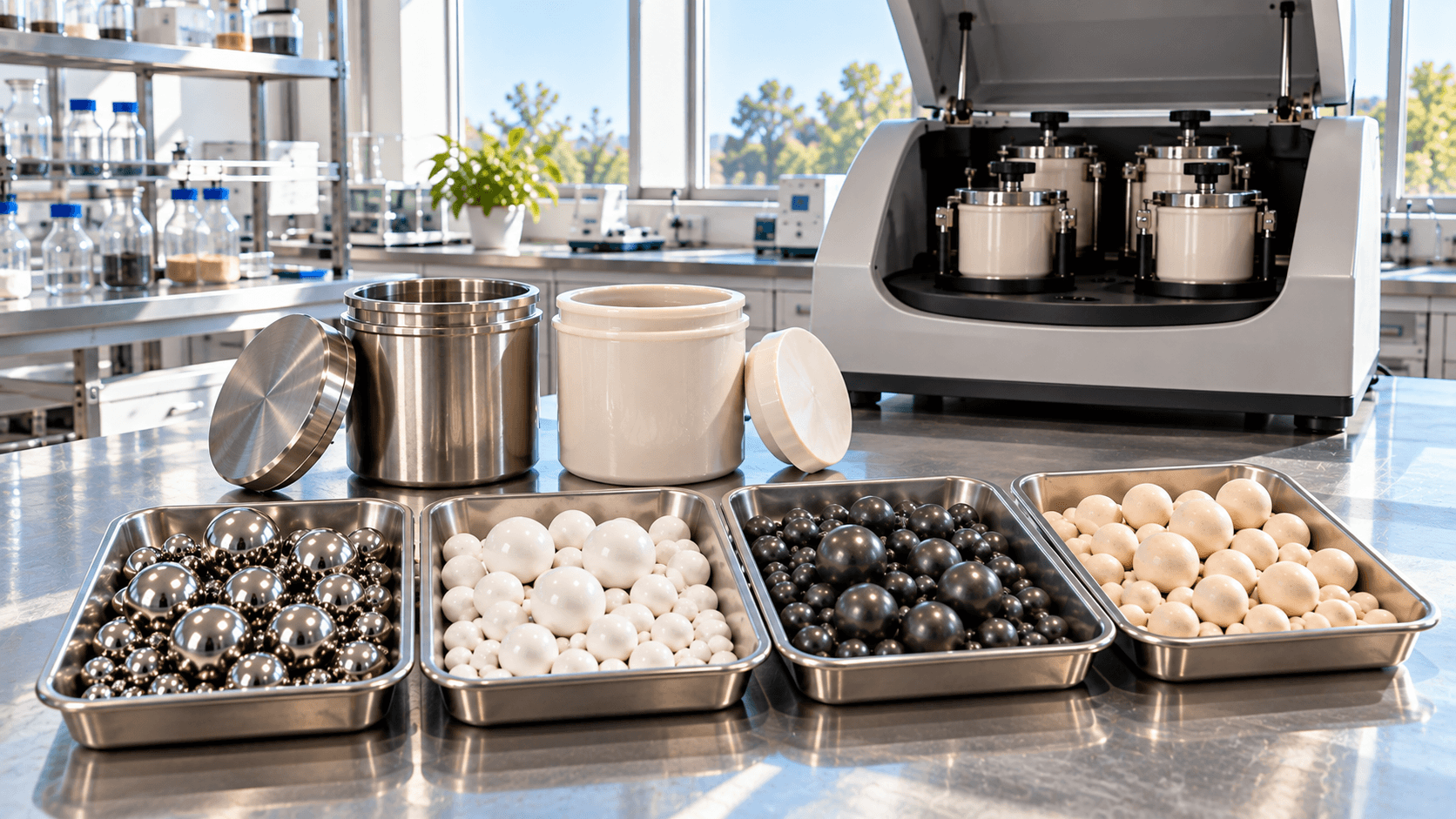
Here's something worth knowing: laboratory ball mill grinding media can have a major influence on particle-size reduction, sample purity, grinding efficiency, and equipment wear.
The grinding balls aren't simply accessories rattling around inside a container. They're responsible for transferring mechanical energy into the material being processed.
Choose the wrong media, and even a capable ball mill can struggle.
At GreenLabGear, laboratories can explore professional milling equipment for different processing applications. Understanding grinding media is an important part of choosing the right setup.
This guide compares common grinding media materials, explains how size and density affect performance, and helps you decide which option best matches your laboratory's needs.
TLDR – Quick Guide
- Stainless steel: Durable and relatively dense, but may introduce metallic contamination.
- Zirconia: Hard, wear-resistant ceramic media often considered for applications requiring low metallic contamination.
- Alumina: A ceramic option with good hardness and wear resistance, although wear-related contamination remains possible.
- Tungsten carbide: Extremely hard and dense, making it useful for certain demanding grinding applications.
- Glass: Suitable for some gentle mixing and grinding applications, but generally less durable than harder alternatives.
- Larger grinding balls: Deliver greater individual impact energy and can help break down coarse material.
- Smaller grinding balls: Provide more contact points and may support finer grinding under appropriate conditions.
- Media compatibility: Always consider the sample, grinding vessel, solvents, and equipment design.
- Contamination risk: Select media according to the impurities your analysis or product can tolerate.
- Best overall choice: There is no universally superior grinding medium; the right material depends on your application.
Detailed Breakdown
What Is Laboratory Ball Mill Grinding Media?
Laboratory ball mill grinding media are the balls or other approved grinding elements placed inside a milling vessel to reduce particle size.
As the mill operates, the media move according to the equipment's mechanical design.
Their movement creates impacts, compression, friction, and shear that can break down material.
The exact grinding mechanism depends on whether you're using a planetary ball mill, rolling mill, or another configuration.
Media performance is influenced by several characteristics:
- Material composition
- Density
- Hardness
- Diameter
- Shape
- Surface condition
- Wear resistance
- Chemical compatibility
The goal is to select media that deliver effective grinding while limiting unwanted contamination and equipment damage.
GreenLabGear's Laboratory Ball Mills collection includes equipment for different laboratory milling requirements.
Before choosing grinding balls, verify which media types and sizes are approved for your specific mill and vessel.
Stainless Steel Grinding Media
Stainless steel is a common choice for laboratory ball mill grinding media because it offers a useful combination of density, durability, and mechanical strength.
Steel grinding balls can deliver substantial impact energy, particularly when processing materials that require stronger mechanical action.
Advantages:
- Good mechanical durability
- Relatively high density
- Suitable for many general-purpose milling applications
- Available in different sizes and grades
- Often more economical than specialty ceramic or carbide media
Limitations:
- Can introduce metallic contamination through wear
- Chemical compatibility depends on the steel grade
- May be unsuitable for contamination-sensitive samples
- Can experience corrosion under incompatible conditions
Not all stainless steel grades behave identically.
If your application involves aggressive chemicals or strict elemental impurity limits, confirm the exact alloy composition and compatibility.
Best suited for: General-purpose grinding where metallic contamination is acceptable and the equipment is compatible.
Zirconia Grinding Media
Zirconia is a high-performance ceramic material widely considered for demanding milling applications.
It offers high hardness, good wear resistance, and relatively high density compared with many other ceramics.
These characteristics can make zirconia useful when laboratories need effective grinding while avoiding contamination associated with steel media.
Advantages:
- High hardness
- Good wear resistance
- Relatively high density for a ceramic
- No steel-derived metallic wear
- Useful for many fine-grinding applications
Limitations:
- More expensive than some conventional media
- Can still introduce zirconium-containing wear particles
- May fracture or chip under unsuitable conditions
- Compatibility depends on the sample and operating environment
Zirconia is not contamination-free.
Every grinding medium can potentially contribute wear particles under sufficiently demanding conditions.
Best suited for: Fine grinding and applications where steel-derived contamination is undesirable, provided zirconia-related contamination is acceptable.
Alumina Grinding Media
Alumina is another commonly used ceramic grinding material.
It offers high hardness and good wear resistance for suitable laboratory applications.
Alumina media are available in different grades and purity levels, which can influence performance and contamination characteristics.
Advantages:
- Hard ceramic surface
- Good wear resistance
- Suitable for many mineral and ceramic-processing applications
- Avoids steel-derived metallic contamination
- Available in different purity grades
Limitations:
- Lower density than zirconia or tungsten carbide
- Can chip or fracture under unsuitable conditions
- May introduce aluminum-containing wear particles
- Performance varies by grade and manufacturing quality
Alumina can be a practical choice when its material characteristics align with the sample and target particle size.
Best suited for: Compatible ceramic, mineral, and general laboratory grinding applications where alumina wear is acceptable.
Tungsten Carbide Grinding Media
Tungsten carbide is extremely hard and dense.
That combination can make it effective for grinding certain hard or abrasive materials.
Because of its density, tungsten carbide media can deliver substantial mechanical energy under appropriate milling conditions.
Advantages:
- Very high hardness
- High density
- Strong wear resistance in suitable applications
- Effective for certain demanding materials
Limitations:
- Higher cost
- Potential tungsten or binder-related contamination
- Possible brittleness under certain impact conditions
- May be unsuitable for some vessels or milling configurations
Many tungsten carbide components contain a binder phase, commonly involving cobalt or another material.
That composition matters when contamination limits are strict.
Best suited for: Certain hard, abrasive materials requiring high-density media, when the equipment and sample are compatible.
Glass Grinding Media
Glass grinding media can be useful in some relatively gentle processing applications.
However, glass is generally less mechanically robust than steel, zirconia, or tungsten carbide.
Its suitability depends heavily on the equipment and material being processed.
Advantages:
- Useful for some low-intensity applications
- May be appropriate where specific material compatibility is required
- Available in different bead sizes
Limitations:
- Lower density than many alternative media
- Greater breakage risk under demanding impacts
- Potential glass-derived contamination
- Often unsuitable for aggressive high-energy milling
Glass beads should never be substituted into a high-energy ball mill unless the equipment manufacturer explicitly approves their use.
Best suited for: Selected lower-energy applications where glass media are compatible and mechanically appropriate.
Laboratory Ball Mill Grinding Media Comparison
Here's how common grinding media materials compare.
Grinding Media
Relative Density
Key Advantage
Main Consideration
Stainless steel
High
Durability and strong impacts
Metallic contamination
Zirconia
High for a ceramic
Wear resistance and fine grinding
Cost and zirconia wear
Alumina
Moderate
Hardness and ceramic compatibility
Lower density and alumina wear
Tungsten carbide
Very high
Hardness and impact potential
Cost and binder contamination
Glass
Relatively low
Suitable for selected gentle applications
Breakage and wear
These are general material comparisons, not guaranteed performance rankings.
Actual results depend on the media grade, ball diameter, mill design, operating conditions, and material being processed.
Does Grinding Media Size Matter?
Absolutely.
Media diameter is one of the most important variables in laboratory ball mill grinding media selection.
Larger balls generally deliver greater energy per individual impact.
This can help when breaking down relatively coarse particles.
Smaller balls provide more contact points and may improve fine-grinding efficiency once the material is sufficiently reduced in size.
However, there's a tradeoff.
Very small media may be ineffective at breaking large, hard feed particles.
Very large media may provide fewer contact points and become inefficient for some fine-grinding applications.
The correct size depends on:
- Starting particle size
- Target particle size
- Material hardness
- Media density
- Mill type
- Vessel dimensions
- Grinding conditions
Some applications benefit from a combination of approved media sizes.
But mixed-size loading should be based on manufacturer guidance and process testing rather than guesswork.
How Media Density Affects Grinding
Density influences the mass of a grinding ball at a given diameter.
For two balls of the same size, the denser material generally has greater mass.
That can affect the energy transferred during impacts.
For example, tungsten carbide is substantially denser than alumina.
Under otherwise comparable conditions, the heavier media may produce stronger individual impacts.
But greater density isn't automatically better.
High-density media may increase wear, mechanical loading, or contamination risks in an unsuitable milling system.
The objective is to match media density to the material and equipment—not simply select the heaviest balls available.
How Grinding Media Affect Particle Size
Grinding media influence how effectively a ball mill reduces material into smaller particles.
But final particle size depends on the complete process.
Important variables include:
For example, switching to smaller media may improve fine grinding under suitable conditions.
However, if the material tends to agglomerate, simply reducing media diameter may not solve the problem.
Likewise, extending grinding time may eventually produce diminishing returns.
For a closer look at the variables involved, read GreenLabGear's Ball Mill Particle Size guide.
Grinding Media Contamination: What Should You Watch For?
Contamination is a major consideration when choosing laboratory ball mill grinding media.
During milling, repeated contact can cause small amounts of media or vessel material to wear away.
Those particles may enter the processed sample.
The contamination risk depends on:
- Media composition
- Vessel material
- Material abrasiveness
- Milling intensity
- Grinding duration
- Media condition
- Cleaning procedures
For analytical laboratories, even small amounts of certain contaminants may interfere with testing.
For processing applications, contamination may affect product quality or downstream requirements.
Choose media based on which impurities your application can tolerate.
Also consider the grinding vessel.
Using low-contamination media won't necessarily solve the problem if the vessel itself introduces unwanted material.
Wet vs Dry Milling: Does Media Selection Change?
Yes, it can.
Dry milling and wet milling expose grinding media to different operating conditions.
In dry milling, media interact with the sample without an intentionally added liquid phase.
In wet milling, an appropriate liquid is present during grinding.
Wet milling can influence particle dispersion, heat transfer, agglomeration, and grinding behavior.
However, it also introduces chemical compatibility requirements.
The selected liquid must be compatible with:
- Grinding media
- Vessel material
- Seals
- Equipment design
- Processed material
Do not assume that a grinding medium suitable for dry milling is automatically suitable for every wet-milling application.
Solvents and other liquids may create additional safety considerations, especially in equipment not designed for flammable or chemically aggressive materials.
Match Grinding Media to Your Ball Mill
Even excellent grinding media can perform poorly in an unsuitable mill.
Different milling systems create different media movement and impact conditions.
A planetary ball mill, for example, operates differently from a conventional rolling ball mill.
Media selection must account for the exact equipment design.
GreenLabGear offers laboratory milling options including the 2L BMQ-2L Ball Mill and 5L BQM-5L Ball Mill.
These represent different nominal capacity classes.
Before choosing either system, verify:
- Approved grinding media materials
- Recommended ball diameters
- Vessel compatibility
- Media and sample loading limits
- Operating speed range
- Wet or dry milling suitability
- Maintenance requirements
A larger-capacity ball mill doesn't automatically produce finer particles.
For additional equipment-selection guidance, see How to Choose a Laboratory Ball Mill.
How to Choose the Right Grinding Media
The best selection process starts with the material you're grinding.
Ask these questions before purchasing:
1. What material are you processing?
Hard, brittle, abrasive, sticky, and ductile materials behave differently during milling.
2. What particle size do you need?
Coarse reduction and fine grinding may benefit from different media sizes and configurations.
3. How important is sample purity?
If metallic contamination is unacceptable, suitable ceramic media may be worth evaluating.
4. What mill and vessel are you using?
Media must be approved for the equipment and mechanically compatible with the vessel.
5. Are you milling wet or dry?
Fluid compatibility and process safety can affect media selection.
6. What are your operating costs?
Consider purchase price, wear rate, replacement frequency, cleaning, and downtime.
The lowest-cost media aren't always the least expensive over the equipment's lifetime.
When Should Grinding Media Be Replaced?
Grinding media don't last forever.
Repeated impacts and abrasion can change their dimensions, surface condition, and performance.
Possible replacement indicators include:
- Visible chips or cracks
- Excessive wear
- Unexpected changes in grinding performance
- Surface deterioration
- Contamination concerns
- Manufacturer-defined service limits
Inspect media according to equipment and facility procedures.
Damaged grinding balls should be removed from service when they no longer meet the application's requirements.
For replacement items and compatible equipment components, explore GreenLabGear's Laboratory Accessories & Parts category.
Always confirm material, diameter, grade, and model compatibility before ordering.
Ball Mill vs Homogenizer: Does Your Process Need Grinding Media?
Not every particle-processing application requires a ball mill.
If the goal is reducing solid particle size through mechanical grinding, a ball mill may be appropriate.
But if you're trying to create a uniform liquid dispersion or emulsion, a homogenizer may be a better fit.
Homogenizers use different mechanical principles and generally don't rely on loose grinding balls.
GreenLabGear's Ball Mill vs Homogenizer guide explains the differences.
Before investing in premium grinding media, confirm that ball milling is the right processing method for your desired result.
Common Grinding Media Selection Mistakes
Laboratories can waste time and money by overlooking a few basic factors.
Common mistakes include:
- Choosing media based only on price
- Assuming the hardest media are always best
- Ignoring contamination requirements
- Using media not approved for the mill
- Selecting balls that are too large or too small
- Overlooking vessel compatibility
- Using unsuitable media for wet milling
- Ignoring wear and replacement requirements
- Assuming larger mill capacity guarantees finer particles
- Changing multiple milling variables without testing
The best laboratory ball mill grinding media deliver consistent performance within the requirements of the process.
That's a more useful goal than simply buying the densest or most expensive option.
Key Takeaways
- Laboratory ball mill grinding media influence grinding efficiency, particle size, contamination, and equipment wear.
- Stainless steel offers durability and relatively high density but can introduce metallic contamination.
- Zirconia provides high hardness and good wear resistance for compatible fine-grinding applications.
- Alumina is a practical ceramic option for many laboratory materials.
- Tungsten carbide offers very high density and hardness for selected demanding applications.
- Glass media are generally better suited to compatible lower-intensity applications.
- Larger balls provide stronger individual impacts, while smaller balls may support finer grinding.
- Media density, hardness, and size must be considered together.
- The grinding vessel can also contribute contamination.
- Wet milling introduces additional chemical compatibility requirements.
- Media must be approved for the exact mill and vessel configuration.
- The best choice depends on the material, target particle size, purity requirements, and operating conditions.
FAQs
What is the best laboratory ball mill grinding media?
The best laboratory ball mill grinding media depend on the material being processed, target particle size, contamination limits, and equipment design. Stainless steel, zirconia, alumina, and tungsten carbide each offer different performance characteristics. Choose media according to manufacturer compatibility requirements and representative process testing.
Is zirconia better than stainless steel grinding media?
Zirconia may be preferable when steel-derived metallic contamination is undesirable and the application is compatible with ceramic media. Stainless steel can offer strong mechanical durability and may be more economical for general-purpose grinding. Neither material is universally superior because performance depends on the sample and milling conditions.
Does smaller grinding media produce finer particles?
Smaller grinding media can support finer grinding by providing more contact points under suitable conditions. However, very small media may struggle to break down large or hard starting particles. Final particle size also depends on milling time, speed, loading, material properties, and mill design.
Can grinding media contaminate laboratory samples?
Yes, grinding media can release wear particles into a sample during milling. The type and amount of contamination depend on media composition, material abrasiveness, operating conditions, and equipment condition. Choose compatible media and vessels based on the impurities your application can tolerate.
How often should laboratory ball mill grinding media be replaced?
Replacement frequency depends on media material, operating intensity, sample abrasiveness, and manufacturer recommendations. Inspect grinding balls for wear, cracking, chipping, or other changes that could affect performance or sample purity. Replace media when they no longer meet the equipment's or process's requirements.