Laboratory Gas Generator Maintenance: What to Check
Learn essential laboratory gas generator maintenance tasks, common warning signs, filter checks, and ways to prevent equipment downtime.
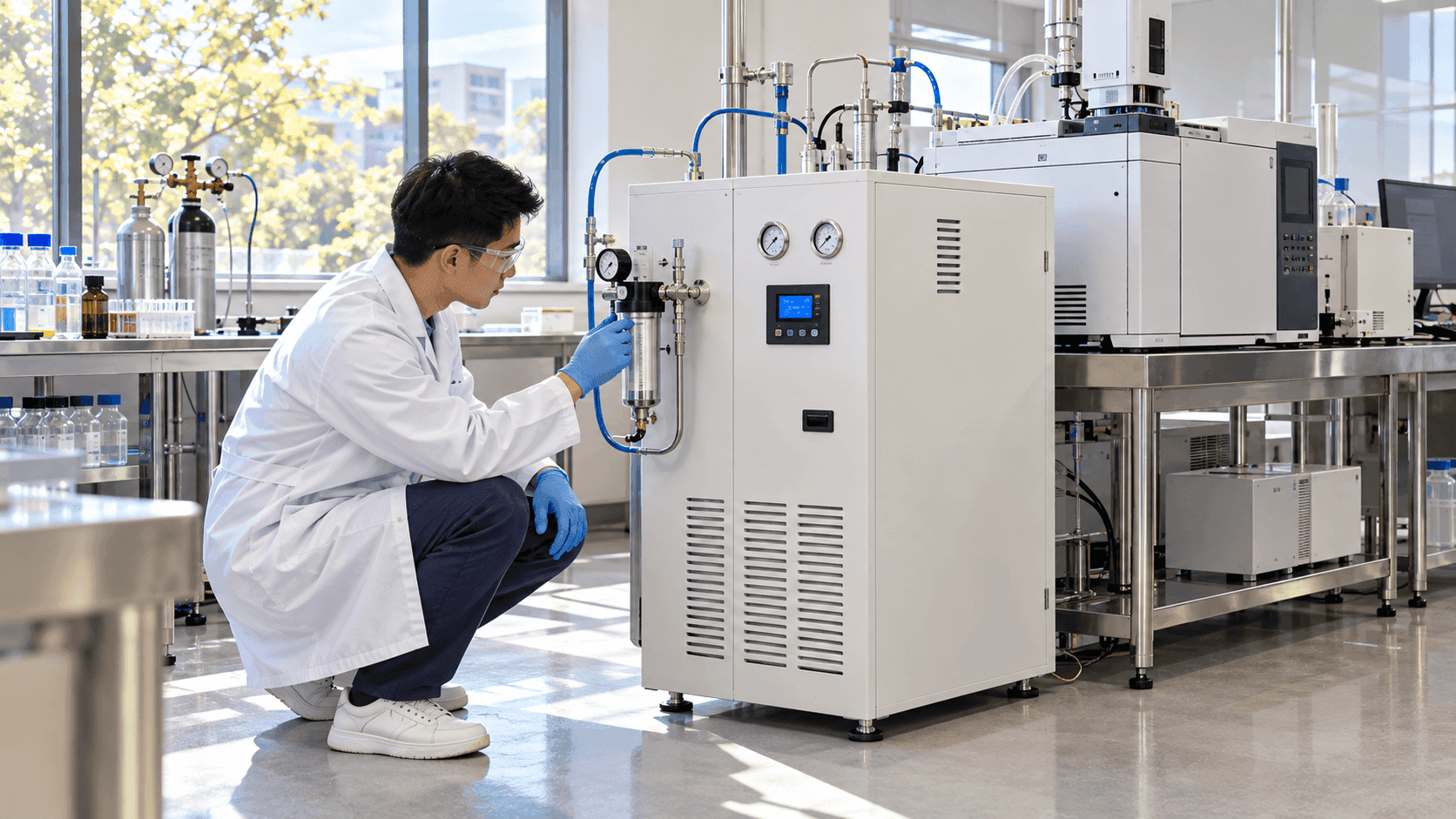
Introduction
Your laboratory gas generator is running quietly in the background. Instruments are receiving gas, workflows are moving, and nobody is thinking about maintenance.
Until the pressure drops, an alarm sounds, or the generator stops delivering the gas your equipment needs.
Suddenly, that quiet machine becomes everyone's problem.
Laboratory gas generator maintenance is essential for maintaining reliable gas supply, protecting connected instruments, reducing unexpected downtime, and supporting safe laboratory operations.
Whether your facility uses hydrogen, nitrogen, or another generator-supported gas, maintenance requirements depend on the generator's design, gas type, output capacity, operating conditions, and manufacturer recommendations.
Some systems require regular filter replacement. Others need attention to water quality, drying components, ventilation, pressure regulation, or internal service parts.
At GreenLabGear, laboratories can explore professional gas-generation equipment for different applications. Understanding how to maintain these systems helps protect both the generator and the equipment that depends on it.
This guide covers what to inspect, common maintenance mistakes, and how to recognize when professional service is necessary.
TLDR – Quick Guide
- Follow the manufacturer’s maintenance schedule: Different gas-generator technologies have different service requirements.
- Inspect filters: Clogged or saturated filters can affect gas flow, purity, and equipment performance.
- Check gas pressure and flow: Unexpected changes may indicate restrictions, leaks, or component problems.
- Monitor gas purity: Confirm output meets the requirements of connected laboratory instruments.
- Inspect tubing and connections: Leaks and damaged fittings can reduce performance and create safety risks.
- Maintain ventilation: Generators need appropriate installation conditions and airflow.
- Check water quality where applicable: Some hydrogen generators depend on specified water purity and supply conditions.
- Review alarms and operating logs: Repeated warnings may reveal developing faults.
- Keep critical replacement parts available: Correct spares can reduce repair delays.
- Use qualified technicians: Internal electrical, gas-system, and pressure-related repairs require appropriate expertise.
Detailed Breakdown
1. Start With the Manufacturer's Maintenance Schedule
The first rule of laboratory gas generator maintenance is simple: don't treat every generator the same way.
Hydrogen generators, nitrogen generators, and other laboratory gas systems can use different technologies.
For example, nitrogen generation may involve membrane separation or pressure swing adsorption, depending on the design. Hydrogen generators may use water electrolysis and associated purification or drying components.
These technologies have different maintenance requirements.
Before creating a service checklist, identify:
- Generator manufacturer and model
- Gas type
- Rated output flow
- Operating pressure
- Required gas purity
- Installed filtration components
- Operating hours
- Manufacturer service intervals
GreenLabGear's Laboratory Gas Generators collection includes equipment intended for different laboratory gas-supply applications.
Always use the exact model's documentation when establishing maintenance procedures.
A generic checklist is useful for planning, but it should never replace the manufacturer's instructions.
2. Inspect Filters and Purification Components
Filters are among the most important components to evaluate during laboratory gas generator maintenance.
Depending on the generator design, filtration may help remove particles, moisture, oil aerosols, or other unwanted substances.
As filters accumulate contaminants or reach their service limits, performance can deteriorate.
Potential warning signs include:
- Reduced gas flow
- Increased pressure drop
- Gas-purity alarms
- Unusual operating behavior
- More frequent maintenance alerts
Not every filter provides the same function.
Particulate filters, coalescing filters, adsorption media, and other purification components have different replacement requirements.
Use manufacturer-approved components and replacement intervals.
Don't assume a filter is still effective simply because it looks clean.
Some purification materials can become exhausted without obvious visual changes.
3. Monitor Gas Pressure and Flow
A laboratory gas generator needs to deliver gas within the requirements of the connected equipment.
If pressure or flow becomes unstable, instrument performance may suffer.
Possible causes include:
- Clogged filters
- Restrictions in tubing
- Leaking connections
- Excessive downstream demand
- Regulator problems
- Generator component faults
- Incorrect operating settings
Record normal operating pressure and flow during stable conditions.
This provides a baseline for identifying changes.
If pressure begins declining over time, compare current readings with previous records and the manufacturer's specified operating range.
Avoid adjusting regulators or bypassing protective controls without authorization and appropriate procedures.
4. Check Gas Purity
Pressure and flow aren't the whole story.
A generator may deliver gas at the expected pressure while failing to meet the required purity specification.
That can be especially important for analytical instruments and other applications sensitive to contaminants.
Depending on the gas and application, relevant quality factors may include:
- Moisture
- Oxygen content
- Hydrocarbon contamination
- Particulates
- Other process-specific impurities
Gas purity requirements should come from the connected instrument's specifications and the generator manufacturer's guidance.
Where appropriate, use validated monitoring or testing methods.
A generator that produces sufficient gas volume but inadequate purity isn't performing its intended job.
5. Inspect Tubing, Fittings, and Connections
Gas leaks can reduce efficiency and create operational or safety problems.
Routine visual inspections should include accessible:
- Tubing
- Hoses
- Fittings
- Regulators
- Valves
- Connection points
- Supports and restraints
Look for visible damage, deterioration, loose connections, or other signs of abnormal condition.
Leak testing should use methods approved for the specific gas and equipment.
Never use an open flame to check for leaks.
For hydrogen systems, particular attention is required because hydrogen is highly flammable and can create serious hazards when released into an unsuitable environment.
If a leak is suspected, follow the facility's emergency and isolation procedures.
6. Maintain Proper Ventilation
Gas generators need installation environments appropriate to their design.
Poor ventilation can contribute to overheating and, depending on the gas and system, create additional hazards.
Check:
- Manufacturer-required clearances
- Ventilation openings
- Ambient temperature
- Nearby heat sources
- Exhaust requirements
- Room ventilation
- Applicable gas detection or safety controls
Hydrogen generators require particular attention to gas-related hazards and manufacturer installation requirements.
Nitrogen systems also require appropriate assessment because nitrogen can displace oxygen in enclosed spaces.
Ventilation and monitoring requirements should be established through the facility's risk assessment and applicable safety standards.
A generator that fits physically under a bench isn't automatically suitable for installation there.
7. Check Water Quality in Hydrogen Generators
Some hydrogen generators use water electrolysis to produce hydrogen.
For these systems, water quality can be critical.
Depending on the design, the manufacturer may specify deionized or otherwise purified water meeting particular conductivity or purity requirements.
Using unsuitable water can contribute to:
- Contamination
- Reduced performance
- Component deterioration
- Increased maintenance
- Premature service requirements
Check the manufacturer's instructions for:
- Required water purity
- Reservoir inspection
- Water replacement
- Approved filling procedures
- Water-treatment components
- Maintenance intervals
Do not substitute ordinary tap water unless the equipment manufacturer explicitly permits it.
Also avoid opening or servicing internal hydrogen-generation components without the appropriate training.
8. Review Dryers and Moisture-Control Components
Moisture can interfere with some gas-generator applications and downstream instruments.
Depending on the system, moisture-control components may include dryers, desiccants, membranes, condensate-management systems, or other purification stages.
These components can require periodic inspection or replacement.
Warning signs may include:
- Moisture alarms
- Declining gas quality
- Unexpected condensate
- Increased pressure drop
- Changes in instrument performance
Follow the manufacturer's service requirements.
Do not assume that all dryers or moisture-control components can be cleaned, regenerated, or replaced using the same procedure.
9. Monitor Operating Hours and Alarm History
Maintenance based only on calendar dates can miss important differences in equipment usage.
A generator operating continuously may accumulate substantially more service hours than one used occasionally.
Where supported, track:
- Total operating hours
- Filter service dates
- Maintenance alerts
- Pressure trends
- Flow trends
- Purity measurements
- Unplanned shutdowns
- Repair history
Alarm history is especially useful.
Repeated warnings may indicate a developing problem even when the generator continues operating.
A warning that disappears after restarting the machine isn't necessarily a problem that has been solved.
10. Inspect Cooling and Electrical Components
Gas generators may contain compressors, fans, power supplies, control boards, sensors, and other electrical or mechanical components.
Depending on the model, overheating or component deterioration can affect reliability.
Potential warning signs include:
- Unusual fan noise
- Excessive heat
- Unexpected shutdowns
- Electrical alarms
- Abnormal vibration
- Intermittent operation
External ventilation openings should remain unobstructed.
Internal electrical repairs, compressor service, and other specialized work should be performed by qualified personnel following manufacturer procedures.
Never bypass interlocks or protective shutdown functions.
11. Match Maintenance to the Generator Type
Different generator technologies require different priorities.
Generator Type
Common Maintenance Considerations
Hydrogen generator
Water quality, gas purity, leak integrity, drying components, ventilation, safety systems
Nitrogen membrane generator
Feed-air quality, filtration, pressure, membrane performance, purity
Nitrogen PSA generator
Feed-air quality, filters, valves, adsorption system, purity, operating cycles
Other specialty gas generators
Technology-specific purification, controls, pressure, and safety requirements
This comparison is general rather than model-specific.
The exact maintenance plan must follow the installed equipment's documentation.
Comparing Laboratory Gas Generator Models
When purchasing or maintaining a generator, model-specific requirements matter more than product naming alone.
GreenLabGear lists several gas-generator models, including:
These products should be evaluated according to their verified gas type, output specifications, pressure requirements, purity performance, and manufacturer maintenance instructions.
Do not assume that similarly named models share identical service parts or operating requirements.
For a broader explanation of generator selection, read GreenLabGear's guide to Gas Generators for Laboratories.
How Often Should Laboratory Gas Generators Be Maintained?
There isn't one universal maintenance interval that applies to every laboratory gas generator.
Service frequency depends on:
- Generator technology
- Operating hours
- Gas output demand
- Feed-air or water quality
- Ambient conditions
- Manufacturer requirements
- Application sensitivity
- Previous maintenance history
However, laboratories can organize maintenance into practical inspection categories.
Frequency
Suggested Checks
Before use or daily
Review alarms, output readings, visible condition, and applicable supply levels
Weekly
Review trends, inspect accessible connections, and confirm ventilation
Monthly
Review maintenance records, operating hours, and service indicators
Manufacturer-specified intervals
Replace filters, service purification components, calibrate instruments, and perform qualified maintenance
After an alarm or abnormal event
Investigate the fault and confirm suitability before returning to normal operation
These are planning categories, not manufacturer-approved service intervals.
Always prioritize the actual maintenance schedule for your generator.
Common Laboratory Gas Generator Maintenance Mistakes
Even well-equipped laboratories can create problems through inconsistent maintenance practices.
Common mistakes include:
- Ignoring filter replacement schedules
- Using incorrect replacement filters
- Overlooking gas-purity requirements
- Assuming pressure alone indicates proper operation
- Failing to monitor water quality
- Ignoring small leaks
- Blocking ventilation openings
- Dismissing repeated alarms
- Using incompatible tubing or fittings
- Skipping maintenance documentation
- Waiting for equipment failure before ordering spare parts
The most expensive maintenance mistake is often assuming that a running generator is a healthy generator.
What Replacement Parts Should You Keep Available?
Spare-parts planning can reduce downtime when routine service is due or an unexpected component failure occurs.
Depending on the model, useful spare categories may include:
- Manufacturer-approved filters
- Compatible tubing
- Specified seals and gaskets
- Approved water-treatment consumables
- Serviceable purification components
- Other manufacturer-recommended maintenance items
Not every component should be replaced by laboratory staff.
Pressure regulators, electrical parts, internal gas-generation components, and safety devices may require qualified service.
GreenLabGear's guide to Laboratory Equipment Replacement Parts explains how to prioritize spares based on failure likelihood, downtime impact, compatibility, and replacement lead time.
Gas Generator Safety in Cannabis and Extraction Laboratories
Laboratories involved in cannabis processing may operate gas generators alongside extraction, distillation, analytical, or other processing equipment.
These environments can introduce additional safety considerations.
Hydrogen presents flammability hazards, while nitrogen can create oxygen-deficiency risks in poorly ventilated spaces.
Facilities should assess gas-generator installation in relation to:
- Ventilation
- Gas detection where required
- Electrical equipment suitability
- Fire protection
- Pressure-system safety
- Emergency shutdown procedures
- Operator training
- Applicable codes and standards
If flammable extraction solvents are used elsewhere in the facility, generator placement must be evaluated within the overall hazardous-area assessment.
GreenLabGear's Extraction Lab Safety Equipment guide discusses broader laboratory safety considerations.
A laboratory gas generator should never be installed or modified without accounting for its gas-specific hazards and intended environment.
How to Build a Preventive Maintenance Program
A useful maintenance program should be simple enough to follow consistently and detailed enough to support troubleshooting.
Start with five steps.
Step 1: Document the equipment. Record the model, serial number, gas type, specifications, installation date, and manufacturer maintenance requirements.
Step 2: Establish normal operating conditions. Record pressure, flow, purity, alarms, and other relevant baseline information.
Step 3: Schedule inspections. Assign routine checks and manufacturer-required service tasks to qualified personnel.
Step 4: Track replacement parts. Maintain an inventory of approved consumables and critical service items.
Step 5: Review performance trends. Use operating logs and maintenance history to identify recurring problems.
A documented maintenance program helps laboratories respond to developing issues before they become unexpected shutdowns.
When Should You Repair or Replace a Gas Generator?
Not every performance issue requires a replacement generator.
Clogged filters, exhausted consumables, unsuitable supply conditions, or routine service requirements may be correctable.
However, replacement may be appropriate when:
- Output no longer meets instrument requirements.
- Gas purity cannot be maintained reliably.
- Repairs become frequent or costly.
- Critical components are unavailable.
- Safety systems cannot be restored to proper operation.
- Equipment capacity no longer meets laboratory demand.
- Downtime repeatedly disrupts production or testing.
Before replacing equipment, compare repair costs with long-term reliability, service availability, operating expenses, and future capacity requirements.
The goal is dependable gas supply—not simply keeping an aging machine running for another week.
Key Takeaways
- Laboratory gas generator maintenance supports reliable gas supply, instrument performance, and laboratory safety.
- Maintenance requirements vary significantly between hydrogen, nitrogen, and other generator technologies.
- Filters and purification components should be inspected and serviced according to manufacturer instructions.
- Gas pressure, flow, and purity are all important performance indicators.
- Tubing, fittings, and connections require appropriate inspection for leaks and deterioration.
- Hydrogen generators may require specific water-quality and drying-system maintenance.
- Ventilation and ambient conditions influence equipment reliability and safety.
- Alarm history and operating-hour records can help identify developing problems.
- Manufacturer-approved replacement parts reduce compatibility risks.
- Qualified technicians should handle specialized gas-system, electrical, and pressure-related repairs.
- Preventive maintenance is generally more manageable than emergency repairs after equipment failure.
FAQs
How often should laboratory gas generators be maintained?
Laboratory gas generator maintenance intervals depend on the generator technology, operating hours, manufacturer requirements, and operating conditions. Routine inspections may be performed more frequently than filter replacement or specialized service tasks. Always follow the exact model's maintenance schedule rather than relying on a universal interval.
What are the most important parts to inspect on a laboratory gas generator?
Important inspection areas can include filters, gas connections, pressure and flow indicators, purification components, ventilation, and safety alarms. Hydrogen generators may also require water-quality checks, while nitrogen generators can have technology-specific feed-air and separation-system requirements. The manufacturer's documentation determines which components need inspection and service.
Can dirty filters reduce gas generator performance?
Yes, clogged or exhausted filters can affect gas flow, pressure, purity, or overall generator performance depending on their function. Some filter problems are not visible from the outside, so appearance alone is not a reliable indicator of condition. Replace filters according to manufacturer specifications and service indicators.
Is laboratory gas generator maintenance different for hydrogen and nitrogen systems?
Yes, hydrogen and nitrogen generators can use different production technologies and have different maintenance requirements. Hydrogen systems may require attention to water purity and flammable-gas safety, while nitrogen systems may emphasize feed-air treatment and separation components. Both require appropriate pressure, purity, ventilation, and safety monitoring.
When should a laboratory gas generator be replaced?
Replacement may be appropriate when the generator repeatedly fails, cannot maintain required gas quality, or becomes uneconomical to repair. Before replacing it, investigate routine maintenance needs, supply conditions, consumables, and serviceable faults. Consider long-term reliability, replacement-part availability, safety, operating costs, and future gas demand.